How Photographs Helped Create Yellowstone, the World's First National Park
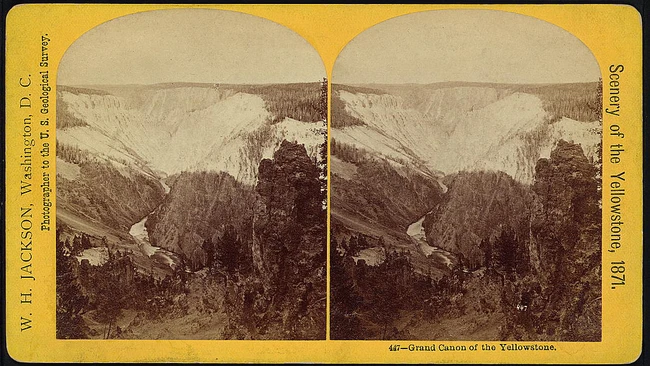
The 1872 law that created Yellowstone runs only a few hundred words and never mentions a photograph. This is a startling omission for a document born of an era where the lens was rapidly reshaping the human relationship with the natural world. The legislation was a pragmatic response to land disputes, a political maneuver to settle jurisdiction between Montana, Idaho, and Wyoming, yet the resulting monument became the world's first national park not because of legal precedent, but because of a visual revolution.
Before the cameras arrived, the American West was largely defined by fur trappers, mountain men, and the hardened imaginations of eastern politicians who viewed the region as a chaotic frontier to be tamed. The landscape was a resource, a collection of timber, water, and minerals. The stereoscopic cards that began flooding back East from the Yellowstone field parties of 1871 changed this calculus entirely. When these images showed the Grand Canyon of the Yellowstone with its vibrant, impossible colors and the river carving a path through ancient rock, they did not just document scenery; they proved a new reality.
The photograph forced a shift in how the public consumed the wilderness. Unlike a painting, which filtered the world through an artist's subjective brushstrokes, or a sketch, which captured only fleeting moments, the photograph presented an objective, undeniable truth. The public could look at these images and see something that did not exist in their own experience. The geothermal features, the massive arches, and the sheer scale of the canyons were rendered with a clarity that stripped away the romantic haze of the mythic West and replaced it with a tangible, awe-inspiring presence that demanded protection.
This visual evidence became the primary tool for conservationists arguing against the relentless encroachment of private timber and mining interests. The logic was irrefutable: if the public could see the value of the land through the lens of the camera, they would support the government's role in preserving it. The photographs served as a catalyst, turning abstract concepts of national heritage into something concrete and emotionally resonant. They provided the visual proof needed to convince a skeptical Congress that this land was not merely a resource to be exploited, but a treasure too valuable to lose.
Ultimately, the creation of Yellowstone was a victory of image over statute. The law itself remains dry and brief, but the photographs that inspired it built the moral and emotional framework necessary for the park's existence. They taught the nation to look differently at the world, to find wonder in the geology and the wild, and to recognize that some places are meant to remain untouched. In doing so, the camera did more than capture a scene; it captured the imagination of a country and secured its future for generations to come.
On Bluesky? Meet HomeSky.
Follower analytics, a growth toolkit, scheduling and AI posting — built for Bluesky. Connect your account and use everything free for 60 days.
Try HomeSky free →