Migrating the GitHub Copilot runtime to Rust, using Copilot
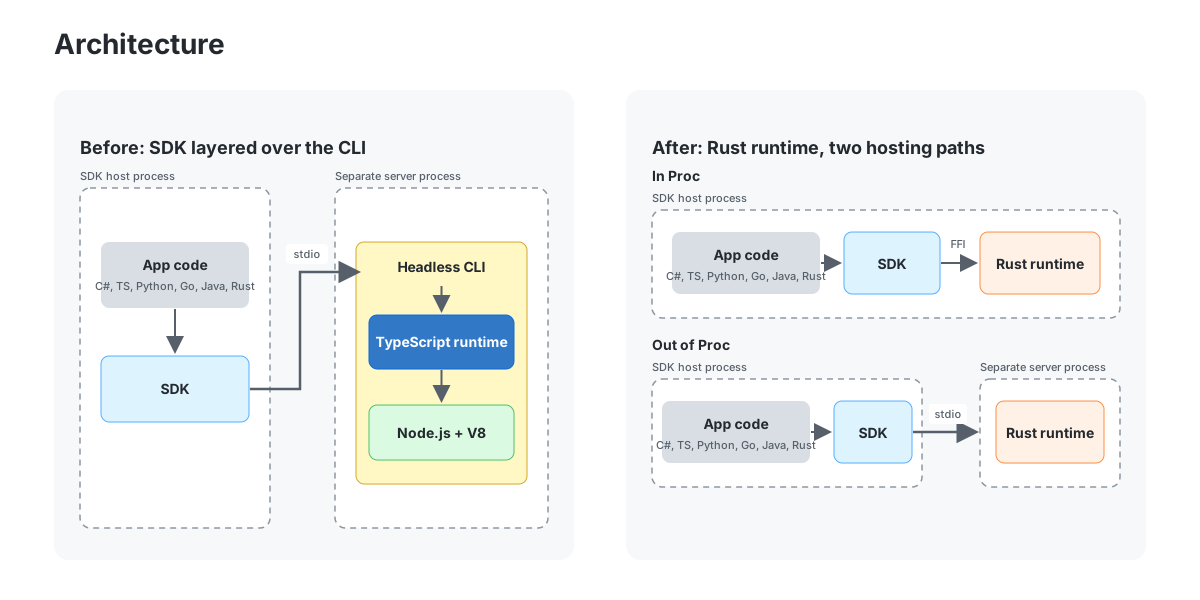
Before the rise of autonomous agents, a rewrite of this magnitude was simply not economically viable. The decision to migrate the GitHub Copilot runtime, a sprawling system of roughly 800,000 lines of production code, to Rust was not made lightly. It represented a fundamental shift in how we approach the reliability of software that assists other software. We were no longer just asking developers to be more careful; we were asking the compiler to be our co-pilot in the pursuit of correctness.
The challenge was not merely syntactic translation but architectural resurrection. Porting a system of this size requires more than a line-by-line conversion; it demands a deep understanding of the underlying intent, often buried under layers of legacy logic and emergent behaviors. The initial phase was a exercise in patience, where every function signature was scrutinized to ensure that the strict type system of Rust would not break the delicate ecosystem of the agent. We had to build a scaffold that could hold the weight of the old implementation while we slowly, methodically, constructed the new one from the ground up.
What makes this undertaking particularly fascinating is the meta-nature of the project: using Copilot itself to facilitate the migration. It was a recursive loop of self-improvement, where the AI generated code that was then audited by the very team that built the AI. This process revealed the true ceiling of current generative models. While the models excel at creating boilerplate and translating idioms, the heavy lifting of maintaining architectural integrity and ensuring safety invariants still falls squarely on human shoulders. The machine provides the draft, but the architect must approve the blueprints.
The transition to Rust introduced a new layer of discipline that permeated the entire codebase. Memory safety was no longer an afterthought; it became a first-class citizen enforced by the compiler. This shift forced a re-evaluation of how data flows through the system, eliminating entire categories of runtime errors that had previously plagued the release cycle. The result is a system that is not only faster but fundamentally more trustworthy, capable of running in environments where failure is not an option.
Looking back, the journey from a monolithic, interpreted runtime to a statically typed, compiled powerhouse highlights a broader truth about software evolution. We are moving toward an era where the tooling itself becomes the primary substrate of development, yet the human element remains the critical differentiator. The 800,000 lines of Rust code standing today are not just a victory of refactoring; they are a testament to the partnership between human intuition and machine efficiency. We did not just port a project; we evolved an entire platform.
On Bluesky? Meet HomeSky.
Follower analytics, a growth toolkit, scheduling and AI posting — built for Bluesky. Connect your account and use everything free for 60 days.
Try HomeSky free →