Project HydraFusion: Frontier quality via multi-model orchestration
For years, the industry has chased a singular, impossible ideal: a model that generates perfect code on the first try, every time. We have poured resources into scaling parameters until the outputs are indistinguishable from human craftsmanship, yet the cost of that perfection has been astronomical, burning through computational budgets at an unsustainable rate. This obsession with a monolithic solution has led to a paradox where the most sophisticated models are often the least practical for the messy, iterative reality of software development.
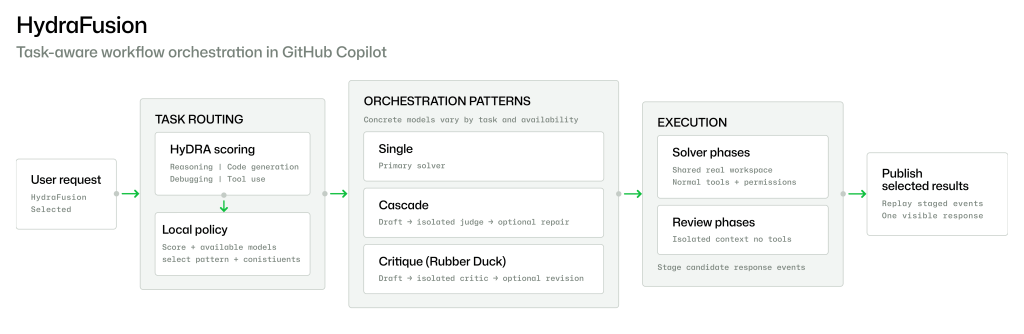
Project HydraFusion emerges not as a larger, faster model, but as a fundamental rethinking of the architecture of intelligence itself. By moving away from the brute-force approach of relying on a single frontier model to handle every task, we have discovered that true efficiency lies in orchestration. Instead of forcing one engine to pull every load, we built a system that knows when to deploy a heavyweight model for complex architectural shifts and when to let a lighter, faster model handle the repetitive, mundane logic. It is the difference between a Formula One car and a fleet of optimized delivery trucks; you need both for a complete logistics network.
The results of our controlled offline evaluations are strikingly clear. When pitted against the Opus 5 baseline, HydraFusion's selective coding workflows matched or even exceeded the quality of that frontier model while simultaneously reducing the estimated workflow cost. This is not a marginal gain; it is a structural shift in how we define value in AI-assisted development. We are no longer paying for maximum theoretical capability in every single line of code generated, but rather for the right capability at the exact moment it is needed. This selective approach allows developers to maintain high standards without the prohibitive overhead that typically accompanies state-of-the-art models.
This technology is now available as a research preview in GitHub Copilot, marking a pivotal moment for enterprises grappling with the balance between innovation and operational expenditure. The implications extend far beyond simple cost savings; they represent a maturation of the field where AI tools finally adapt to the economic constraints of real-world engineering teams. By integrating multi-model orchestration directly into the developer environment, we are removing the friction that usually separates experimental AI features from daily production workflows.
As we look toward the future of software creation, the trajectory is clear: the era of the "one-size-fits-all" AI model is ending. The most powerful systems will not be those with the largest parameter counts, but those with the sharpest intuition for context and resource allocation. HydraFusion proves that by orchestrating a symphony of models rather than relying on a soloist, we can achieve frontier quality without the prohibitive price tag. The next generation of coding assistants will not just write code; they will manage the intelligence required to write it efficiently.