Project HydraFusion: Frontier quality via multi-model orchestration
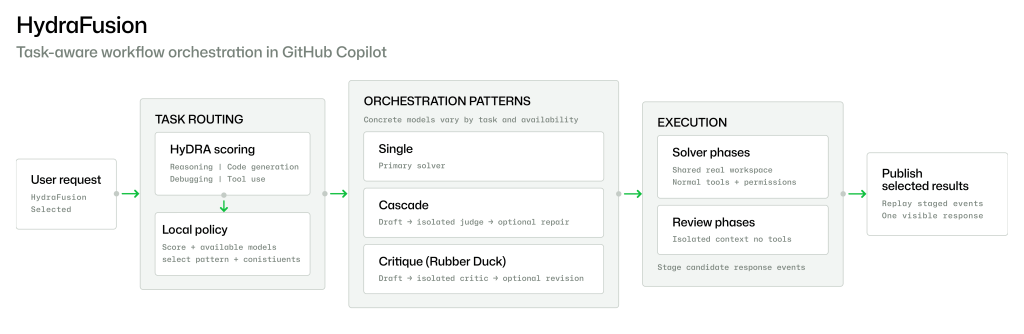
In the high-stakes arena of software development, the search for perfection is often a journey of diminishing returns. We have spent years chasing the elusive "frontier" of code generation, training models until they are indistinguishable from human experts, only to find that the cost of deploying these monolithic giants makes them impractical for most teams. The prevailing assumption was that to get better code, you needed a bigger, smarter, more expensive model. But what if the answer wasn't to build a larger beast, but to orchestrate a smarter choir? This is the core insight behind Project HydraFusion, a new approach that challenges the status quo of single-model dominance.
The problem with relying on a single flagship model, like the Opus 5 baseline, is not necessarily that it produces bad code, but that it is inefficient. It applies a sledgehammer to every nail, expending massive computational resources on tasks that could be solved with a precise, lightweight tool. In controlled offline evaluations, the research team at GitHub discovered that by shifting from a monolithic strategy to a multi-model orchestration framework, they could match or even exceed the quality of the best standalone models while significantly reducing the estimated workflow cost. It is a revelation that quality does not require scale; it requires selection.
HydraFusion operates on the principle of selective coding workflows. Rather than asking one massive model to solve an entire complex function, the system breaks down the task and routes specific sub-tasks to the most appropriate model in its arsenal. For routine, boilerplate generation, a smaller, faster model handles the load with speed and accuracy. For complex architectural decisions or novel logic, the system seamlessly delegates to a frontier model capable of deep reasoning. This dynamic routing ensures that every line of code generated is handled by the tool best suited for the job, eliminating the waste of over-allocating resources to simple problems.
The implications for the engineering community are profound. For years, teams have faced a trilemma where they could only pick two of the following: speed, cost, and quality. HydraFusion proves that all three can be optimized simultaneously. By lowering the barrier to entry for frontier-level intelligence, this approach allows smaller teams and startups to access capabilities previously reserved for enterprise giants without breaking the bank. It democratizes access to the highest tiers of AI assistance, ensuring that the quality of code in a startup repository can rival that of a Fortune 500 company, provided they have the right orchestration.
This research preview marks a pivotal moment in the evolution of developer tools, signaling a shift from brute-force computation to intelligent strategy. As we move forward, the focus will undoubtedly shift from training ever-larger models to building ever-smarter schedulers and routers that can navigate the landscape of available models with surgical precision. The era of the single, all-purpose coding model may be ending, replaced by a flexible, adaptive ecosystem where the right tool is always at hand, exactly when it is needed.