Social Media Engagement: summer 2026
The landscape of digital discourse shifted dramatically between early 2025 and the summer of 2026, a period that feels less like a natural evolution and more like a tectonic shift in how information is consumed and valued. For years, the prevailing wisdom suggested that fragmentation was the enemy of reach, but recent data reveals a far more complex reality where attention has consolidated rather than scattered. It is not that users have stopped engaging, but rather that they have become ruthlessly selective, demanding a level of relevance and depth that generic broadcasting can no longer provide.
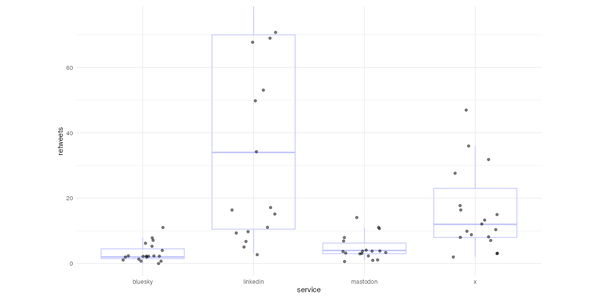
When examining the specific metrics from this recent window, the disparity across platforms is nothing short of staggering. There exists one primary service that has emerged as the undisputed capital of professional interaction, capturing the vast majority of meaningful exchanges and driving the core of my daily output. This platform has evolved from a simple utility into a sophisticated ecosystem where high-fidelity discussion thrives, attracting audiences who are not merely scrolling but actively participating in the construction of knowledge. The engagement here is deep, sustained, and indicative of a community that has found a new language for collaboration.
Contrast this vibrancy with the precipitous decline witnessed on the other major contender, a service that once dominated the early part of the year. What began as a steady stream of interaction has curdled into silence, a sharp drop-off that defies simple explanations of algorithmic changes. This is not merely a seasonal dip; it is a fundamental retraction of the user base, suggesting that the value proposition of that platform has evaporated for the professional demographic. The content that once felt timely now feels obsolete, discarded in favor of channels that offer more direct lines to expertise and less noise in the feed.
The implications of this migration are profound for how technical thought is disseminated. In the past, the strategy was often to broadcast broadly and hope for the best, but the summer of 2026 has forced a recalibration toward precision. Writers and thinkers must now focus intensely on the platforms where their audience actually resides, recognizing that diluting effort across multiple fronts is no longer a viable strategy. The cost of missing the primary channel is not just lost views, but a loss of the critical feedback loop necessary to refine ideas and solve complex problems.
This consolidation is a reminder that the internet, despite its vast appearance, operates on finite human attention spans. As tools become more capable of filtering the irrelevant, the signal-to-noise ratio becomes the single most important metric of success. Those who can adapt to this new hierarchy, focusing their energy on the few channels that matter and accepting the quiet fade of the rest, will find themselves better positioned to contribute to the discourse. The future of technical writing lies not in shouting the loudest, but in speaking clearly to the few who are truly listening.
Ultimately, the data from this summer tells a story of maturation. The chaotic early days of social media, where every platform offered a new frontier, have given way to a settled order where value dictates visibility. This is a sobering but necessary evolution, one that rewards depth over breadth and sustained engagement over fleeting moments. For anyone still trying to navigate these waters, the lesson is clear: find your ground, understand the currents, and stop fighting a tide that has already receded.