Social Media Engagement: summer 2026
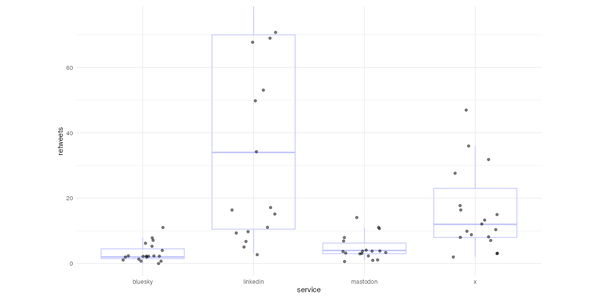
The landscape of digital discourse has shifted dramatically since the spring of 2025, leaving a stark contrast between the platforms that once dominated the engineer's attention span and those that have quietly faded into the background. A recent review of my own social footprint reveals a story that is both predictable in its trajectory and surprising in its magnitude. While some channels have seen a modest uptick in interaction, one specific service has surged ahead, becoming the undisputed gravitational center for technical conversation. It is no longer merely a place to share links; it has evolved into the primary venue where ideas are debated, refined, and ultimately adopted by the wider community.
This phenomenon is not just about algorithmic favoritism; it is a reflection of a changing demographic of the developer community. The rise of the leading platform coincides with a maturation of its user base, where the ratio of seasoned practitioners to novices has tipped in a way that favors deep, nuanced technical exchange. In the past, discussions were often fragmented across multiple sites, requiring constant cross-pollination to find the right audience. Now, the concentration of engagement on a single service suggests that the network effect has finally achieved a critical mass where the quality of discourse self-reinforces. The most interesting comments, the most rigorous critiques, and the most actionable insights are now flowing through a single digital vein.
Conversely, the decline observed on other major platforms is precipitous and alarming, resembling a rapid exodus rather than a natural tapering off. What began as a slow drip of reduced activity in early 2025 has accelerated into a full-scale withdrawal by the summer of 2026. The reasons are multifaceted, ranging from user interface fatigue to a perceived shift in the cultural tone of the platforms themselves. Developers, who historically prized efficiency and signal over noise, are increasingly unwilling to spend their limited time on channels where the signal-to-noise ratio has degraded. The absence of meaningful conversation on these fading channels is not a lack of users, but a lack of value.
The implications of this migration extend far beyond simple click counts or follower numbers. It represents a fundamental realignment of where professional knowledge is created and consumed. When a significant portion of the industry moves its attention to a new home, the norms of that home evolve to suit the collective needs of the group. We are seeing a standardization of expectations for engagement, where brevity gives way to substance, and performative posting yields to genuine inquiry. This shift forces platforms to adapt or risk becoming digital ghost towns, empty shells where the machinery of connection remains, but the lifeblood of human interaction has dried up.
Ultimately, this analysis of summer 2026 serves as a mirror to the broader state of the internet for technical professionals. It highlights a community that is discerning, selective, and increasingly vocal about where it chooses to invest its cognitive energy. The platforms that survive are not necessarily the ones with the most advanced algorithms or the most aggressive marketing campaigns, but those that successfully cultivate an environment where experts feel heard and respected. As we look toward the future, the lesson is clear: the currency of the digital age is not just attention, but the quality of the attention given. The services that provide the highest yield for that currency will define the next era of software discourse, while the rest will simply fade into the static of the past.
On Bluesky? Meet HomeSky.
Follower analytics, a growth toolkit, scheduling and AI posting — built for Bluesky. Connect your account and use everything free for 60 days.
Try HomeSky free →