Strange Galaxies in the Early Universe Were Shaped by Weird Stars
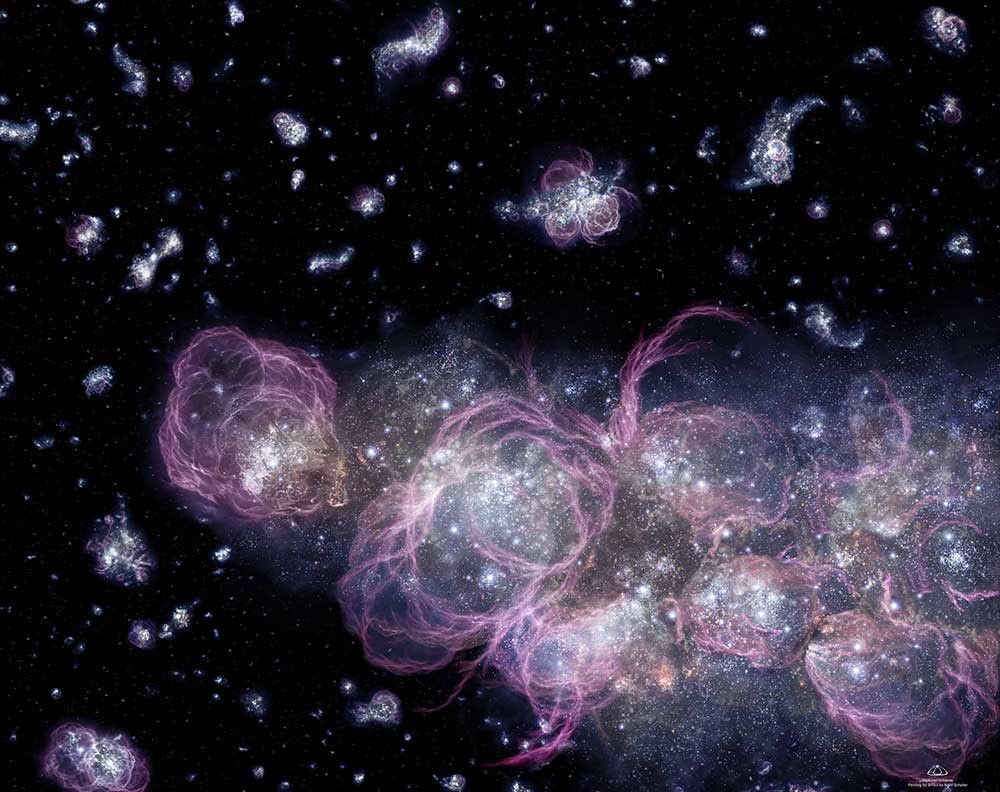
For the first few hundred million years of existence, the cosmos was a chaotic, starved landscape devoid of the heavy elements that now build planets and life. The early universe was composed almost entirely of hydrogen and helium, a pristine soup that yielded stars fundamentally different from the sun or the giants we observe today. These primordial objects, known as Population III stars, were likely monstrous in scale, burning with such ferocity that they shaped the very fabric of their host galaxies in ways we are only beginning to understand.
To bridge the gap between our modern observations and that ancient darkness, astronomers at the University of Utah launched a groundbreaking survey called TEMPOS. The project aims to find "analog" stars in nearby galaxies that have similarly low metallicity, meaning they lack the heavy elements forged in previous generations of stars. By studying these distant cousins, researchers can peek into the mechanisms that governed the infant universe, effectively using the present as a window to the past.
The investigation relies heavily on the ultraviolet light emitted by these metal-poor stars, captured by the Cosmic Origins Spectrograph aboard the Hubble Space Telescope. This specific wavelength of light acts as a crucial diagnostic tool, revealing details about stellar winds, magnetic fields, and the intense radiation these ancient behemoths pump into their surroundings. Unlike the more complex chemistry of modern stars, the simplicity of these early giants allows scientists to isolate specific physical processes that were likely responsible for sculpting the first galaxies.
The implications of this work extend far beyond mere academic curiosity; they touch upon the fundamental question of why the universe evolved the way it did. The strange, distorted shapes of early galaxies suggest that the intense radiation and powerful winds from these weird stars pushed gas around in turbulent patterns, preventing the smooth formation of spirals we see today. Understanding this chaotic phase is essential for modeling how the cosmos transitioned from a gas-filled void to a structured universe capable of supporting complexity.
As the TEMPOS data continues to accumulate, it promises to rewrite our textbooks on stellar evolution and galactic formation. We are moving closer to a complete picture of the cosmos's infancy, where the rules of physics were the same, but the actors were so alien to our current experience that they shaped the stage itself. Every new spectrum analyzed brings us one step closer to understanding how the strange, lonely stars of the early universe paved the way for the diverse, metal-rich world we inhabit today.
On Bluesky? Meet HomeSky.
Follower analytics, a growth toolkit, scheduling and AI posting — built for Bluesky. Connect your account and use everything free for 60 days.
Try HomeSky free →