The First Photograph of a Tornado Was Taken in 1884 by a Kansas Fruit Grower
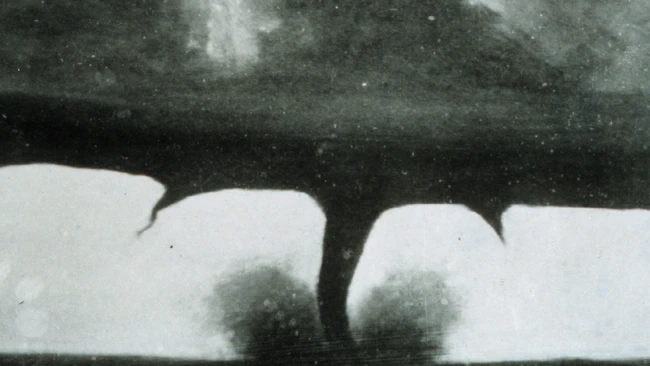
The image that captures the mind's eye when thinking of tornadoes is a specific tableau: a heavy, black funnel punching through the sky, flanked by smaller, spiraling vortices, set against a backdrop of devastation. This is the dramatic shot you likely saw in documentaries or weather reports, a frozen moment of nature's raw fury. Yet, this iconic composition was not captured in the age of high-definition video or even color photography. It was first immortalized in 1884 by a man named Edwin Porter, who was not a meteorologist or a professional photographer, but a Kansas fruit grower with a camera in his pocket.
Porter, living in a modest farmhouse in Nebraska, happened upon a twister tearing through his fields on May 23, 1884. The timing was fortuitous, but not guaranteed. Tornadoes are fleeting events, often lasting only minutes, making them nearly impossible to capture with the slow shutter speeds of the era. Porter managed to snap the exposure just as the funnel touched the ground, capturing a scene that would become the definitive visual record of a tornado for decades. The photograph is striking in its simplicity and power, devoid of the modern clutter of sensors and digital overlays, offering a raw, unfiltered glimpse into the phenomenon.
What makes this image so significant is the context of its creation. In the late 19th century, our understanding of atmospheric dynamics was in its infancy. Tornadoes were often dismissed as mere "whirlwinds" or attributed to supernatural causes rather than understood through the lens of physics. Porter's image provided irrefutable evidence that these were tangible, physical structures with measurable dimensions. It forced the scientific community to take notice, shifting the discourse from myth to meteorology. The photo became a crucial data point in the early study of storm paths and behavior, laying the groundwork for the warning systems and prediction models we rely on today.
Beyond its scientific utility, the photograph serves as a haunting reminder of the fragility of human civilization against the forces of nature. The landscape in the image is quiet and snow-covered, a stark contrast to the chaotic energy of the storm above. This juxtaposition highlights the suddenness of destruction; the storm arrived without the chaotic buildup we might expect today, simply tearing through the serene countryside. It is a testament to the fact that nature does not care about the season or the state of the land; it is a relentless force that demands respect and vigilance.
Today, as we look back at this century-old snapshot, we see the evolution of our relationship with the sky. We now have satellites, Doppler radar, and high-speed cameras that can track tornadoes in real-time, predicting their path with startling accuracy. Yet, the 1884 photograph remains the anchor of our history, the first visual proof that we could document the un-documentable. It stands as a monument to the power of observation, reminding us that sometimes the most profound insights come not from complex technology, but from the simple act of raising a camera and hoping for the best.
On Bluesky? Meet HomeSky.
Follower analytics, a growth toolkit, scheduling and AI posting — built for Bluesky. Connect your account and use everything free for 60 days.
Try HomeSky free →