Artemis III Crew Visits NASA Kennedy's Vehicle Assembly Building
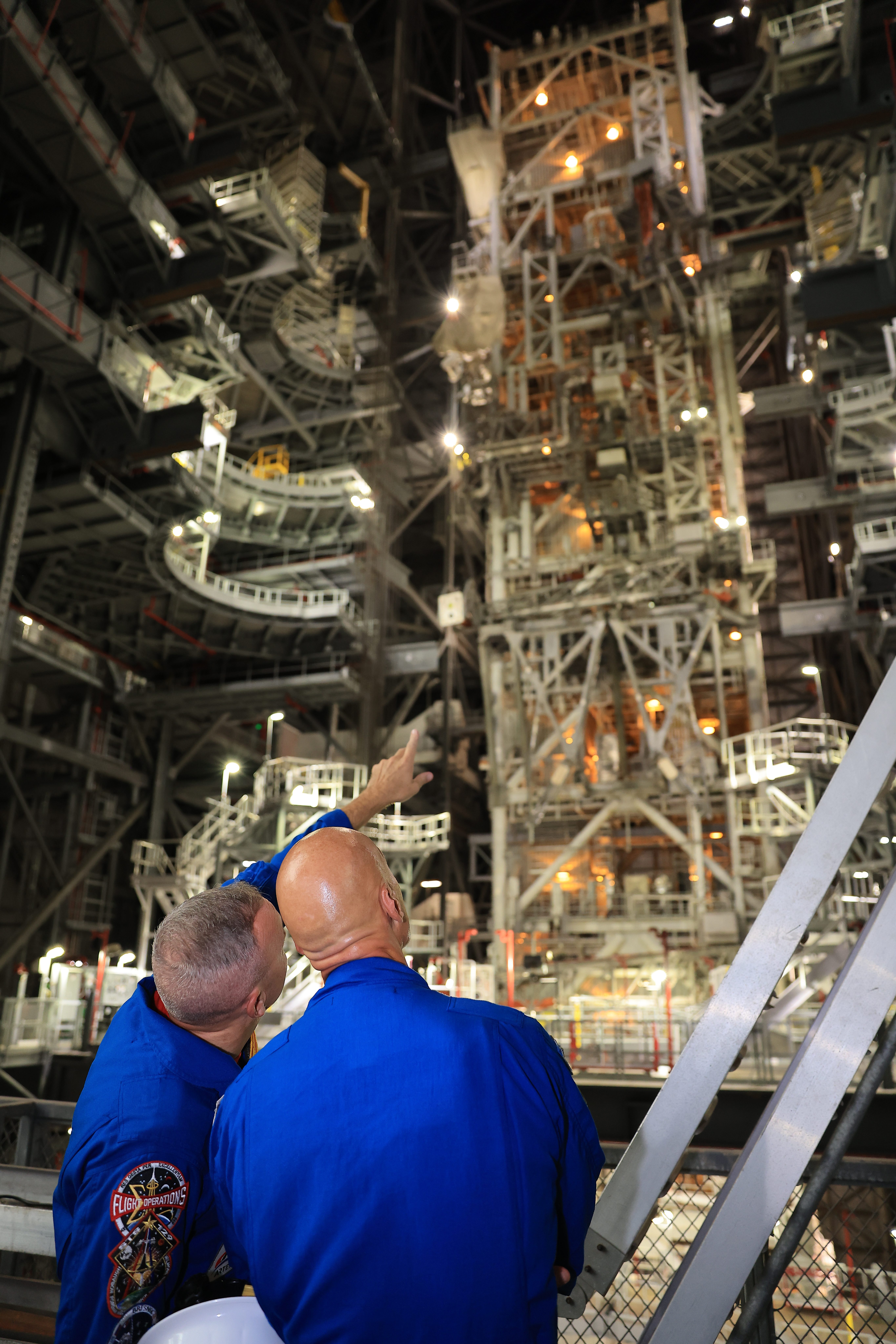
There is a profound difference between watching a rocket launch from a monitor and walking through the cavernous silence of the Vehicle Assembly Building while the components that will send humanity to the Moon loom overhead. On a crisp Wednesday in September 2026, that distinction vanished for NASA astronaut Randy Bresnik and his European Space Agency partner, Luca Parmitano. Standing inside High Bay 3, the pair didn't just observe the integration of the solid rocket boosters; they felt the sheer scale of the engineering challenge that has defined the Artemis program for over a decade. The space around them was a cathedral of industry, where the hum of machinery and the distant thud of assembly operations served as a rhythmic reminder that history is being written in real time, bolt by bolt.
The visit was not merely a ceremonial tour, but a critical technical inspection at a pivotal moment for the SLS rocket. The solid rocket boosters, the largest solid-propellant motors ever built, are the muscle that provides the initial thrust to lift the Orion spacecraft and its crew beyond the atmosphere. For Bresnik and Parmitano, who represent the bridge between the Artemis II uncrewed test flight and the upcoming Artemis III lunar landing, seeing the integration process firsthand is essential. They are not just future explorers; they are the architects of the timeline, ensuring that the hardware is ready to carry the weight of human ambition. Their presence in High Bay 3 signals a shift from development to execution, a moment where theoretical models are replaced by the tangible reality of a vehicle ready to fly.
What makes this visit particularly significant is the international collaboration inherent in the mission. With Parmitano representing the European Space Agency, the scene inside the bay underscores a fundamental truth of modern spaceflight: we are no longer competing alone. The integration of the solid rocket boosters requires a level of precision that no single nation can achieve in isolation. The astronauts' discussion with the Kennedy Space Center teams reflects a seamless exchange of expertise, where the unique strengths of the NASA workforce are amplified by the rigorous standards and innovative approaches brought by international partners. This synergy is the bedrock upon which the Artemis III mission rests, proving that the return to the Moon is a collective human endeavor rather than a solitary national triumph.
Beyond the immediate technical checks, the atmosphere in High Bay 3 carries the weight of history. The Vehicle Assembly Building, with its immense walls and high ceilings, was the site where the Saturn V rockets were assembled before Apollo sent humans to the surface. Now, it hosts the next generation of that legacy. When Bresnik and Parmitano looked upon the integrated boosters, they were looking at the same kind of engineering marvel that lifted Neil Armstrong and Buzz Aldrin, yet the context has shifted. This time, the goal is not just to land a man on the Moon, but to establish a sustainable presence there. The solid rocket boosters are the first step in a long chain that will lead to the Lunar Gateway and eventually to Mars, transforming our role in the solar system from visitors to residents.
As they prepared to leave the bay, the astronauts carried with them a renewed sense of urgency and clarity. The journey to the Moon has faced delays and challenges, but moments like this—standing amidst the giants of rocketry and witnessing the culmination of years of work—reaffirm the necessity of the mission. The solid rocket boosters are ready, but the true test lies ahead, in the vacuum of space and the dust of the lunar surface. For Randy Bresnik and Luca Parmitano, this visit was more than a photo opportunity; it was a commitment to the future, a promise that the next chapter of space exploration would be written with the same courage and ingenuity that defined the past.
On Bluesky? Meet HomeSky.
Follower analytics, a growth toolkit, scheduling and AI posting — built for Bluesky. Connect your account and use everything free for 60 days.
Try HomeSky free →