Social Media Engagement: summer 2026
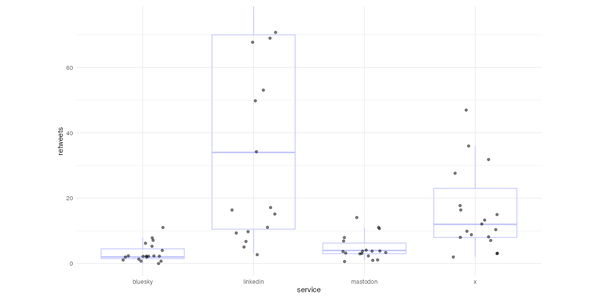
There is a distinct digital seasonality to how we consume technical thought, and as I looked back at the summer of 2026, the patterns were as starkly defined as the changing leaves outside. While many platforms have settled into a comfortable, if mediocre, equilibrium of passive scrolling, one service has emerged as the undisputed heavyweight champion of engagement. It is not merely about volume, but about the depth of the conversation; here, developers are not just consuming content but actively debating, refining, and building upon it in real-time. The algorithm seems to have finally aligned with human curiosity, pushing high-signal content to the front while quietly demoting the noise that used to clog the feeds of every major network.
In contrast, the trajectory of another major platform tells a story of precipitous decline that feels almost like a digital exodus. Since early 2025, the energy there has siphoned off, leaving behind a graveyard of dormant threads and broken links. It is a stark reminder that social media for developers is not a static utility; it is a living ecosystem that requires constant attention and relevance. When the audience stops showing up, the value proposition collapses, regardless of how sophisticated the underlying infrastructure might be. The silence on that platform is deafening compared to the vibrant hum of activity elsewhere.
What makes this shift particularly interesting is not just the movement of users, but the shift in the nature of the discourse itself. The platform that has seized the crown has fostered a culture where code snippets are treated with the same reverence as literature, and where the failure to reply to a thoughtful question is seen as a professional failing rather than a polite boundary. This has created a feedback loop of quality; because the audience is demanding better, the creators are delivering more rigorous analysis, which in turn attracts a more discerning crowd. It is a virtuous cycle that seems to have broken the stagnation that plagued the industry for so many years.
The implications for how we distribute knowledge are profound. If the data from summer 2026 is any indicator, the future of technical communication lies in community-driven, high-integrity spaces rather than in the broad, attention-hungry arenas of the past. We are seeing a maturation of the field, where the loudest voices are no longer the most valuable, but the most useful. This is a departure from the "shout the loudest" mentality that dominated the early social web, replacing it with a more nuanced understanding of what it means to truly contribute to a field.
As we move into autumn, the question is no longer which platform will win the war of engagement, but how we, as practitioners, will adapt to these new realities. The tools will change, the algorithms will evolve, but the core need for connection, for shared problem-solving, and for the collective elevation of our craft remains constant. The summer of 2026 was simply a mirror, reflecting the choices we have made and the communities we have chosen to invest in. It is a clear signal that the age of passive consumption is over, and the era of active, meaningful collaboration has truly begun.
On Bluesky? Meet HomeSky.
Follower analytics, a growth toolkit, scheduling and AI posting — built for Bluesky. Connect your account and use everything free for 60 days.
Try HomeSky free →