Migrating the GitHub Copilot runtime to Rust, using Copilot
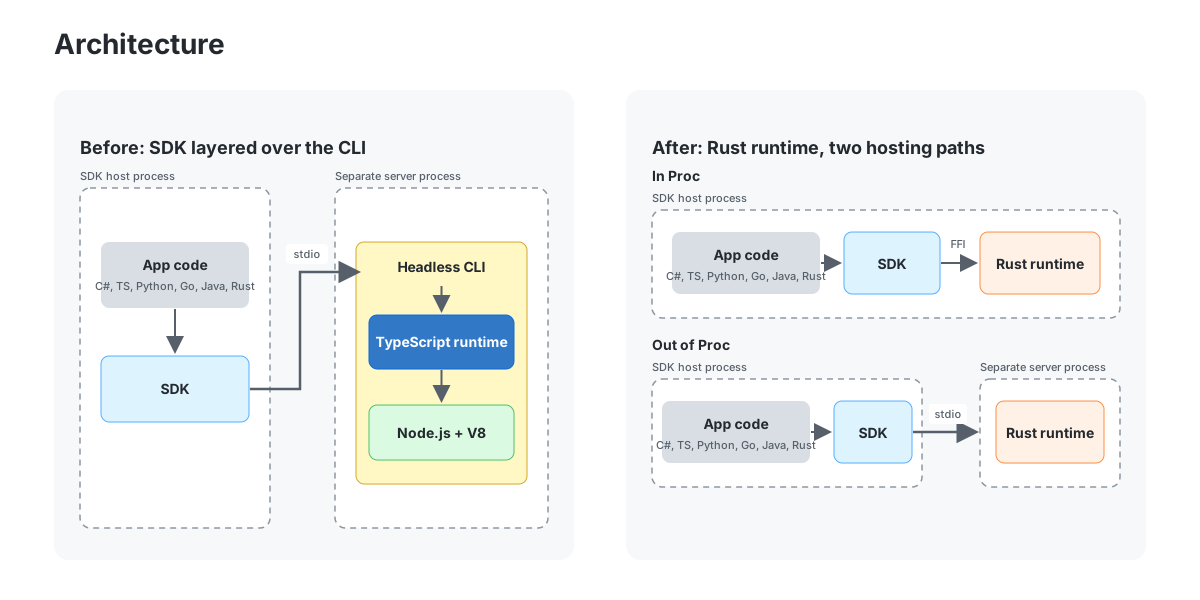
For years, the idea of porting a massive, complex codebase to a new language was a herculean task reserved for teams of hundreds and budgets measured in millions. The sheer cognitive load of understanding eight hundred thousand lines of intricate business logic, coupled with the fear of introducing regressions, made such a migration feel practically impossible. We looked at the mountain of legacy C++ and Go code powering the Copilot agent runtime and decided it was simply too expensive to rewrite. That calculation, however, was built on the assumption that human developers were the only tools available to tackle the job.
Enter the Copilot agent runtime itself, the very system designed to write code for us. In a twist of meta-progression, we decided to use the thing we were building to help build it. The strategy wasn't to replace human engineers but to augment them, creating a feedback loop where the AI generated the boilerplate and structural glue while humans focused on architecture and verification. It was a test of whether an LLM could navigate the labyrinth of a production-grade codebase without losing its way, treating the migration not as a manual excavation but as a collaborative engineering effort.
The results were both humbling and exhilarating. What initially seemed like a multi-year undertaking compressed into a sprint that felt almost too fast to be true. The AI didn't just copy-paste syntax; it understood the semantic relationships between modules, refactored dependencies, and handled the tedious drudgery of updating type definitions across thousands of files. It transformed the migration from a daunting prospect of manual labor into a dynamic process of review and refinement, allowing us to move with a velocity that would have been unthinkable just a few years ago.
Of course, the transition wasn't without its friction. There were moments where the generated code was clever but misguided, or where the AI stumbled over edge cases that required deep domain knowledge to resolve. These moments forced us to evolve our own workflow, creating new patterns for how humans and agents collaborate on large-scale system rewrites. The goal wasn't to build a system where the AI does everything, but to create a symbiotic relationship where the machine handles the volume and the human handles the intent.
This migration serves as a case study for the future of software engineering. It proves that the barrier to entry for massive refactoring projects is no longer the size of the task, but the quality of the collaboration between developer and tool. We are no longer bound by the limits of human cognitive bandwidth when it comes to syntax and structure. By leveraging the power of the Copilot runtime to migrate itself to Rust, we have demonstrated a new paradigm: that the most complex problems in software are best solved by combining the precision of rigorous languages like Rust with the generative power of modern AI agents.
On Bluesky? Meet HomeSky.
Follower analytics, a growth toolkit, scheduling and AI posting — built for Bluesky. Connect your account and use everything free for 60 days.
Try HomeSky free →