Migrating the GitHub Copilot runtime to Rust, using Copilot
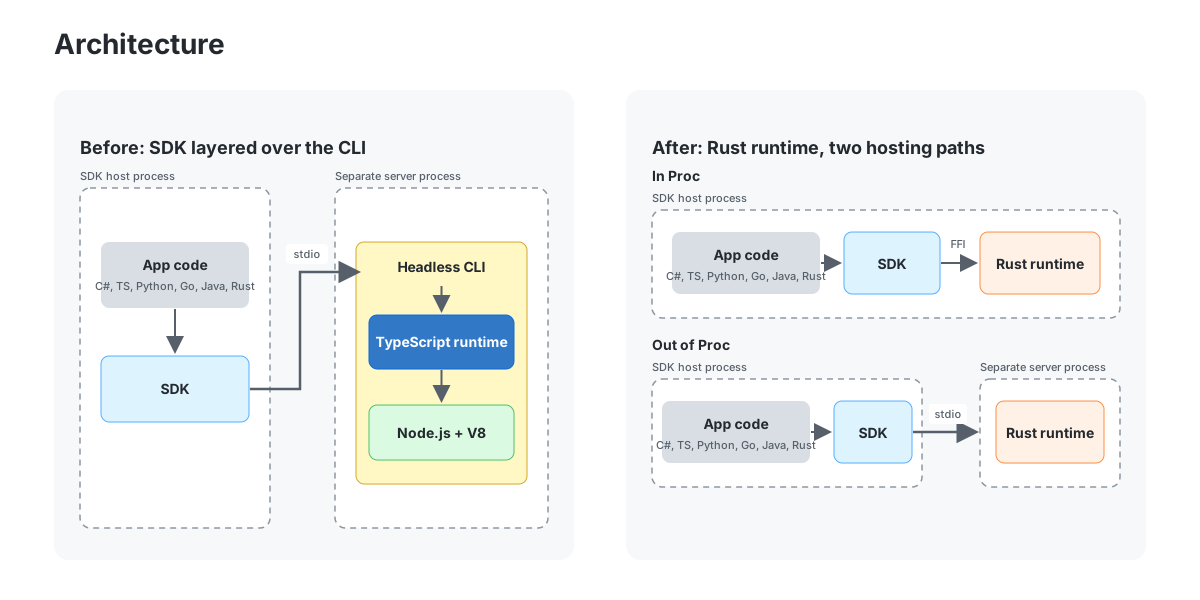
Before the concept of AI agents even entered the collective consciousness, rewriting a codebase of this magnitude was a logistical nightmare. The original Copilot runtime, built in a higher-level language, was a sprawling collection of logic that handled everything from context retrieval to prompt construction. Moving it to Rust was not just a theoretical exercise in performance; it was a necessity for the stability and safety required in a production environment serving millions of developers. The sheer volume of the task—roughly 800,000 lines of production Rust—suggested that a traditional, manual refactor would take years, perhaps a decade, and involve a army of engineers burning out on the tedium of translation.
The turning point came when we stopped viewing the migration as a constraint and started viewing our own AI tools as the solution to the problem. By deploying Copilot to the very task of rewriting Copilot, we created a recursive loop of self-improvement that defied conventional wisdom. The AI didn't just generate code; it understood the semantic intent of the legacy system and translated it into idiomatic, safe Rust patterns. It was a moment where the tool became the architect, capable of navigating the labyrinthine dependencies and architectural quirks that usually stump human teams.
This approach allowed us to tackle complexity in ways that were previously impossible. Human developers, no matter how skilled, hit a cognitive ceiling when staring at millions of lines of interconnected logic. The AI agent, however, could maintain context across the entire system, suggesting refactors that optimized memory usage and reduced latency simultaneously. It wasn't magic, but it felt close; the agent could identify subtle race conditions or performance bottlenecks in the old code and propose Rust equivalents that leveraged the language's ownership model to solve them elegantly, often in seconds where a human might spend days.
The result was a runtime that is not only faster and more reliable but also significantly smaller in footprint. Rust's strict compile-time guarantees meant that we could eliminate entire classes of runtime errors that plagued the previous implementation. The migration process itself became a case study in leveraging modern AI capabilities to overcome historical barriers. We are seeing a shift in how large-scale systems evolve; the bottleneck is no longer the availability of human time, but the alignment of our tools with our goals.
Looking forward, this rewrite sets a new precedent for maintaining and evolving complex software infrastructure. It proves that when the right tools are applied to the right problems, the scale of what we can achieve expands exponentially. The journey from a legacy monolith to a high-performance Rust system, driven by the very AI that powers it, is a testament to the rapid acceleration of our engineering capabilities. We are not just writing code faster; we are rewriting the rules of what is possible to build.
On Bluesky? Meet HomeSky.
Follower analytics, a growth toolkit, scheduling and AI posting — built for Bluesky. Connect your account and use everything free for 60 days.
Try HomeSky free →