Migrating the GitHub Copilot runtime to Rust, using Copilot
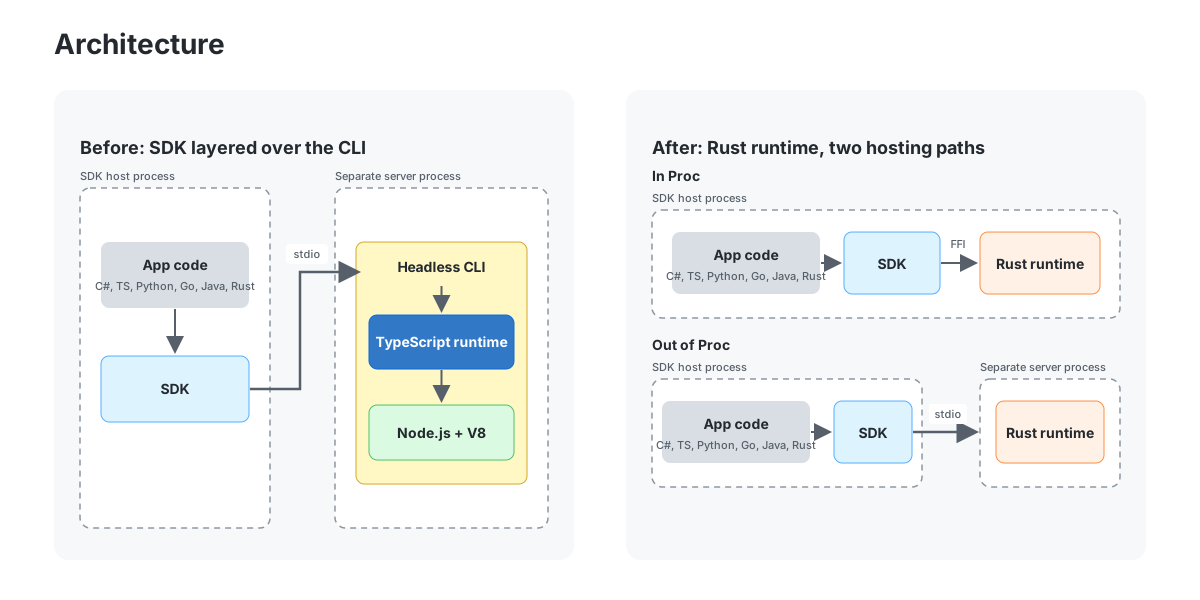
For years, the idea of rewriting a massive software component in Rust felt like a dream reserved for mythical engineering heroes. We had the vision of memory safety and blazing speed, but the cost of execution was prohibitive; the sheer volume of work required to port millions of lines of code simply wasn't affordable. Then came the era of AI agents, and suddenly, that impossible mountain became a manageable climb. By leveraging Copilot to handle the heavy lifting of boilerplate and boilerplate-heavy logic, we were able to tackle a rewrite that previously would have taken a team years, compressing what felt like a decade of work into a sprint that didn't break the bank.
The project at hand was no small beast: migrating the Copilot agent runtime, a sprawling system composed of approximately 800,000 lines of production code, to Rust. This wasn't just a cosmetic refactor or a minor feature addition; it was a fundamental overhaul of how the model interacts with the world. The stakes were high because this runtime is the brain behind one of the most widely used coding assistants on the planet, and any instability in the translation layer could ripple out to millions of developers. The challenge wasn't just technical; it was a test of whether modern AI could actually bridge the gap between theoretical feasibility and practical execution at a scale that matters.
The process revealed something profound about the current state of software engineering. In the past, attempting this migration would have required a dedicated team of senior engineers for months, navigating a labyrinth of edge cases, performance bottlenecks, and architectural dependencies. Today, the agent acts as a force multiplier, allowing a smaller, more focused group to direct the flow of work rather than doing every single line of typing. It changes the nature of the engineer's role from a manual laborer to an architect, where the value shifts from writing syntax to designing systems and verifying outcomes. The agent doesn't just write code; it understands the intent, suggesting structural changes and implementing logic that aligns with the rigorous safety standards Rust demands.
Of course, it wasn't a magic wand that fixed everything instantly. There were moments of friction where the agent's suggestions needed human refinement, particularly when dealing with the nuanced interactions between the language model and the underlying infrastructure. The transition required a new kind of discipline, where the human team had to constantly validate the agent's output against the strict type system and ownership rules of Rust. This collaboration created a feedback loop where the codebase became cleaner and safer with every iteration, proving that the combination of human oversight and AI velocity is a powerful new paradigm for building reliable software.
Ultimately, this migration serves as a case study for the future of development. It demonstrates that the barriers to entry for complex, high-performance rewrites are lowering, not rising. What once was a project of monumental difficulty is now a routine part of the software lifecycle, driven by tools that can understand context, intent, and scale. The result is a more robust, efficient runtime that benefits every user, but the real victory is the shift in how we approach problems that previously seemed unsolvable. We are no longer limited by the speed of our fingers or the size of our teams; we are limited only by the clarity of our goals and the ingenuity of our collaborators.
On Bluesky? Meet HomeSky.
Follower analytics, a growth toolkit, scheduling and AI posting — built for Bluesky. Connect your account and use everything free for 60 days.
Try HomeSky free →