Migrating the GitHub Copilot runtime to Rust, using Copilot
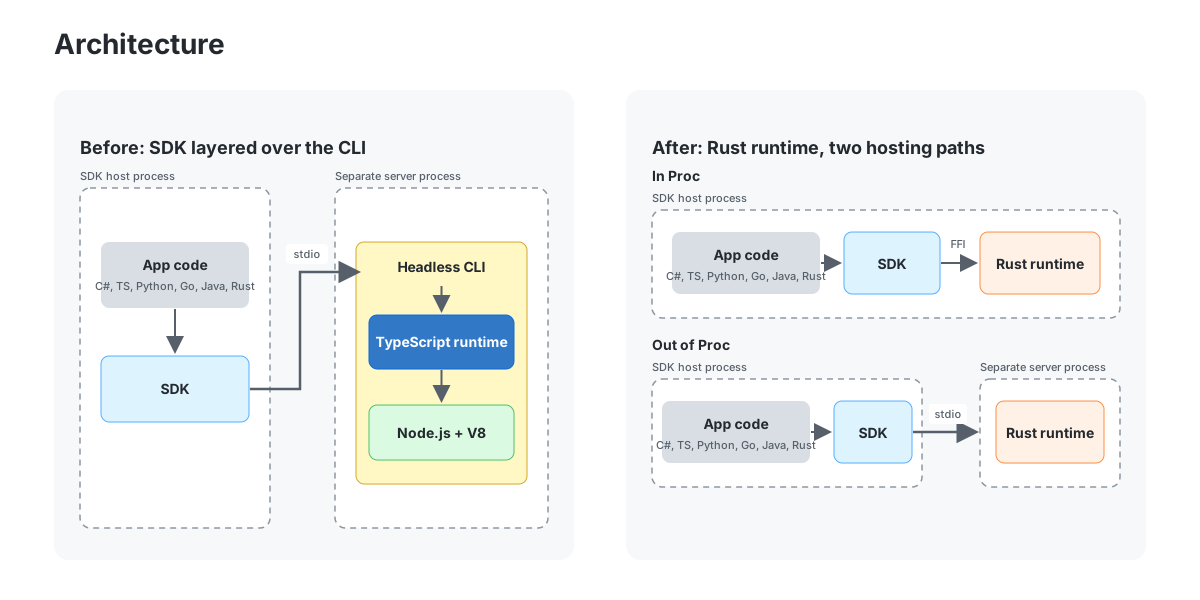
For years, the idea of rewriting a massive codebase in Rust felt like a logistical nightmare, a task so expensive that companies would simply endure the technical debt of legacy languages. But the landscape shifted when intelligent agents arrived, turning a project that would have cost millions and taken years into a journey completed in weeks. We decided to migrate the GitHub Copilot runtime, an 800,000-line system, and the irony of using Copilot to build Copilot was the perfect catalyst for this transformation.
The original runtime was a sprawling beast written in Python, heavily reliant on dynamic typing and ad-hoc workarounds that made it brittle at scale. Every feature added was a potential new edge case that had to be manually reasoned through, a process that slowed innovation. Rust, by contrast, demanded a level of discipline that forced us to design the system from the ground up rather than patching it on top. The goal wasn't just to translate code line-by-line; it was to reimagine the architecture so that memory safety and concurrency could be guaranteed by the compiler, not the developer.
The process began with the hardest part: defining the constraints. We fed the agent the existing documentation and codebase, asking it to generate a Rust scaffold that mirrored the logic but enforced strict ownership rules. What emerged was not a direct port, but a modernization of the architecture itself. The agent identified patterns where the old Python code was messy and suggested Rust idioms that simplified the logic, effectively rewriting the business rules while we slept.
However, the tool is only as good as the operator, and we learned quickly that "set it and forget it" was not a strategy for a rewrite of this magnitude. We treated the migration as a human-in-the-loop experiment. We reviewed the generated code, refactored the agent's prompts to handle the specific nuances of our internal APIs, and iterated on the scaffolding. It became a dialogue between the developer and the machine, where the AI did the heavy lifting of boilerplate and pattern matching, while humans made the critical architectural decisions.
The results speak for themselves. The final runtime is significantly faster, more reliable, and easier to reason about than its predecessor. But the real victory isn't just the performance gains; it's the validation that the future of software development isn't about replacing humans with machines, but about creating a partnership where the machine handles the drudgery of syntax and memory management, freeing us to focus on what actually matters: solving hard problems.
As we look toward the next iteration, the feedback loop between our engineering team and the agent has become a permanent fixture. We are no longer bound by the limitations of a single language or the sheer volume of code we must maintain. The migration proved that with the right tools, the impossible becomes not just affordable, but inevitable.
On Bluesky? Meet HomeSky.
Follower analytics, a growth toolkit, scheduling and AI posting — built for Bluesky. Connect your account and use everything free for 60 days.
Try HomeSky free →