Migrating the GitHub Copilot runtime to Rust, using Copilot
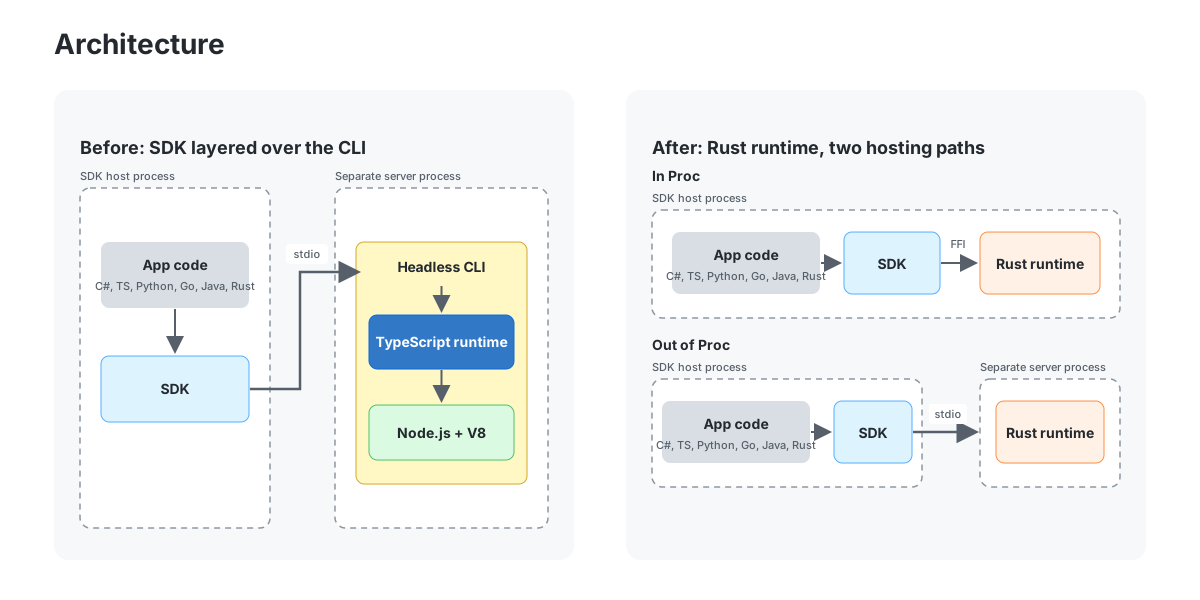
For years, the idea of rewriting a massive production system in a new language was a logistical nightmare, reserved for greenfield projects or desperate migrations. When we looked at the GitHub Copilot runtime—an intricate beast of 800,000 lines of code managing the heartbeat of our AI agent infrastructure—the thought of porting it to Rust felt less like an engineering challenge and more like a suicide mission. The costs were clear: the time, the risk, and the sheer scale of human effort required to validate every line. But the landscape has shifted beneath our feet. We have entered an era where autonomous agents don't just execute code; they can reason about it, critique it, and guide the migration process itself.
The decision to move to Rust wasn't just about memory safety or performance, though those are significant benefits for a system handling millions of requests. It was about trust. The runtime acts as the gatekeeper for the entire Copilot ecosystem, deciding when an AI suggestion is safe enough to present to a developer. In a system where the AI is the product, the gatekeeper must be flawless. Rust offers a different kind of safety—one enforced by the compiler rather than runtime checks—but getting there required a level of self-correction we never possessed in our previous stack. We needed a system that could identify its own bugs before they were deployed.
That is where the irony, and the breakthrough, lies. We didn't just hire a team to write the Rust code; we asked Copilot to help write the Rust code. It sounds recursive, almost absurd, to have an AI agent migrate its own runtime to a stricter language, but it is the most logical step in the evolution of autonomous development. The agents analyzed the legacy Python code, mapped the dependencies, and generated the Rust equivalents, creating a feedback loop where the AI was constantly validating its own work against the strictures of the new language. It turned the migration from a manual grind into a collaborative sprint.
The results were startlingly efficient. While the codebase is nearly a million lines long, the actual window of active development was measured in months rather than years. The agents handled the repetitive lifting of the bulk of the logic, allowing human engineers to focus on the complex architectural decisions and the tricky edge cases where the AI's suggestions occasionally hit a wall. When the AI made a mistake, we didn't just fix it; we used the error to refine the prompts and the agent's own reasoning capabilities, creating a loop of continuous improvement.
This is the future of large-scale software engineering. The barrier to entry for massive undertakings is no longer just the availability of skilled developers, but the ability to orchestrate intelligence that can handle the cognitive load. Porting the Copilot runtime to Rust proved that the tools we build today can be the architects of their own evolution. We are no longer just writing code; we are cultivating systems that can think, refactor, and grow with us.
Looking back, the rewrite wasn't just a technical victory; it was a validation of a new paradigm. We took a system that powers the world's leading AI coding assistant and rebuilt its foundation using that same assistant. The 800,000 lines of Rust now stand as a testament to what happens when human intent meets autonomous execution at scale. The journey was far from frictionless, but for the first time, the path forward was clear.
On Bluesky? Meet HomeSky.
Follower analytics, a growth toolkit, scheduling and AI posting — built for Bluesky. Connect your account and use everything free for 60 days.
Try HomeSky free →