Migrating the GitHub Copilot runtime to Rust, using Copilot
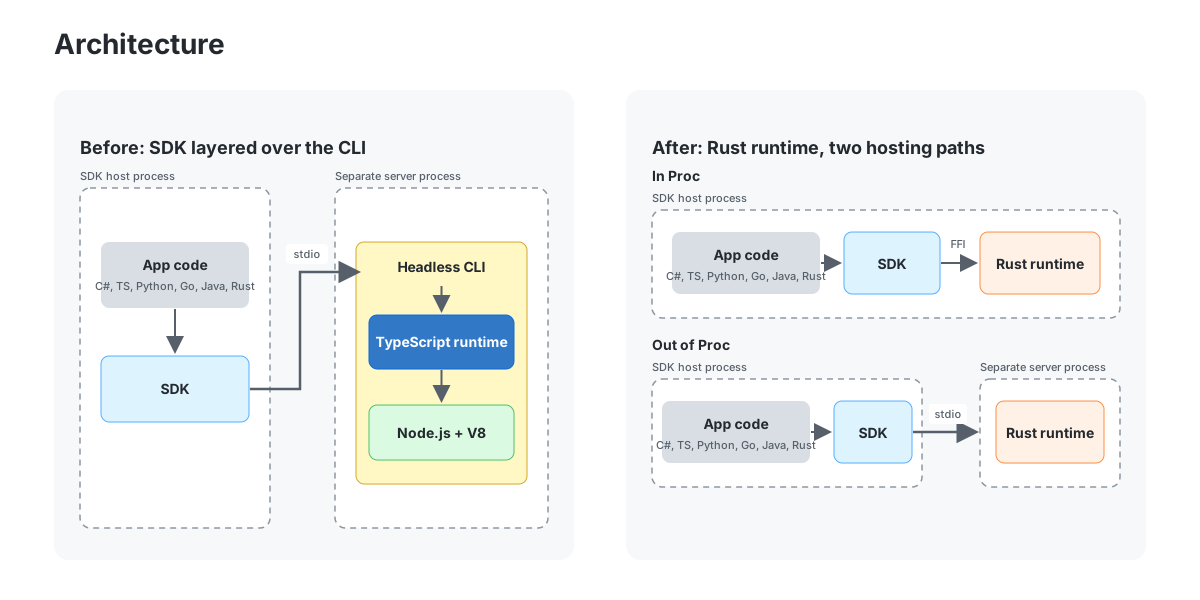
For years, the prospect of rewriting the Copilot runtime in Rust was dismissed as an impossibility. The sheer scale of the operation—eight hundred thousand lines of production-grade Rust—was not just a logistical hurdle but a psychological barrier that suggested such a migration was simply too expensive to attempt. We were operating under the assumption that the complexity of the codebase and the fragility of the existing logic would make any rewrite a catastrophic gamble, one where the risk of breaking core functionality far outweighed the potential gains in performance and security.
Then came the shift in the industry landscape, where the advent of autonomous agents fundamentally altered the equation of software development. Before this era, a rewrite of this magnitude was indeed unaffordable; the human cost in time, effort, and the likelihood of introducing subtle bugs was prohibitive. However, the new capabilities of AI agents allowed us to treat the porting process not as a manual, line-by-line translation exercise, but as a collaborative exploration where the machine could reason about the structure, context, and intent of the original code far more effectively than any human team could have alone.
The journey began by breaking the monolithic challenge into smaller, manageable contexts that the agent could comprehend without losing the forest for the trees. We utilized the Copilot agent to analyze the intricate web of dependencies and data flows within the legacy codebase, identifying patterns that were invisible to static analysis tools. This approach allowed us to generate high-fidelity Rust implementations that adhered strictly to safety standards while maintaining the complex behaviors required for the runtime to function correctly in a production environment.
What surprised us most was how the agent navigated the nuances of idiomatic Rust. Porting from a dynamically typed language to a strictly typed system usually requires a deep understanding of ownership and borrowing rules that can trip up even seasoned engineers. Yet, the agent demonstrated an ability to infer the necessary type signatures and borrow lifetimes on the fly, effectively acting as a senior architect who had seen the code a thousand times before writing a single line of the new implementation.
The result is a system that is not only faster and more memory-efficient but also significantly more reliable. By leveraging these advanced agents, we achieved a level of code quality and architectural clarity that would have taken a large human team several years to replicate manually. This project stands as a testament to the transformative power of AI in modern software engineering, proving that tasks once deemed intractable can become routine when the right tools are applied to the right problem.
Looking ahead, the implications of this migration extend far beyond the specific codebase of the Copilot runtime. It sets a new precedent for how large-scale infrastructure can be modernized, suggesting that the next generation of enterprise software might be built with a similar confidence in AI-driven development. The era of manual, exhaustive rewrites is ending, replaced by a future where intelligent agents handle the heavy lifting of complex system transitions, freeing human developers to focus on innovation rather than maintenance.
On Bluesky? Meet HomeSky.
Follower analytics, a growth toolkit, scheduling and AI posting — built for Bluesky. Connect your account and use everything free for 60 days.
Try HomeSky free →