Migrating the GitHub Copilot runtime to Rust, using Copilot
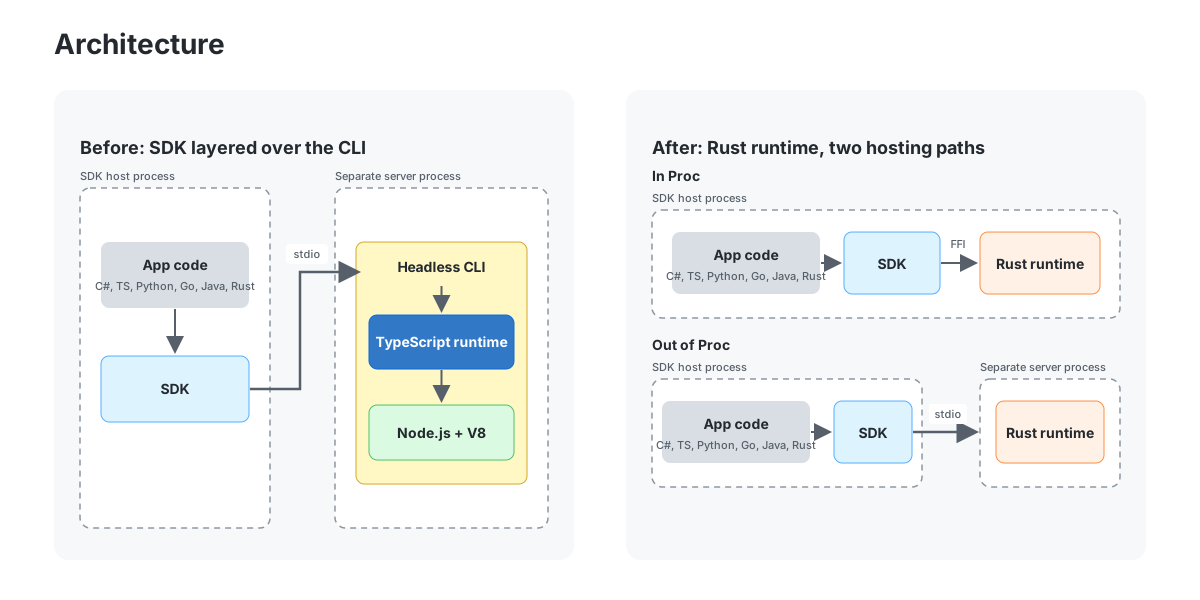
Before the emergence of AI agents, undertaking a rewrite of this magnitude would have been economically impossible. The GitHub Copilot runtime is a complex beast, spanning roughly 800,000 lines of production Rust, a volume of code that simply didn't make financial sense for a human team to refactor manually. We needed a way to bootstrap the migration without burning through the entire engineering budget on translation tasks that machines could handle far better.
The irony of the approach was the solution itself: we used Copilot to migrate Copilot. It sounds like a paradox, but the reality is that modern AI agents are uniquely capable of understanding the semantic context of a massive codebase better than any single human could. By leveraging the very system we were building to achieve the port, we created a feedback loop where the AI analyzed the existing Go logic, generated the Rust equivalent, and then we, the humans, acted as the final gatekeepers to ensure the generated code adhered to our strict security and performance standards.
The technical depth required for this port was immense. Porting isn't just about syntax conversion; it involves reimagining concurrency models, memory management, and the intricate orchestration of microservices. The Rust ecosystem offers superior safety guarantees and performance, but the learning curve for maintaining a system of this scale is steep. We didn't just copy-paste; we engaged in a deep dialogue with the codebase, asking the agent to explain why a specific function existed before rewriting it, ensuring that the underlying logic survived the transition intact.
There were moments where the generated code felt too eager, prioritizing elegance over the pragmatic constraints of a legacy system. In those instances, the human role became critical. We had to step in to guide the agent, providing the context that the raw code didn't immediately reveal. This collaboration transformed the migration from a mechanical task into a strategic evolution, where the AI handled the heavy lifting of boilerplate and pattern matching while engineers focused on architectural decisions and edge cases.
Looking back, the success of this migration validates a new paradigm for software development. We are moving away from the era where humans must write every line from scratch to an era where developers act as architects and editors of AI-generated assets. The 800,000 lines of Rust now running our core infrastructure prove that this hybrid approach is not just a clever trick, but a necessary evolution for maintaining complex, high-stakes systems in an increasingly automated world.
On Bluesky? Meet HomeSky.
Follower analytics, a growth toolkit, scheduling and AI posting — built for Bluesky. Connect your account and use everything free for 60 days.
Try HomeSky free →