APOD: 2026 September 20 – Analemma over the Callanish Stones
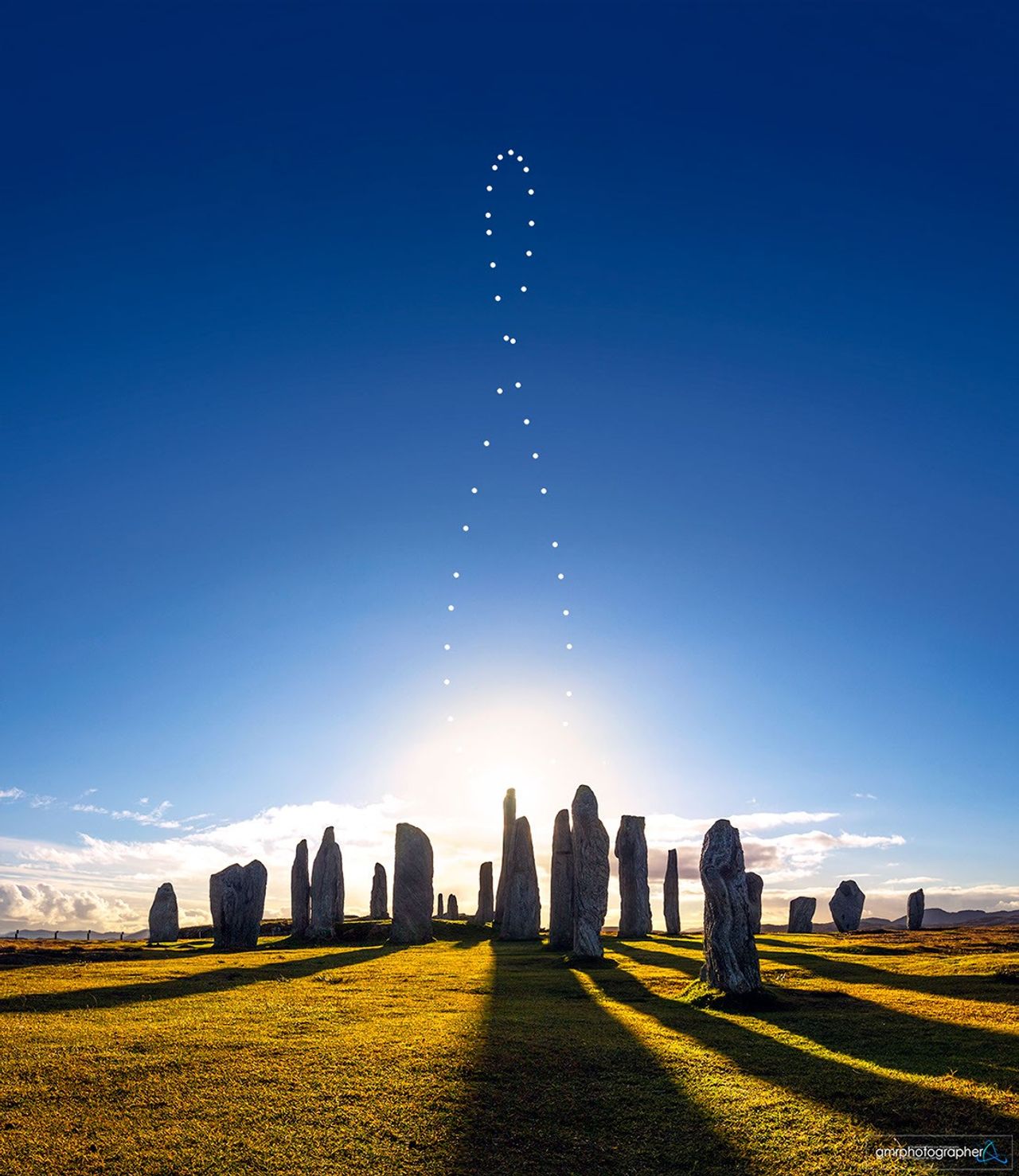
There is a peculiar, hourglass-shaped ghost in the sky that most people never see unless they stand at just the right spot on Earth at the exact right moment. Known as the analemma, this figure-eight loop is the celestial signature of our planet's wobble and tilt, a visual reminder that our orbit is not a perfect circle and our axis is not perfectly vertical. While standard star charts show us where the sun should be on a given date, the analemma reveals the subtle dance between the tropical year and the sidereal year, a dance that repeats every 365.25 days in a pattern that has fascinated observers since the age of the telescope.
To witness this phenomenon clearly, one must look at the Callanish Stones, a Neolithic stone circle located on the Isle of Skye in the Outer Hebrides of Scotland. These monoliths were erected around 3000 BCE, long before the invention of clocks or calendars, yet they possess an uncanny alignment with the movements of the heavens. On September 20, 2026, the sun will pass directly over the stones in a way that frames the analemma perfectly against the ancient backdrop. It is a rare convergence of prehistoric engineering and celestial mechanics, where human history and astronomical physics align to create a moment that feels both ancient and startlingly new.
The formation of the analemma relies on two primary factors: the Earth's axial tilt of approximately 23.4 degrees and the eccentricity of its orbit around the sun. Because our orbit is slightly elliptical, the Earth travels faster when it is closer to the sun and slower when it is farther away, causing the sun to appear to move at different speeds throughout the year. Combined with the tilt, which causes the sun to trace a figure-eight path against the background stars over the course of a year, this creates the loop we see when photos taken at the same time every day are overlaid. It is a testament to the precision of our solar system's mechanics, a visible proof that the heavens are governed by predictable, albeit complex, rules.
What makes the 2026 date so special is the location of the sun within this loop relative to the Callanish Stones. The stones themselves are aligned with the midsummer sunrise and the midwinter sunset, marking the solstices, but they also interact with the daily motion of the sun in ways that are only fully appreciated when viewing the analemma. As the sun climbs over the monoliths, the figure-eight shape appears to hover just above the horizon or high in the sky, depending on the specific time of day captured. This creates a visual narrative where humanity's earliest attempts to understand the cosmos are literally framed by the mechanics of that cosmos.
For the modern observer, this event serves as a bridge between the scientific and the spiritual. We often look at astronomy as a cold, hard science of data points and orbital parameters, yet the image of the sun tracing its loop over ancient stones reminds us that we are part of a continuous story. The Callanish builders did not need to understand the math of Kepler or the mechanics of Earth's orbit to sense the significance of these alignments; they simply watched, recorded, and built. Today, we use telescopes and satellites to study the same sky, but the underlying wonder remains identical.
As the seasons change and the year 2026 progresses, the analemma will shift slightly, growing larger or smaller depending on the season, but the view from Skye offers one of the most dramatic perspectives on Earth. It is a chance to pause and consider our place in the universe, to recognize that even in a digital age, there is still profound beauty in the simple act of watching the sun move across the sky. The figure-eight ghost lingers in the sky, a permanent reminder of the delicate balance that allows life to flourish on this spinning rock, framed by the enduring silence of stone that has stood guard for millennia.
On Bluesky? Meet HomeSky.
Follower analytics, a growth toolkit, scheduling and AI posting — built for Bluesky. Connect your account and use everything free for 60 days.
Try HomeSky free →