Migrating the GitHub Copilot runtime to Rust, using Copilot
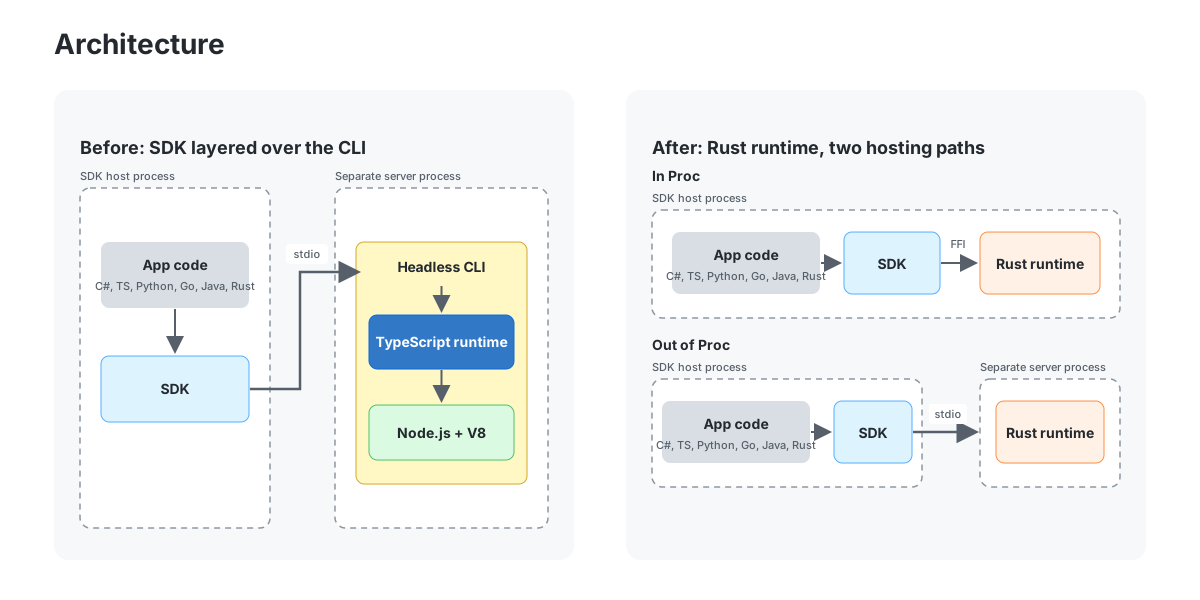
Rewriting a system as critical and complex as the GitHub Copilot agent runtime was once a luxury afforded only to massive teams with endless man-months to spare. The sheer scale of the codebase, sitting at around 800,000 lines of production Rust, made this transition an exercise in high-stakes precision engineering rather than a simple code migration. Before the rise of intelligent agents, such a rewrite would have been prohibitively expensive, requiring months of dedicated focus solely on refactoring without the ability to verify correctness in real-time. The introduction of AI agents fundamentally shifted the calculus, turning an impossible logistical hurdle into a manageable, albeit intense, engineering sprint.
The decision to port the runtime to Rust was driven by a need for performance and reliability that other languages could not guarantee for this specific workload. Rust's memory safety guarantees without a garbage collector offered the deterministic execution required for an AI model serving millions of developers. However, the challenge lay not just in the language choice but in the sheer volume of logic that needed to be translated into a new paradigm. Every function, every edge case, and every interaction pattern had to be re-evaluated and reimplemented, creating a landscape where a single typo could ripple through the entire system. The team faced the daunting task of ensuring that the new Rust implementation behaved identically to the previous version while simultaneously unlocking new capabilities inherent to the language.
What made this particular migration unique was the use of Copilot itself to aid in the migration. It was a meta-engineering feat where the tool being rewritten helped rewrite itself. The agents were tasked with generating boilerplate, suggesting refactorings, and even handling the mundane aspects of testing and validation. This created a feedback loop where the AI learned the domain-specific nuances of the Copilot runtime, allowing it to propose solutions that were contextually aware rather than generic. The developers acted as conductors, guiding the orchestra of agents to ensure that the generated code adhered to strict architectural standards and security protocols.
Despite the assistance of AI, the human element remained the critical bottleneck and the ultimate safety net. The engineers had to constantly verify the output, catching subtle logic errors that the agent might have misinterpreted. There were moments of intense scrutiny where a generated function had to be manually audited line-by-line, ensuring that the optimization strategies did not introduce hidden bugs. This hybrid approach of human oversight and AI acceleration demonstrated that while technology can scale the effort, it cannot replace the necessity of deep domain expertise and critical judgment.
The result is a runtime that is not only faster and more secure but also more maintainable in the long run. The migration to Rust has paved the way for future innovations, allowing the team to iterate on features with a confidence that was previously unattainable. It serves as a testament to the evolving relationship between developers and their tools, showing that the next generation of software engineering will be defined by this symbiosis. The 800,000 lines of code now stand as a monument to a new era where the boundaries of what can be built are pushed further by the fusion of human intent and artificial intelligence.
On Bluesky? Meet HomeSky.
Follower analytics, a growth toolkit, scheduling and AI posting — built for Bluesky. Connect your account and use everything free for 60 days.
Try HomeSky free →