Migrating the GitHub Copilot runtime to Rust, using Copilot
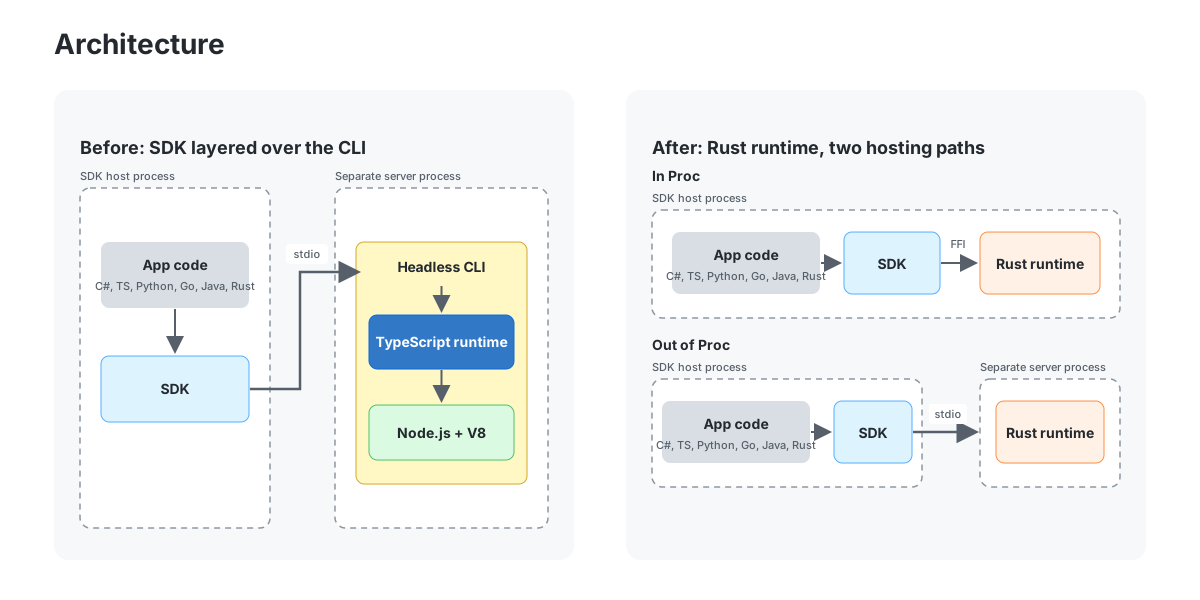
Before the rise of autonomous agents, a software rewrite of this magnitude was simply not affordable. The sheer volume of human hours required to translate millions of lines of legacy code into a modern, high-performance language would have stalled a project for years, draining resources that could have been spent elsewhere. Today, we are talking about porting the entire GitHub Copilot agent runtime to Rust, a language known for its safety guarantees and blazing speed, despite the system's original complexity spanning approximately 800,000 lines of production code.
The decision to undertake this migration wasn't driven by nostalgia or a desire for change's sake; it was a necessity born from performance and reliability constraints. The original implementation, while functional, carried the weight of a dynamic runtime that struggled under the increasing load of real-time code completion requests. Rust offered a different philosophy—one where memory safety is enforced by the compiler rather than the garbage collector, eliminating entire classes of bugs that had plagued the system. However, attempting such a massive lift manually would have been a logistical nightmare, prone to subtle errors that could only surface in production under heavy fire.
Enter Copilot, acting not just as a code generator but as a collaborative partner in the migration itself. By leveraging Copilot's ability to understand context and generate idiomatic patterns, we were able to scaffold the new Rust architecture while simultaneously refactoring the old logic. It wasn't a case of the tool doing all the work; rather, it served as a force multiplier that allowed the engineering team to focus on architectural decisions and edge cases that required deep human intuition. The AI didn't just write functions; it helped navigate the labyrinth of dependencies and state management that defined the original runtime.
The results speak for themselves, validating the hypothesis that AI can fundamentally shift the economics of large-scale engineering. The new Rust implementation not only matches the functionality of the previous version but does so with significantly lower latency and reduced memory overhead. In the world of distributed systems where milliseconds matter, this performance gain translates directly to a better developer experience for millions of users worldwide. The rewrite, which would have taken an army of engineers years to complete, was achieved in a fraction of the time, proving that the integration of human oversight and AI productivity is the future of software development.
This migration also highlights a broader shift in how we approach legacy modernization. It challenges the notion that porting massive codebases is a purely manual, artisanal craft. While human judgment remains critical for validating complex business logic and ensuring security protocols, the heavy lifting of translation and pattern matching is increasingly within the reach of intelligent agents. We are moving toward an era where the barrier to entry for high-performance systems is lowered, allowing teams to focus on innovation rather than maintenance.
Ultimately, the journey to port the Copilot runtime to Rust is more than a technical achievement; it is a testament to the evolving relationship between human intent and machine execution. It demonstrates that when we arm our teams with the right tools, the impossible becomes merely a matter of iteration. As we look to the future, the potential for even larger, more complex rewrites becomes visible, promising a landscape where software can be built with unprecedented speed and confidence.
On Bluesky? Meet HomeSky.
Follower analytics, a growth toolkit, scheduling and AI posting — built for Bluesky. Connect your account and use everything free for 60 days.
Try HomeSky free →