Migrating the GitHub Copilot runtime to Rust, using Copilot
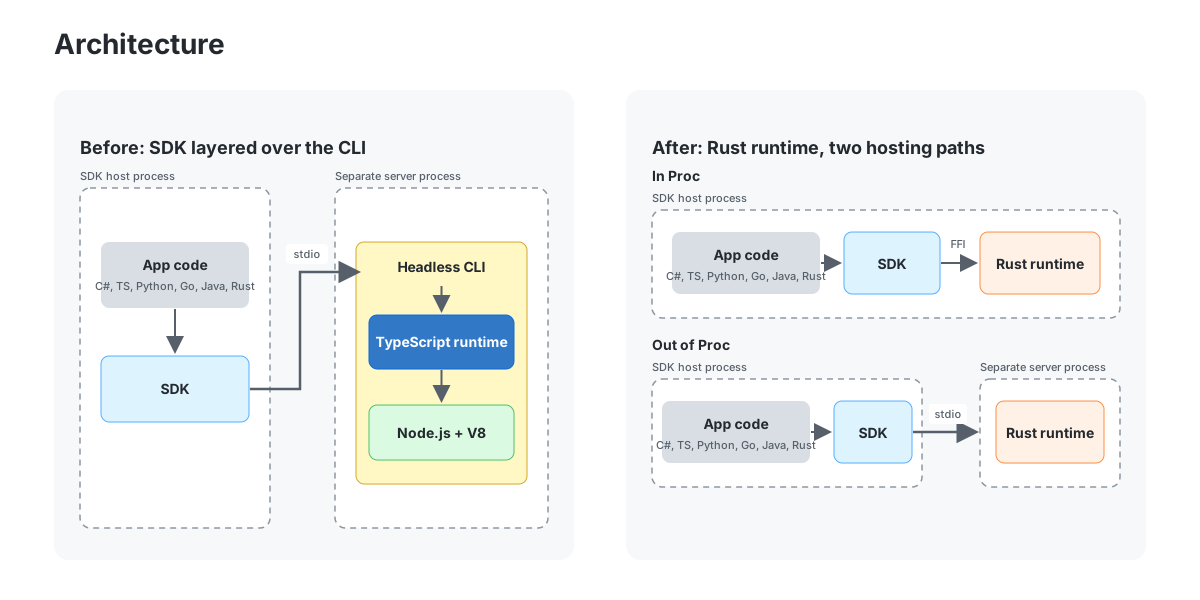
It feels almost ironic that the very tool designed to accelerate engineering should have been the catalyst for rewriting its own engine in a language it didn't originally use. Before the arrival of AI agents, the idea of tackling a rewrite of this magnitude—porting the Copilot agent runtime to over 800,000 lines of production-grade Rust—would have been a logistical nightmare, likely requiring years of manual labor and a massive team of specialists. The sheer scale of the codebase, which powers features for millions of developers, meant that the risk of introducing regressions during a migration was too high to justify the effort. Yet, here we are, standing on the precipice of a performance revolution that only became possible because Copilot could handle the complexity of the migration itself.
The decision to switch to Rust wasn't just about syntax or aesthetics; it was a fundamental shift in architectural philosophy. The legacy Python runtime had served us well, but it began to hit the ceilings of what is possible in high-throughput, low-latency environments. Rust offered memory safety without the garbage collector pauses, and a deterministic model that aligns perfectly with the real-time demands of an AI agent. However, the gap between a theoretical benefit and a deployed reality is where most projects stall. The challenge wasn't writing the code in Rust; it was doing it without breaking the existing logic, without slowing down the release cycle, and without sacrificing the speed of development that Rust promises.
This is where the agent truly changed the equation. Instead of assigning fifty engineers to manually translate thousands of lines of code, we leveraged Copilot to act as a pair programmer on an industrial scale. The AI didn't just offer autocomplete suggestions; it understood the semantic intent of the migration, bridging the gap between Python's dynamic nature and Rust's strict type system. We watched as the agent generated complex pattern matching logic, implemented safe concurrency primitives, and handled the intricate error states that define a robust production system. It wasn't magic, but it was the closest thing to it that we had seen in the history of software engineering.
Of course, "using Copilot" to write the code that powers Copilot sounds like a recursive paradox, but the reality is a disciplined workflow of human oversight and machine execution. The developers were no longer fighting the syntax or wrestling with boilerplate; they were focusing on architecture, testing strategy, and edge cases. The AI handled the heavy lifting of translation, allowing the team to verify correctness rather than construct correctness from scratch. This shift in focus meant that the migration, which would have taken a team of senior engineers months or even years, was completed with a velocity that defies traditional project management models.
The results speak for themselves, though the metrics are just the beginning. The new Rust runtime is faster, more memory-efficient, and capable of handling the increasing load of generative AI models without the latency penalties that plagued the previous iteration. But beyond the numbers lies a more profound truth: the barrier to entry for massive system rewrites has been shattered. We have demonstrated that the tools we build can now participate in their own evolution, turning what was once a monumental, high-risk undertaking into a manageable, iterative process.
As we look at the future of software development, this migration stands as a testament to the changing nature of our craft. The era of solitary heroism in code is giving way to a symbiotic relationship where humans and AI co-author the systems that define our digital world. The 800,000 lines of Rust are not just a new codebase; they are a signal that the tools of tomorrow are already being written today, faster and more reliably than ever before, powered by the very intelligence they aim to serve.
On Bluesky? Meet HomeSky.
Follower analytics, a growth toolkit, scheduling and AI posting — built for Bluesky. Connect your account and use everything free for 60 days.
Try HomeSky free →