Migrating the GitHub Copilot runtime to Rust, using Copilot
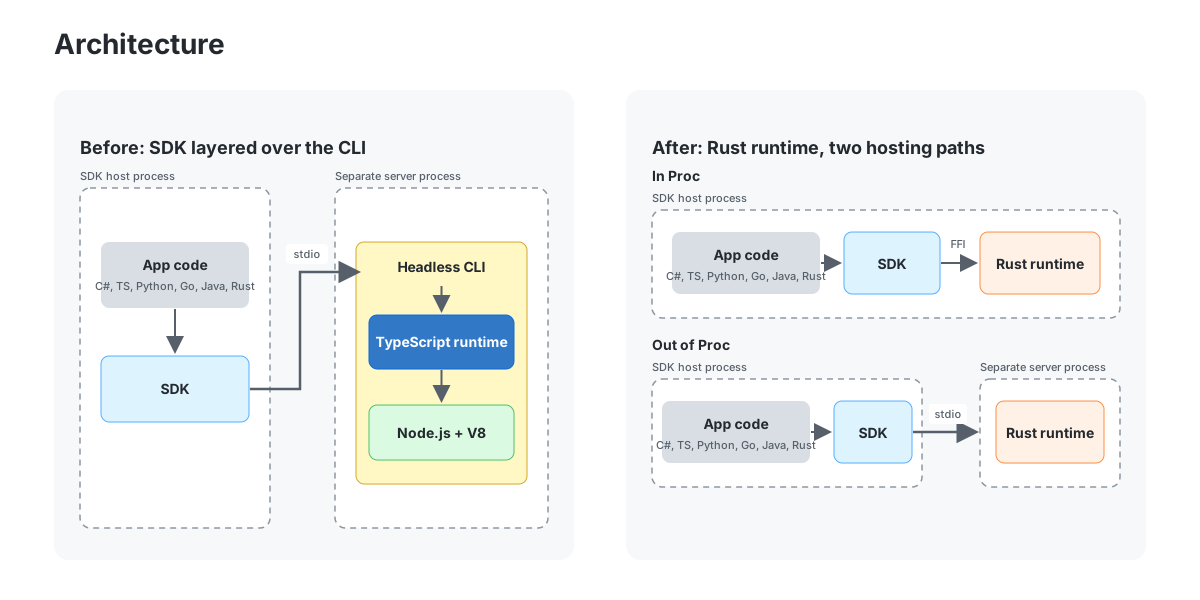
Before the era of autonomous agents, a rewrite of this magnitude was an economic impossibility. The sheer volume of code required to port the GitHub Copilot runtime—roughly 800,000 lines of production-grade Rust—represented a logistical hurdle that would have demanded years of dedicated manual labor. We stood at a crossroads where the only viable path forward was not a slower, more careful migration, but a recursive one: using the very tool we were building to build itself. This wasn't just a technical exercise; it was a fundamental test of whether an AI agent could navigate the chaotic, context-heavy landscape of a massive codebase without losing its way.
The decision to switch from the previous language to Rust was driven by hard engineering constraints rather than philosophical purity. We needed memory safety guarantees that were critical for the runtime's reliability and performance characteristics under heavy load. However, translating the intent of millions of lines of logic while simultaneously ensuring that the AI understood the nuance of every function signature and architectural pattern required a level of contextual awareness that standard translation tools simply couldn't provide. It demanded an approach where the agent could reason about the code as a living system, not just a static collection of files.
The process was less like writing code and more like conducting an orchestra of competing priorities. The agent had to synthesize hundreds of thousands of commits, understand the evolution of the codebase over years, and generate replacements that maintained backward compatibility while adhering to Rust's strict borrowing rules. There were moments where the generated code was syntactically perfect but semantically wrong, requiring human intervention to guide the model back on track. This back-and-forth created a unique workflow where the developer and the AI were co-architects, iterating on the structure of the runtime in real time.
What makes this migration significant is that it validates a new paradigm for software engineering. We are no longer bound by the linear velocity of human typing; the rate of production has shifted from a human-limited pace to a tool-augmented scale that was previously unimaginable. The success of this port demonstrates that with the right prompts and guardrails, agents can handle the complexity of enterprise-scale systems, turning what was once a multi-year debt into a manageable, albeit intense, sprint.
Looking ahead, this rewrite sets a precedent for how we will tackle future infrastructure challenges. The Rust version of the Copilot runtime is leaner, safer, and faster, but the real victory lies in the methodology. By proving that we can use an AI agent to refactor itself, we have opened the door to a future where software evolution is accelerated by orders of magnitude, allowing us to focus less on the mechanics of maintenance and more on the creativity of innovation.
On Bluesky? Meet HomeSky.
Follower analytics, a growth toolkit, scheduling and AI posting — built for Bluesky. Connect your account and use everything free for 60 days.
Try HomeSky free →