Migrating the GitHub Copilot runtime to Rust, using Copilot
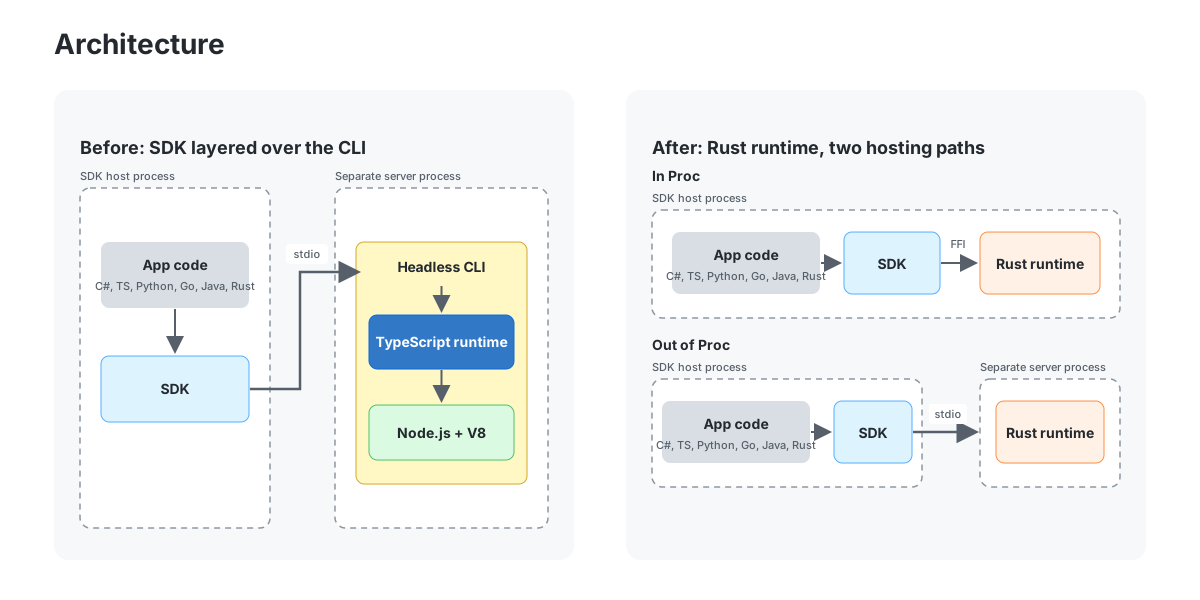
For years, the idea of rewriting a massive, critical piece of infrastructure in Rust felt like a fantasy reserved for startups with infinite runway. The GitHub Copilot agent runtime, at 800,000 lines of production code, was a beast that had long been fed the familiar, comfortable diet of Python. But the cost of that comfort was becoming too high; performance bottlenecks and memory overhead were starting to bleed into the user experience. Before the advent of AI agents, this specific rewrite was simply not affordable. The manual effort required to translate millions of lines of logic, fix edge cases, and maintain parity would have consumed a team's entire budget for years, yielding little more than a theoretical speedup.
Then came the shift in leverage. By deploying Copilot itself to write the port, the equation changed completely. We stopped trying to manually map every function signature and started letting the language model handle the heavy lifting of translation, boilerplate generation, and even debugging the resulting Rust code as we went. It wasn't magic; it was a massive feedback loop where the AI generated code, we reviewed it, corrected it, and fed the corrections back into the context window. This allowed us to tackle a problem that was previously considered a logistical nightmare, turning a multi-year strategic project into something achievable within a realistic timeframe.
The technical challenges were far from trivial. Rust is unforgiving, and the strict type system demands a precision that many Python developers instinctively shy away from. The AI struggled initially with complex ownership lifetimes and the nuances of async runtime behavior in our specific environment. However, by using Copilot to generate unit tests alongside the implementation, we created a safety net that caught regressions before they could propagate. The model learned our internal patterns and API constraints faster than a human could have, effectively acting as a senior engineer on call 24/7, capable of refactoring a messy module into idiomatic Rust in seconds.
What makes this migration unique is the meta-nature of the exercise. We used the very tool we were optimizing to optimize itself. It's a recursive loop that highlights the potential of developer agents not just as assistants for small tasks, but as partners in architectural transformation. The result isn't just faster compilation times or lower memory footprints; it's a system that is more robust by design. Rust's panic safety and borrow checker eliminated entire classes of runtime errors that had plagued the Python version for years, resulting in a platform that is significantly more stable for the millions of developers relying on it.
Looking back, the lesson is clear: the barrier to entry for massive infrastructure rewrites is no longer just technical debt or budget. It is the willingness to trust new paradigms of development. By leveraging agents, we have democratized the ability to undertake enterprise-grade refactoring, making it possible for organizations to modernize their stack without burning out their engineering teams. The 800,000 lines of Rust now running the Copilot agent runtime stand as proof that when tools evolve to meet human intent, the impossible becomes a standard Tuesday.
On Bluesky? Meet HomeSky.
Follower analytics, a growth toolkit, scheduling and AI posting — built for Bluesky. Connect your account and use everything free for 60 days.
Try HomeSky free →