Migrating the GitHub Copilot runtime to Rust, using Copilot
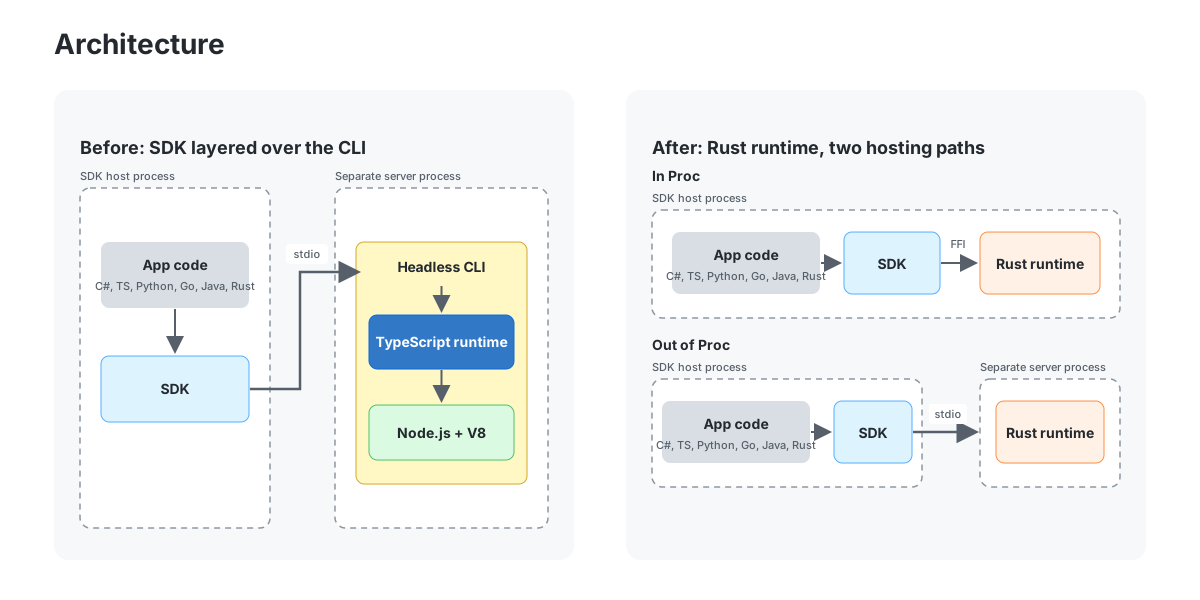
Before the concept of autonomous agents even entered our collective technical consciousness, a rewrite of this magnitude was a logistical impossibility for a single engineering team. Porting the GitHub Copilot runtime, a beast composed of roughly 800,000 lines of production-grade code, to Rust was not merely a task of translation; it was a fundamental reconstruction of how we think about safety, performance, and maintainability in large-scale systems. The sheer volume of code acted as an insurmountable wall, one that previous methodologies simply could not breach without years of incremental refactoring and a level of risk we were unwilling to take.
The decision to attempt this migration was driven by a specific, painful reality: the existing runtime, while functional, carried the heavy baggage of its original implementation language. We needed the memory safety guarantees and concurrency models that Rust offers, but we couldn't afford the traditional path of line-by-line rewriting. In the world of legacy system modernization, the old way involved hiring armies of engineers and accepting a timeline measured in years, a luxury that simply didn't exist for a product as critical as Copilot. We needed a lever, a mechanism to move a mountain without lifting a single stone ourselves.
Enter the very tool we were building: Copilot. It seems almost ironic, yet profoundly practical, to use an AI agent to build an AI runtime. By feeding the agent the existing codebase along with strict architectural constraints and type signatures, we created a feedback loop where the agent could generate new Rust implementations while simultaneously understanding the semantic intent of the original logic. This wasn't magic; it was a sophisticated orchestration of prompts, verification scripts, and human-in-the-loop reviews that allowed us to navigate the complexity of 800k lines with a precision that was previously unattainable.
The process was less about replacing the code and more about proving a new paradigm. We watched as the agent iterated through modules, converting complex state machines and asynchronous patterns into idiomatic Rust. The challenges were immense—handling borrow checker conflicts, ensuring zero-cost abstractions didn't introduce latency, and maintaining the specific behavior of edge cases that had survived years of production usage. Yet, the agent's ability to synthesize solutions for problems that had stumped human engineers for weeks was the catalyst that made the impossible affordable.
What emerged from this migration was more than just a faster, safer runtime; it was a validation that the future of software engineering involves a deep symbiosis between human oversight and machine capability. The resulting system runs leaner and faster, offering the same reliability users expect, but it also represents a significant shift in how we approach massive codebases. We have essentially created a new factory for software, where the blueprint is the existing system and the builder is an intelligent partner capable of scaling its own output.
Ultimately, porting the Copilot runtime to Rust was a bold experiment in leveraging our own tools to evolve them. It proved that when faced with a problem too big for traditional methods, the solution might just be to automate the struggle itself. As we move forward, this experience serves as a blueprint for countless other teams facing similar walls, showing that with the right approach, even the most daunting technical debt can be transformed into a foundation for the next generation of innovation.
On Bluesky? Meet HomeSky.
Follower analytics, a growth toolkit, scheduling and AI posting — built for Bluesky. Connect your account and use everything free for 60 days.
Try HomeSky free →