Migrating the GitHub Copilot runtime to Rust, using Copilot
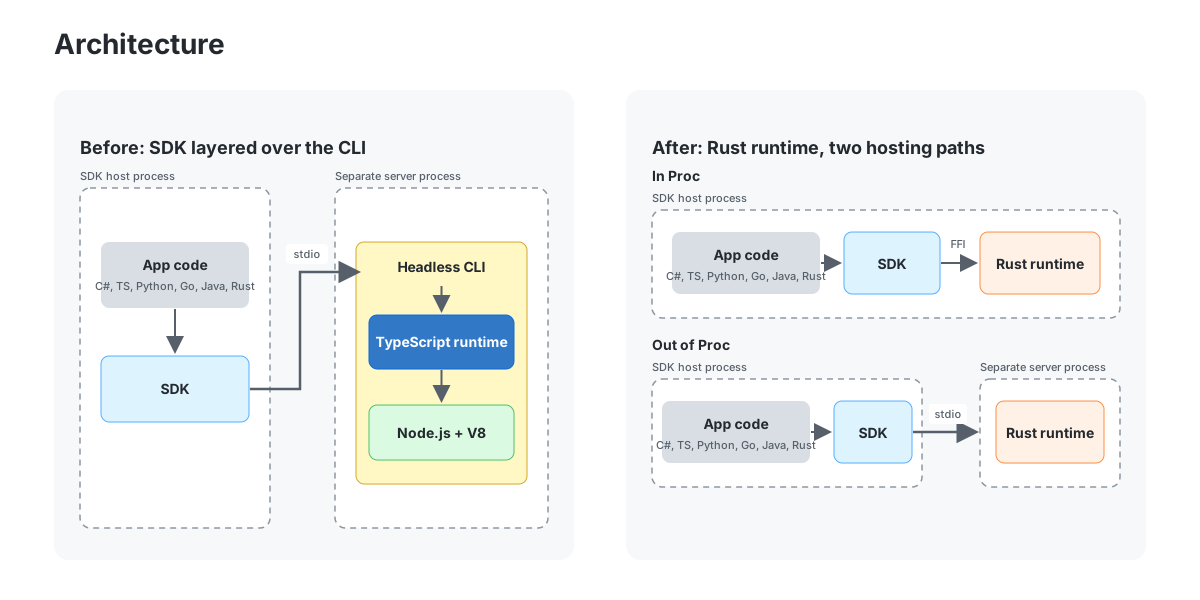
Porting the GitHub Copilot runtime to Rust wasn't just a technical refactor; it was a fundamental shift in how we approach large-scale agent infrastructure. For years, the complexity of managing an AI agent that needs to interact with codebases, understand context, and execute actions reliably has been a bottleneck that older paradigms couldn't easily solve. The sheer volume of legacy code, the fragility of dynamic typing, and the performance overhead of interpreted languages meant that scaling the runtime to production standards felt like an impossible hill to climb. Before the advent of modern AI agents, the cost of such a rewrite was prohibitive, requiring years of manual labor and risking significant downtime.
The decision to tackle an 800,000-line production rewrite in Rust was born from a necessity for raw speed and safety, qualities that Rust brings to the forefront of systems programming. We needed a runtime that could handle the chaotic, non-deterministic nature of AI interactions without crashing or leaking memory, which is a common pitfall in high-throughput environments. Rust's ownership model provided the strict guarantees needed to ensure that the agent's internal state remained consistent even under heavy load, effectively turning a potential liability into a robust asset. This wasn't about chasing trends; it was about building a foundation sturdy enough to support the future of automated software development.
The irony, of course, is that we used Copilot itself to write the code that would replace Copilot. It was a meta-exercise in self-improvement, leveraging the very tool we were optimizing to perform the optimization. The process was not seamless; the AI would occasionally generate Rust that was syntactically correct but logically flawed, or it would miss specific architectural constraints that only humans understood. However, by treating the AI as a powerful yet fallible intern, we created a workflow where the tool did the heavy lifting on boilerplate and repetitive logic, while human engineers focused on the complex integration points and safety invariants.
The narrative of this migration is one of gradual evolution rather than a sudden leap. It involved breaking the monolithic runtime into smaller, testable units that could be iterated upon rapidly. Each module was rewritten, tested, and integrated, allowing us to catch regressions early and build confidence in the new system. The friction between the AI's suggestions and the rigorous demands of Rust's type system forced a level of precision in our logic that we hadn't achieved before. It was a lesson in how constraints can actually liberate creativity, pushing developers to find more elegant and efficient solutions than they would have settled for in a more permissive language.
Ultimately, the move to Rust has transformed the Copilot runtime from a fragile prototype into a production-grade engine capable of handling millions of interactions with minimal latency. The journey highlights a shifting paradigm in software engineering, where the boundary between human and machine collaboration is becoming increasingly blurred. By embracing the challenges of a difficult rewrite, we have not only improved our current capabilities but have also established a blueprint for how the next generation of AI-powered tools can be built: fast, safe, and scalable. The path forward is clear, and the foundation we've laid is solid.
On Bluesky? Meet HomeSky.
Follower analytics, a growth toolkit, scheduling and AI posting — built for Bluesky. Connect your account and use everything free for 60 days.
Try HomeSky free →