Migrating the GitHub Copilot runtime to Rust, using Copilot
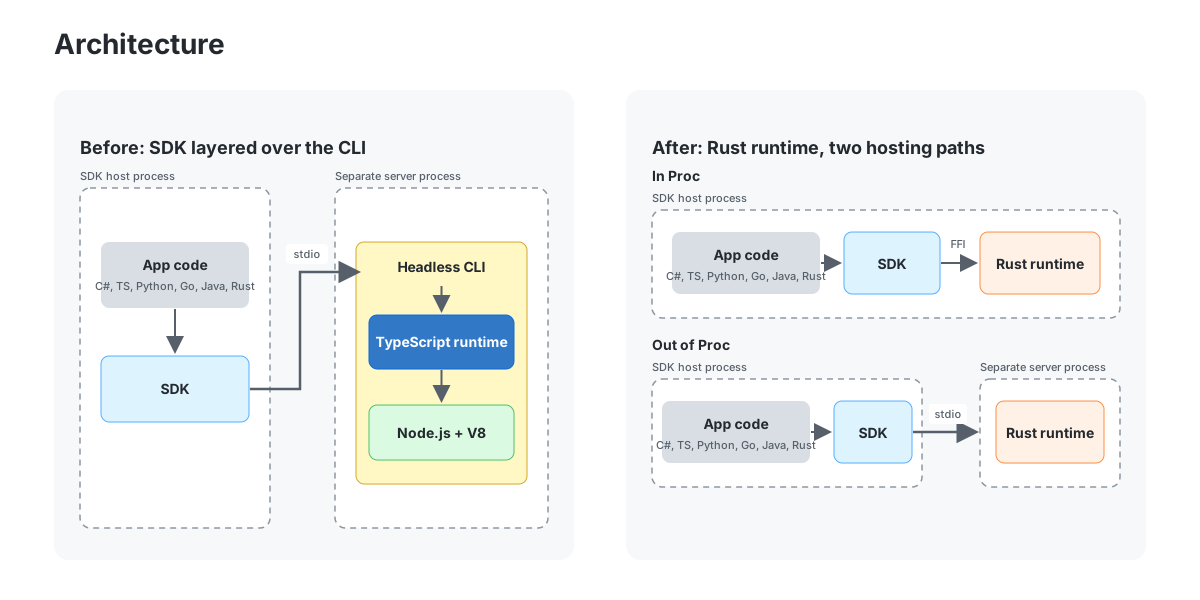
Before the era of autonomous agents, the concept of rewriting a critical piece of infrastructure in a new language was a logistical nightmare, a task that demanded months of human toil and carried a heavy risk of regression. The decision to migrate the GitHub Copilot runtime to Rust, a project spanning roughly 800,000 lines of production code, was not just a technical refactor but a strategic pivot that only became feasible because of the very tool being rewritten. It was a meta-moment in software history where the system used to write the code was also the engine driving the migration, effectively solving the chicken-and-egg problem that had plagued engineering teams for decades.
The sheer scale of the undertaking underscores just how much the paradigm has shifted. In the past, a project of this magnitude would have required a dedicated team of dozens of engineers, a timeline stretching over years, and a tolerance for errors that would be unacceptable in a high-stakes AI service. The Rust porting effort demonstrated that with the right cognitive augmentation, a single engineer or a small squad could achieve what previously required an entire division. The AI didn't just generate snippets; it understood the architectural constraints, the security implications of the new language, and the subtle nuances of the existing business logic, acting as a force multiplier that turned an impossible deadline into a manageable sprint.
What makes this migration particularly fascinating is the recursive nature of the development process. The team wasn't just using Copilot to write Rust; they were using Copilot to write the Rust that would make Copilot faster and more reliable. This created a feedback loop of improvement where the act of migration directly enhanced the product's core performance. By leveraging the language's memory safety guarantees and concurrency primitives, the runtime became more robust, reducing the latency that users experience when interacting with AI assistants. It proved that the infrastructure supporting an AI model can be as intelligent and adaptive as the model itself.
The technical hurdles were not merely about syntax translation but about preserving the soul of the application. Every function, every state machine, and every interaction pattern had to be scrutinized to ensure that the new implementation didn't just mimic the old one but improved upon it. The ability to ask the AI to explain why a specific Rust idiom was chosen or how a particular optimization worked added a layer of educational value to the codebase, fostering a culture where developers could learn from the generated code rather than blindly trusting it. This transparency turned the migration into a massive knowledge transfer initiative, elevating the skill set of the entire team.
Ultimately, the success of the GitHub Copilot runtime migration serves as a powerful testament to the maturity of modern development tools. It signals a future where large-scale software evolution is no longer bound by the linear limits of human cognition but accelerated by the exponential potential of collaborative intelligence. As we stand on the precipice of an era where agents can refactor entire codebases autonomously, this project stands as a landmark achievement, showing that the tools we build today are the very architects of the software of tomorrow.
On Bluesky? Meet HomeSky.
Follower analytics, a growth toolkit, scheduling and AI posting — built for Bluesky. Connect your account and use everything free for 60 days.
Try HomeSky free →