Migrating the GitHub Copilot runtime to Rust, using Copilot
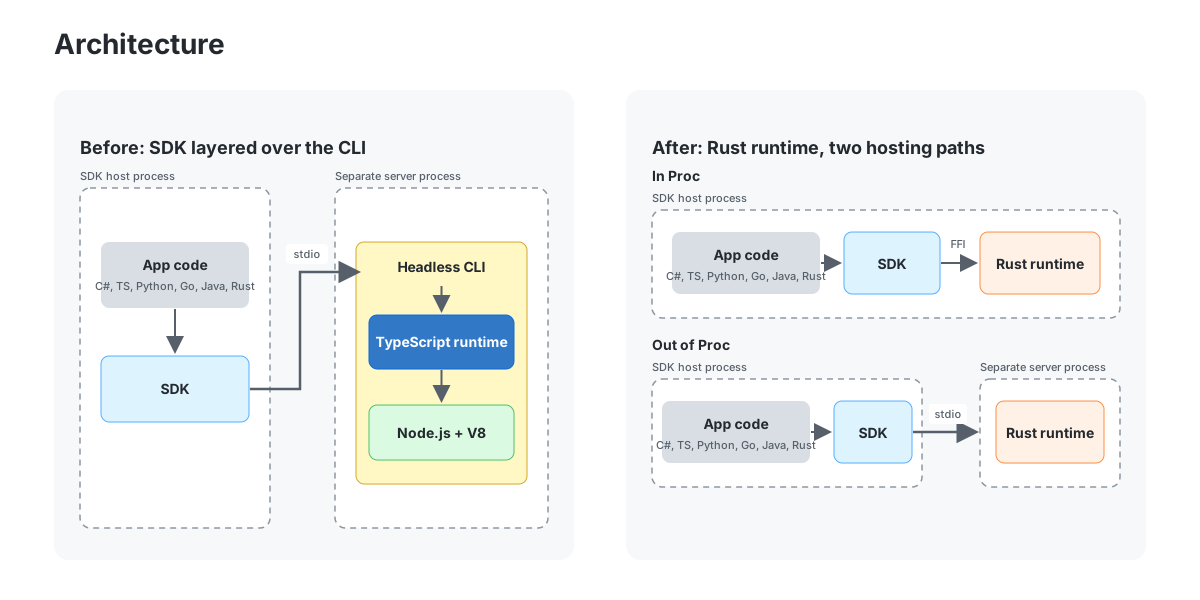
Before the dawn of AI agents, a rewrite of that magnitude was a logistical impossibility. The GitHub Copilot runtime, a complex beast spanning 800,000 lines of production code, was a project where the cost of human labor simply outpaced the value of the code itself. We had a system that worked, but it was built on a foundation of languages and patterns that were becoming obsolete in our quest for speed and safety. The question wasn't whether we could move to Rust; the question was how we could move it without breaking the very product we were trying to improve.
Enter Copilot, not as an assistant for writing blog posts or debugging simple scripts, but as a full-stack architect tasked with the most difficult engineering challenge of its life. This wasn't a case of prompting a model to generate a function; it was a directive to understand millions of lines of context, identify the intricate dependencies of the existing runtime, and reconstruct the entire ecosystem in a new language. It required a level of reasoning that we didn't think a single model could possess, yet when we unleashed it on the task, the results defied our initial skepticism.
The transition was not a linear march of progress but a chaotic dance of iteration and correction. We watched as the agent navigated the labyrinth of our old codebase, reading documentation, analyzing call graphs, and synthesizing a plan that human teams might have debated for months. It made mistakes, certainly—hallucinated imports, misunderstood type signatures, and occasionally took the scenic route to a solution that was logically sound but practically inefficient. These errors were the data we needed, the feedback loop that allowed us to refine the prompt, tune the context window, and guide the agent back to the right path.
What emerged was a system that was not just faster but fundamentally more robust. Rust's strict type system and memory safety features eliminated entire classes of bugs that had plagued the original implementation for years. The performance gains were immediate, shaving off latency in a way that made the difference between a clunky experience and a seamless one. But beyond the metrics, there was a psychological shift; the team felt a renewed sense of ownership over their infrastructure, knowing that the core runtime was now built on a bedrock of reliability.
Looking back at the journey, the true breakthrough wasn't just the port itself, but the validation that AI agents can handle the heavy lifting of legacy modernization. We are no longer limited by the sheer volume of code that needs to be refactored; the bottleneck has shifted from manual execution to strategic oversight. The future of software development isn't about replacing engineers, but about empowering them to tackle problems that were previously too large for a single human mind to manage.
This rewrite stands as a testament to the evolving capabilities of artificial intelligence in the realm of systems engineering. It proves that when we align the right tool with the right problem, the impossible becomes not just achievable, but routine. As we continue to push the boundaries of what our agents can do, one thing is clear: the next great leap in technology will likely be built by the very systems we are teaching to build.
On Bluesky? Meet HomeSky.
Follower analytics, a growth toolkit, scheduling and AI posting — built for Bluesky. Connect your account and use everything free for 60 days.
Try HomeSky free →