Migrating the GitHub Copilot runtime to Rust, using Copilot
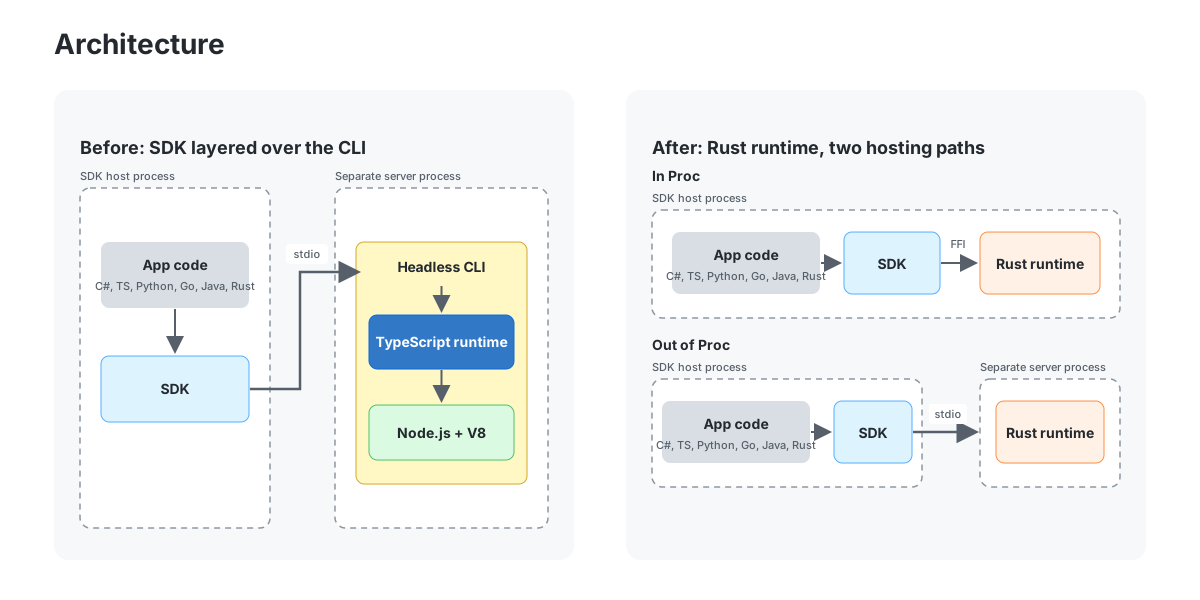
For years, the decision to rewrite a massive codebase in Rust felt like an impossible logistical nightmare, a project that would require an army of engineers and decades of iterative refinement. We looked at the sheer scale of the GitHub Copilot runtime—approximately 800,000 lines of production code—and assumed the cost of migration would be prohibitive. The traditional path involved months of manual refactoring, extensive testing cycles, and a risk of breaking functionality that simply wasn't acceptable for a service used by millions. But the landscape of software development has shifted dramatically with the arrival of AI agents, turning a task that once seemed unaffordable into a manageable, if complex, engineering challenge.
The core of the problem wasn't just translating syntax from one language to another; it was understanding the intent behind millions of lines of logic and ensuring that the new implementation preserved the exact behaviors of the original. In the old days, this would have meant painstakingly reviewing every function, writing thousands of test cases, and hoping for the best. Today, we leveraged Copilot itself to perform the heavy lifting, creating a feedback loop where the agent understood the existing Python codebase, generated the Rust equivalents, and then we verified the results. It was a meta-process of using the tool to build the tool, allowing us to tackle a rewrite of this magnitude with a fraction of the human effort previously required.
The technical hurdles were significant, ranging from idiomatic Rust patterns to the intricacies of the AI's underlying model. We had to ensure that the generated Rust code wasn't just syntactically correct but also followed the performance and safety standards that Rust is famous for. There were moments where the agent would produce code that looked right but failed to handle edge cases, requiring human intervention to guide the rewrite toward higher quality. This collaboration between human expertise and AI generation proved to be the key differentiator, allowing us to iterate rapidly and fix issues in real-time rather than waiting for a full sprint cycle.
Beyond the immediate efficiency gains, the migration highlighted a broader truth about the future of software engineering. The barrier to entry for large-scale refactoring is no longer just about having enough developers; it is about having the right tools to amplify human capability. By porting the Copilot runtime to Rust, we weren't just improving performance or memory safety; we were demonstrating that the paradigm of software evolution has changed. We can now tackle modernizations that were once considered too risky or too expensive, freeing up engineering teams to focus on innovation rather than legacy maintenance.
The success of this migration serves as a proof of concept for a new era of software development where AI agents act as force multipliers. It shows that the combination of rigorous engineering principles and advanced AI capabilities can overcome the inertia of massive codebases. As we continue to evolve the Copilot platform, the lessons learned from this rewrite will guide how we approach future challenges, ensuring that we remain agile, efficient, and capable of building the tools that power the global developer community.
On Bluesky? Meet HomeSky.
Follower analytics, a growth toolkit, scheduling and AI posting — built for Bluesky. Connect your account and use everything free for 60 days.
Try HomeSky free →