Migrating the GitHub Copilot runtime to Rust, using Copilot
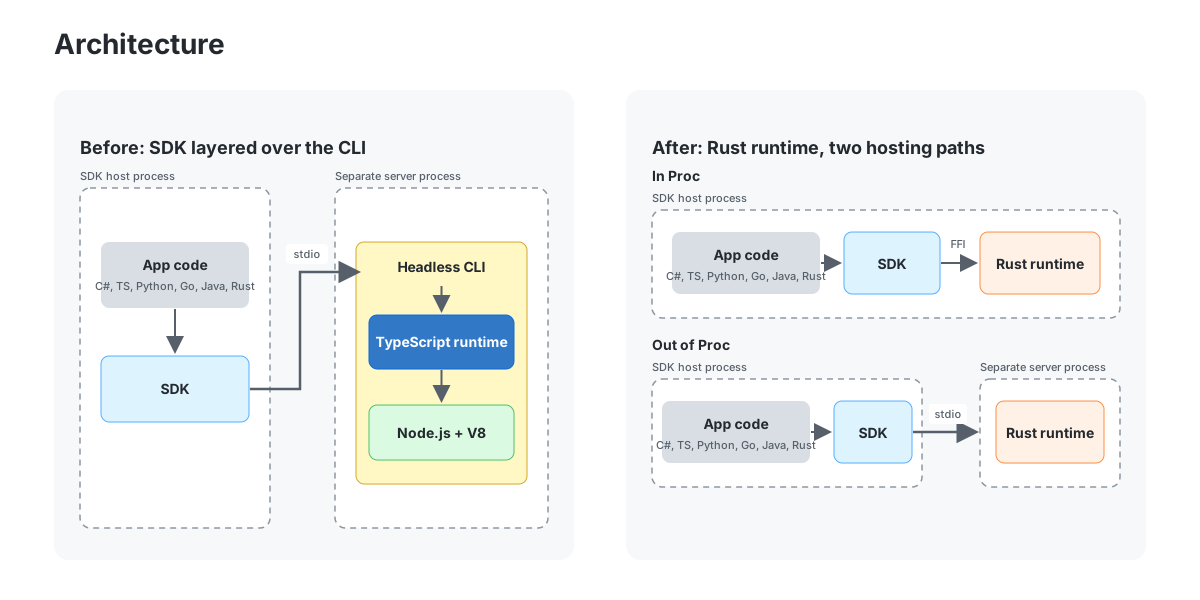
Before the rise of AI agents, migrating a codebase of this magnitude was a logistical nightmare that often dictated the trajectory of an entire engineering team. The GitHub Copilot runtime, which underpins one of the world's most popular AI coding assistants, is not merely a script or a simple microservice; it is a sprawling beast composed of roughly 800,000 lines of production-grade Rust. Porting this critical infrastructure from its previous stack to Rust was a monumental undertaking that would have been financially and operationally prohibitive just a few years ago. The sheer volume of code and the intricate dependencies meant that manual refactoring was not just difficult, but practically impossible within a reasonable timeframe or budget.
The decision to attempt this migration was driven by a singular, powerful realization: the very tools we use to build software could now be used to rebuild them. By leveraging the Copilot agent itself to analyze, refactor, and rewrite its own runtime, we turned the challenge into a self-correcting loop. This approach wasn't about replacing human engineers with machines; rather, it was about augmenting them with a force multiplier that could handle the repetitive, grueling drudgery of massive-scale code translation. It allowed a smaller, highly skilled team to tackle a task that would typically require hundreds of person-years of effort, fundamentally changing the economics of large-scale systems migration.
The narrative of this rewrite is not one of effortless automation, but of constant negotiation between the agent's suggestions and the developer's intent. Every line of code generated by the AI required a human review to ensure it maintained the specific performance constraints, safety guarantees, and architectural patterns that defined the Copilot experience. The Rust language, known for its steep learning curve and strict compilation rules, demanded precision that left little room for error. We found that the agent excelled at boilerplate generation and standard library integrations but struggled with nuanced business logic, forcing us to adopt a collaborative workflow where the machine handled the heavy lifting and the humans steered the ship.
What emerged from this process was more than just a rewrite; it was a profound validation of the potential for AI to drive engineering productivity. The resulting runtime is not only more performant and memory-efficient due to the nature of Rust, but it also serves as a living testament to what is possible when advanced agents are applied to their own source code. This migration has set a new precedent for the industry, demonstrating that the barrier to entry for undertaking massive infrastructure projects can be significantly lowered if we have the right intellectual partners at our side. It is a story of how we are moving from an era where we wrote our own tools to an era where we can ask our tools to write our tools for us.
Looking forward, this experience suggests that the future of software development lies in a symbiotic relationship between human intuition and machine scale. We are no longer limited by the linear scaling of human effort; instead, we are entering a phase where complex systems can be iterated upon with unprecedented speed and confidence. The journey of porting the Copilot runtime to Rust using Copilot is just the beginning of a broader shift in how we architect, build, and maintain the digital foundations of our world. It is a humbling reminder that while we may not have invented the silicon chips that power our civilization, we now have the ability to reshape them at a pace that feels almost magical.
On Bluesky? Meet HomeSky.
Follower analytics, a growth toolkit, scheduling and AI posting — built for Bluesky. Connect your account and use everything free for 60 days.
Try HomeSky free →