Migrating the GitHub Copilot runtime to Rust, using Copilot
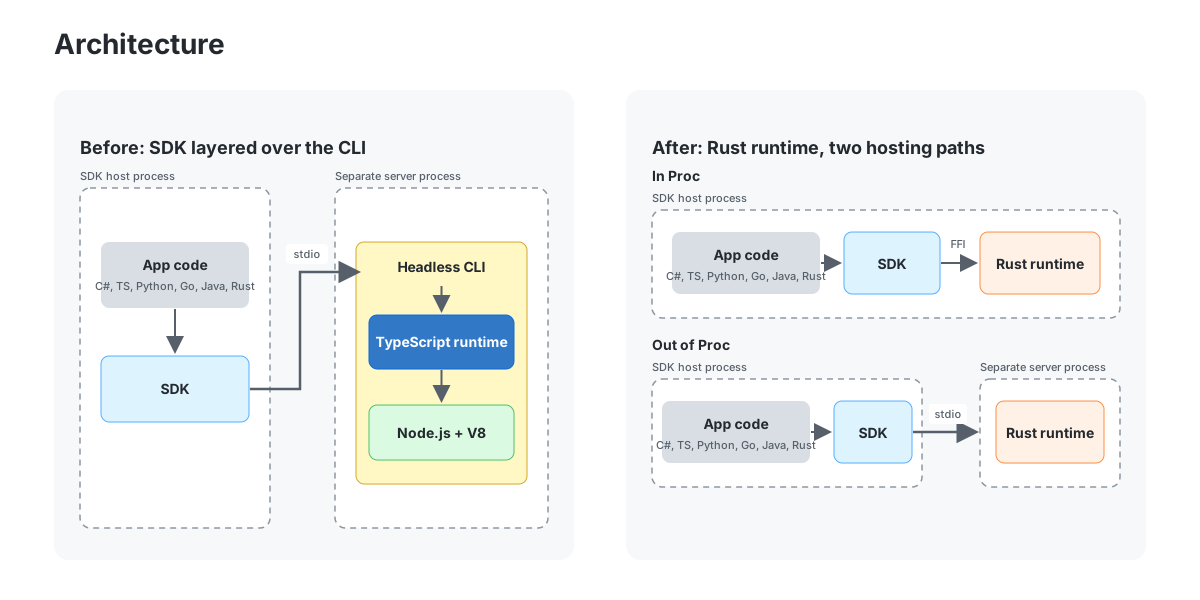
For years, the sheer scale of porting the GitHub Copilot runtime from JavaScript to Rust felt like an impossible mountain to climb. The gap between the two ecosystems was so wide, and the complexity of the existing 800,000 lines of production code so daunting, that a rewrite was simply not affordable. It required a team of senior engineers, months of dedicated sprints, and a willingness to risk the stability of one of our most critical services. But today, that calculation has changed entirely because we are finally leveraging the very product we are trying to build.
The shift represents a fundamental change in how we approach massive system rewrites. Previously, you would hire a team of architects, map out the dependency graph, and spend weeks on preliminary research before writing a single line of new code. With Copilot, the workflow has inverted. We are now able to use the agent itself to generate the initial scaffolding, translate logic patterns, and even write the complex unit tests required to verify the new Rust implementation. This isn't just about speed; it's about cognitive offloading, allowing our human engineers to focus on the high-level architecture and the edge cases that AI inevitably misses.
However, this transition is not a magic wand that erases all complexity. Porting the runtime has revealed deep architectural nuances that a simple translation cannot solve. We encountered issues where the semantic understanding of the JavaScript runtime differed subtly from the strict type safety of Rust, forcing us to refactor internal abstractions in ways we hadn't anticipated. The AI helps generate the code, but it requires a human in the loop to validate that the generated logic actually fits the broader system context, ensuring that the "copy-paste" nature of the interaction evolves into a true co-pilot relationship.
The real breakthrough lies in the feedback loop we have established. As the Rust codebase grows, we feed the agent's outputs back into its own training data, effectively teaching Copilot the specific idioms and patterns of our proprietary infrastructure. This creates a self-reinforcing cycle where the agent becomes increasingly specialized in our codebase, making subsequent iterations faster and more accurate. It transforms the rewriting process from a linear, painful grind into an iterative dialogue where the machine and the developer refine each other's work.
Ultimately, this migration proves that the future of large-scale software maintenance isn't about doing more work with fewer people; it's about changing the nature of the work itself. By using Copilot to build Copilot, we have validated a new paradigm for engineering at scale. We have turned a prohibitive cost center into a manageable, albeit complex, engineering challenge. The 800,000 lines of Rust are no longer a barrier to entry but a testament to a new way of collaborating with intelligent tools to push the boundaries of what is possible in production software.
On Bluesky? Meet HomeSky.
Follower analytics, a growth toolkit, scheduling and AI posting — built for Bluesky. Connect your account and use everything free for 60 days.
Try HomeSky free →