Migrating the GitHub Copilot runtime to Rust, using Copilot
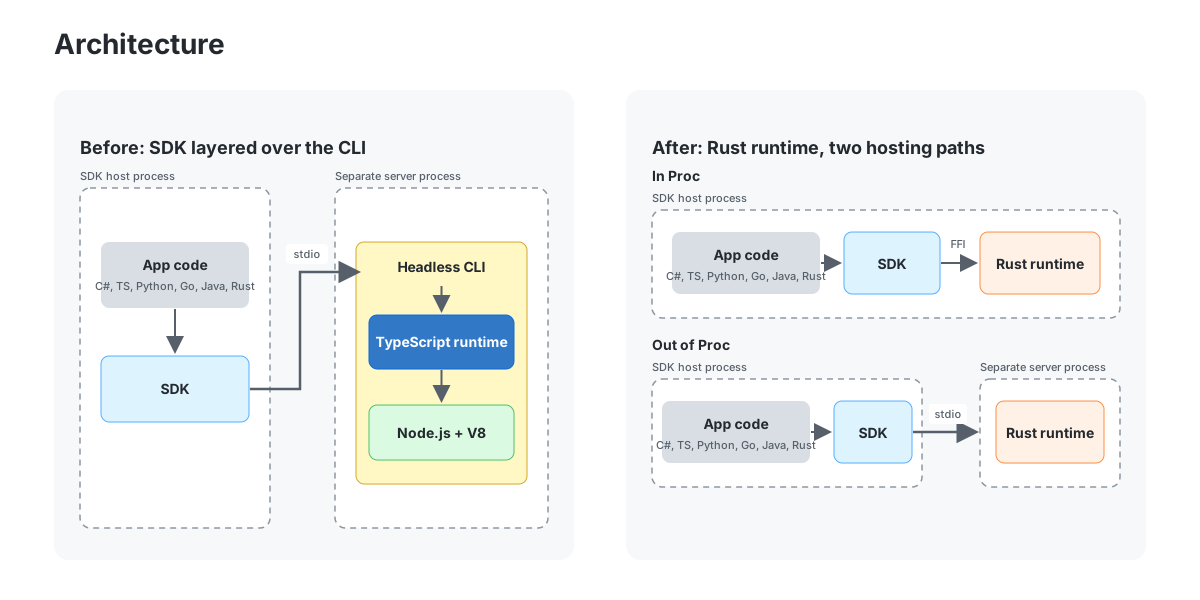
For years, the idea of rewriting a massive, mission-critical system in a new language felt like a logistical impossibility. Before the rise of autonomous agents, a project of this magnitude required armies of engineers, years of planning, and an army of specialized tooling that often introduced more bugs than it fixed. The GitHub Copilot runtime, a complex beast comprising over 800,000 lines of code, was no different. It was a fortress of legacy architecture, tightly coupled and deeply entrenched. Yet, the decision to migrate this entire ecosystem to Rust was not just about performance or memory safety; it was a necessary evolution to ensure the tool could keep up with the demands of modern software development without burning through resources or slowing down the very developers it was meant to assist.
The irony of the undertaking was palpable: we were asked to build the new runtime using the very tool we were replacing. In a meta-loop of unprecedented scale, the Copilot agent was tasked with generating the Rust code that would power the Copilot runtime. It was a test of trust, a high-stakes game of chicken where the safety net was also the player. Early attempts revealed the friction between the abstract, intent-based nature of AI generation and the concrete, type-safe rigor required by Rust. The compiler would scream in the face of generated code, rejecting 90% of the initial output as unsafe or logically flawed. It was a stark reminder that while agents excel at pattern matching and syntactic construction, they still struggle with the deep, contextual understanding of a codebase's internal logic.
The solution did not lie in trying to force the AI to write perfect code on the first pass, but rather in building a sophisticated feedback loop. We developed a hybrid workflow where the agent would propose changes, and then a series of automated validation steps would rigorously test those proposals against the existing architecture. This process turned the migration into a dialogue. The agent would suggest a refactor, the validation suite would flag a memory safety issue or a performance bottleneck, and the agent would iterate. Over thousands of hours of iteration, the AI learned the specific constraints and architectural patterns of the Copilot runtime. It wasn't just writing code; it was learning how to think like a Rust developer, understanding borrow checker rules and ownership semantics as naturally as it understands Python or JavaScript.
The results of this endeavor have been transformative. The new Rust implementation is significantly faster, consuming fewer resources, and offering a level of stability that was previously unattainable. More importantly, the migration proved that AI agents can handle large-scale, high-stakes refactoring when guided correctly. It shattered the old paradigm that said such a rewrite was simply too expensive or risky to attempt. By leveraging Copilot to migrate Copilot, we demonstrated a new model for software engineering where human intent guides the architecture, but machines execute the heavy lifting of translation and validation at a scale no human team could have managed alone.
This journey highlights a broader truth about the future of software development. We are standing at a precipice where the boundary between coding and specifying behavior is blurring. The success of this migration suggests that the next wave of industry transformation won't come from humans writing more code, but from humans defining better problems for agents to solve. The 800,000 lines of Rust are just the beginning; they represent a proof of concept that intelligent agents can be trusted with the most critical parts of our digital infrastructure, provided we build the right frameworks for collaboration. The future of the runtime is bright, but it is also built on the foundation of lessons learned from a difficult, automated struggle that redefined what is possible in software engineering.
On Bluesky? Meet HomeSky.
Follower analytics, a growth toolkit, scheduling and AI posting — built for Bluesky. Connect your account and use everything free for 60 days.
Try HomeSky free →