Migrating the GitHub Copilot runtime to Rust, using Copilot
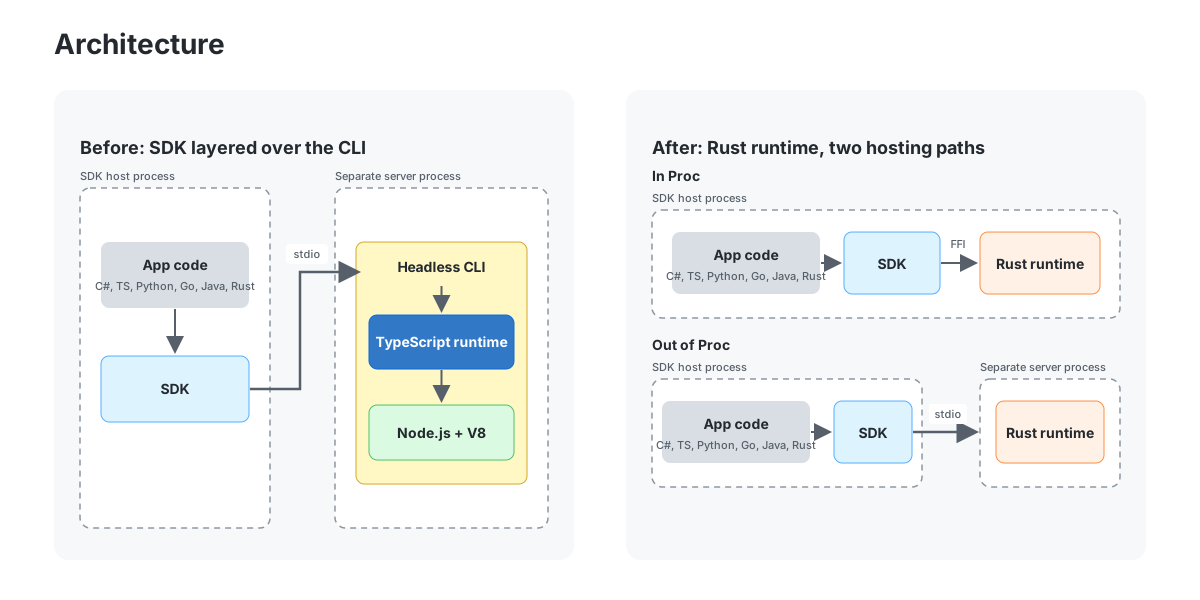
A rewrite of this magnitude was never economically viable until the arrival of intelligent agents. For years, the decision to port the GitHub Copilot runtime to Rust was blocked by the sheer volume of cognitive labor required; moving 800,000 lines of production code across languages is a monumental task that typically demands armies of engineers and years of dedicated effort. But when you introduce an agent capable of understanding context, reading documentation, and executing code with near-human precision, the equation changes entirely. What once seemed like a project of impossible scope suddenly becomes a manageable, if complex, journey of translation and verification.
The architecture of the Copilot runtime is built on the premise of reliability, which is why Rust was the only viable target language for the migration. In the world of high-performance code generation, memory safety and concurrency correctness are not just nice-to-have features; they are the bedrock of user trust. By rewriting the logic in Rust, we are ensuring that the suggestions Copilot makes are grounded in a system that guarantees no null pointer dereferences and no data races. This wasn't just a change of syntax; it was a fundamental shift in how the agent interacts with the underlying infrastructure, turning a legacy system into a fortress of safety.
The process of getting there was far more iterative than a simple find-and-replace operation would suggest. It involved a dance between human oversight and machine execution, where the agent would draft a chunk of code, the human would review the intent, and then the machine would refine the implementation against real-world constraints. There were moments where the agent confidently hallucinated a standard library function that didn't exist, or optimized a path that the compiler later rejected as unsound. These failures were not setbacks but rather the necessary friction that taught the system how to think like a seasoned engineer rather than a literal translator.
Ultimately, this migration proves that the future of large-scale software development lies in the symbiosis of human direction and automated execution. We are standing on the precipice of a new era where the most arduous parts of software engineering—the boilerplate, the legacy refactoring, the safety-critical rewrites—are delegated to tools that can reason about the code they are writing. The result is a system that is not only faster and safer but also a testament to what happens when we stop fighting our own tools and start leveraging them to build the things we couldn't have built alone.
On Bluesky? Meet HomeSky.
Follower analytics, a growth toolkit, scheduling and AI posting — built for Bluesky. Connect your account and use everything free for 60 days.
Try HomeSky free →