Migrating the GitHub Copilot runtime to Rust, using Copilot
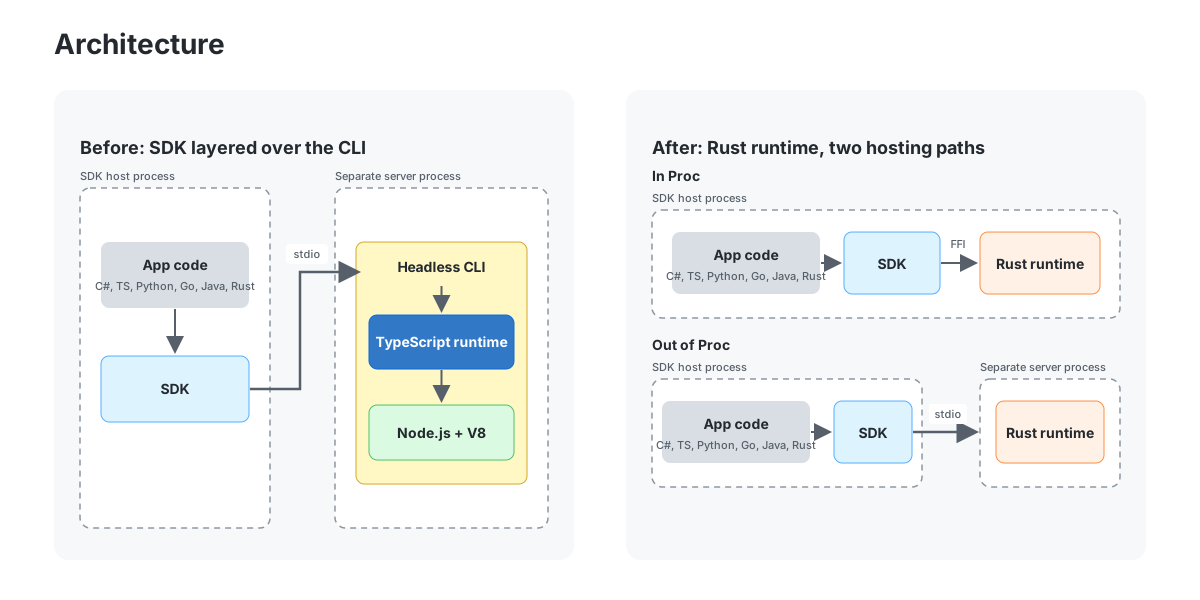
For years, the idea of rewriting a massive, production-grade AI runtime in Rust seemed like a fantasy reserved for sci-fi novels, not a Tuesday morning agenda item. The GitHub Copilot agent runtime, at the time, was a sprawling beast of over 800,000 lines of code, built on a legacy stack that had served us faithfully but was no longer agile enough for the demands of modern machine learning. Moving such a monolithic system to Rust wasn't just a technical exercise in refactoring; it was a fundamental shift in how we thought about performance, safety, and the very architecture of intelligent assistance. Before the arrival of sophisticated AI agents capable of autonomous problem-solving, a rewrite of this magnitude would have been economically unfeasible and practically suicidal.
The catalyst for this migration was a simple yet profound realization: the tools we used to build the runtime were becoming the bottlenecks that limited the intelligence of the runtime itself. As Copilot evolved from a simple code completion suggestion engine into a complex agent capable of orchestrating multi-step coding tasks, the latency and memory overhead of the old stack began to erode the user experience. We needed a foundation that could handle the stochastic nature of AI inference without the heavy baggage of dynamic typing and garbage collection pauses. This is where the irony deepens—we didn't just use an agent to write the code; we used Copilot itself to guide the migration, effectively using the very technology we were optimizing to improve the infrastructure of that technology.
Porting 800,000 lines of code is a logistical nightmare, a task that usually requires armies of engineers and months of downtime. However, the integration of Copilot into the development workflow transformed the process from a manual drudge into a collaborative evolution. The agent didn't just autocomplete; it understood context, suggested architectural patterns, and handled the tedious translation of idioms between the old and new languages. It was a feedback loop of unprecedented efficiency, where the AI analyzed the legacy code, proposed Rust equivalents, and allowed human engineers to review, refine, and approve the changes in real-time. This synergy turned a potential project that could have taken years into a focused sprint that delivered a robust, high-performance system.
The results speak for themselves in the metrics that matter most to developers and operations teams alike. The migration yielded a significant reduction in memory footprint and a dramatic improvement in cold start times, making the agent responsive enough to feel instantaneous even on slower hardware. But beyond the numbers, the shift to Rust introduced a layer of memory safety that is critical for a system running proprietary AI models and user data. The ability to catch null pointer dereferences and buffer overflows at compile time provides a reliability that simply wasn't possible with the previous stack, ensuring that the Copilot experience remains stable as the underlying models grow more complex.
Looking back, this migration stands as a testament to how the relationship between developers and their tools is evolving. We are no longer just writing code to build software; we are writing code to build the very agents that will write our future. The success of porting the Copilot runtime to Rust validates the hypothesis that AI agents can serve as the ultimate force multiplier for large-scale engineering challenges. It proves that with the right combination of human oversight and artificial intelligence, we can tackle problems that were previously deemed too complex or too expensive to attempt. The path forward is clearer, faster, and safer than ever before.
On Bluesky? Meet HomeSky.
Follower analytics, a growth toolkit, scheduling and AI posting — built for Bluesky. Connect your account and use everything free for 60 days.
Try HomeSky free →