Migrating the GitHub Copilot runtime to Rust, using Copilot
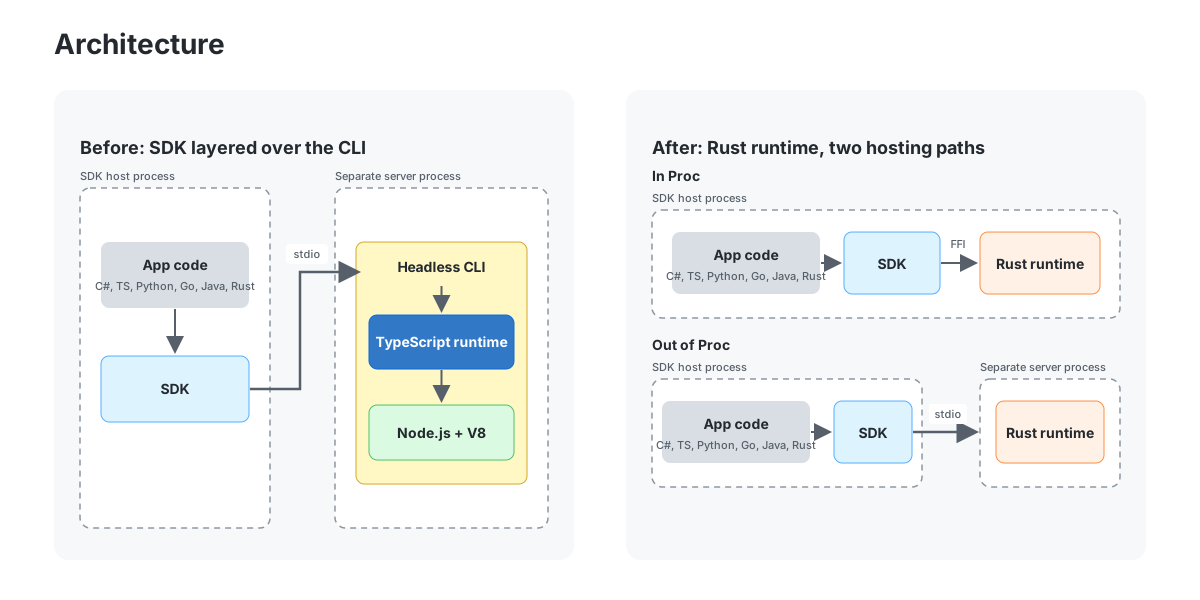
Before the era of autonomous agents, the idea of rewriting a massive, complex codebase with the assistance of an AI tool was a fantasy reserved for science fiction. Today, that fantasy became the foundation of a real-world engineering reality: we ported the GitHub Copilot runtime, a system spanning approximately 800,000 lines of production-grade Rust, using Copilot itself. This was not a theoretical exercise or a proof-of-concept on a toy project; it was a mission-critical migration that demanded absolute reliability, memory safety, and performance characteristics that only a systems language like Rust could provide.
The sheer scale of the challenge initially made the undertaking seem impossible. Porting millions of lines of code is typically a multi-year endeavor requiring armies of senior engineers, yet we found that with the right orchestration, the timeline compressed into something manageable. The core philosophy was simple but radical: we would not write the code by hand. Instead, we would guide an AI agent through the migration, treating the tool as a senior engineer who needs clear context, constraints, and feedback loops. This approach flipped the traditional hierarchy, where the developer dictates every line, and replaced it with a collaborative model where the developer acts as the architect and the agent as the builder.
However, trusting an autonomous agent with such a massive codebase introduced a new set of risks that traditional unit testing could not fully mitigate. A single hallucinated function or a misunderstood context window could introduce subtle bugs that would ripple through the entire system, potentially destabilizing the very product we were trying to improve. We had to design a rigorous scaffolding of verification steps, where the AI generated code, but a deterministic set of linters, type checkers, and integration tests validated every single change before it was merged. It was a dance of high-speed generation against slow, deliberate verification, ensuring that the speed of innovation did not outpace the speed of safety.
The transition to Rust was not merely a change of syntax; it was a fundamental shift in how we thought about concurrency, memory management, and system stability. The original runtime relied on dynamic typing and garbage collection, which, while developer-friendly, introduced latency and unpredictable pauses. By migrating to Rust, we gained fine-grained control over the memory layout and the ability to write truly concurrent code without the fear of race conditions or crashes. The AI agent had to learn the idioms of Rust, the ownership model, and the borrow checker, effectively teaching itself the language from scratch while simultaneously building the compiler tooling that powers millions of developers.
Looking back, this project serves as a case study for the future of software development. It demonstrates that the bottleneck is no longer the ability to write code, but the ability to verify it. As we push the boundaries of what AI can generate, our role as developers evolves from being the primary authors of logic to becoming the curators of correctness. The 800,000 lines of Rust that now power the Copilot runtime stand as a testament to what is possible when human intent is amplified by artificial intelligence, turning an unaffordable dream into a production-grade reality.
On Bluesky? Meet HomeSky.
Follower analytics, a growth toolkit, scheduling and AI posting — built for Bluesky. Connect your account and use everything free for 60 days.
Try HomeSky free →