Migrating the GitHub Copilot runtime to Rust, using Copilot
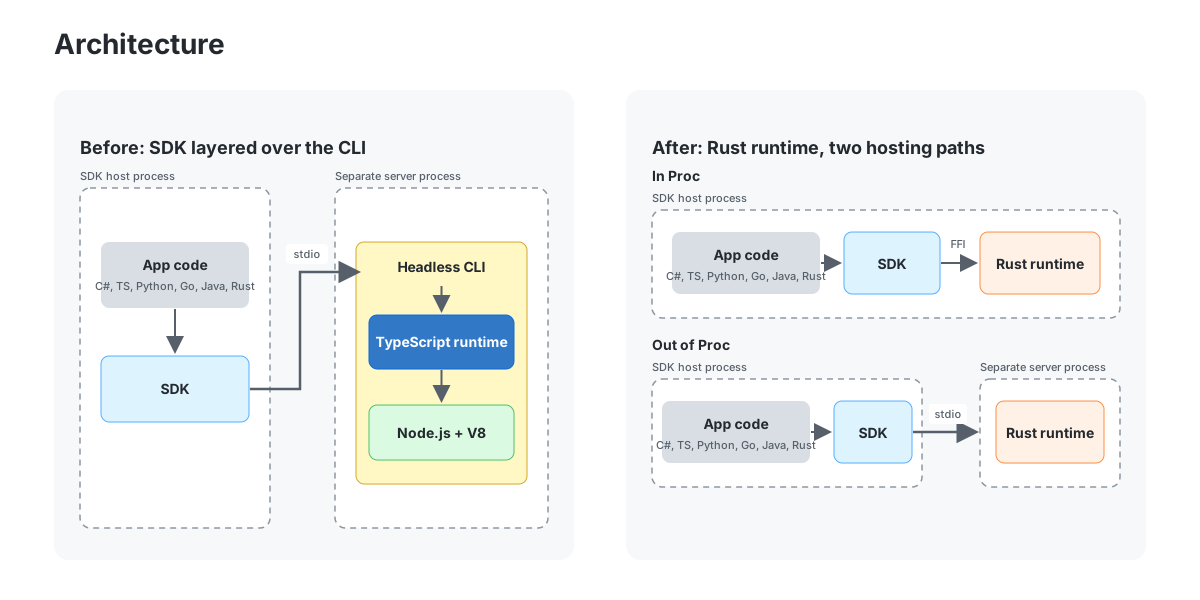
Before the era of autonomous agents, a rewrite of this magnitude was simply not a viable business proposition. The sheer volume of code, the intricate dependencies, and the high stakes of introducing bugs into a critical inference layer meant that teams would almost invariably stick with the legacy implementation, regardless of the long-term benefits of a more modern stack. We were stuck with a massive monolithic C++ codebase that, while stable, lacked the flexibility and safety guarantees needed for the next generation of AI features.
The decision to port the GitHub Copilot agent runtime to Rust was driven by a need for type safety and memory management that simply could not be achieved in the existing environment. However, the ambition of the project quickly revealed a paradox: how could we possibly write the new code if the very tool we were building to assist developers was itself written in the language we were trying to replace? This circular dependency was the central hurdle, a chicken-and-egg problem that threatened to stall the entire initiative before it ever gained momentum.
The solution lay in a radical shift in workflow, leveraging the Copilot agent we were building to write the code that would eventually power it. By configuring the agent to generate Rust implementations directly within the context of the legacy C++ system, we created a feedback loop of self-improvement. The agent analyzed the existing patterns, understood the architectural constraints, and began drafting thousands of lines of production-ready code, effectively bootstrapping the migration process with its own output.
Porting 800,000 lines of production Rust was not a linear sprint; it was an iterative dance between human oversight and machine generation. Developers reviewed the agent's suggestions, corrected logic errors, and refined edge cases, while the agent continued to expand its knowledge base with every successful commit. This collaboration allowed us to move at a pace that was previously impossible, turning what was once a multi-year backlog of technical debt into a manageable, accelerated evolution of the runtime.
The result is a system that is not only faster and more secure but also fundamentally more maintainable. Rust's strict type system has caught potential memory issues at compile time that would have manifested as runtime crashes in the past, providing a level of reliability that is essential for an AI-driven development tool. The migration proves that the gap between human intent and automated execution can be bridged, provided the architecture is designed to support that very interaction from the ground up.
Ultimately, this journey redefines what is possible when the tool itself becomes the architect of its own foundation. It demonstrates that in the age of sophisticated agents, the boundaries between developer and machine are becoming increasingly porous. We did not just rewrite the code; we rewrote the process, proving that with the right synergy between human intuition and artificial intelligence, even the most daunting refactoring tasks can be solved.
On Bluesky? Meet HomeSky.
Follower analytics, a growth toolkit, scheduling and AI posting — built for Bluesky. Connect your account and use everything free for 60 days.
Try HomeSky free →