Migrating the GitHub Copilot runtime to Rust, using Copilot
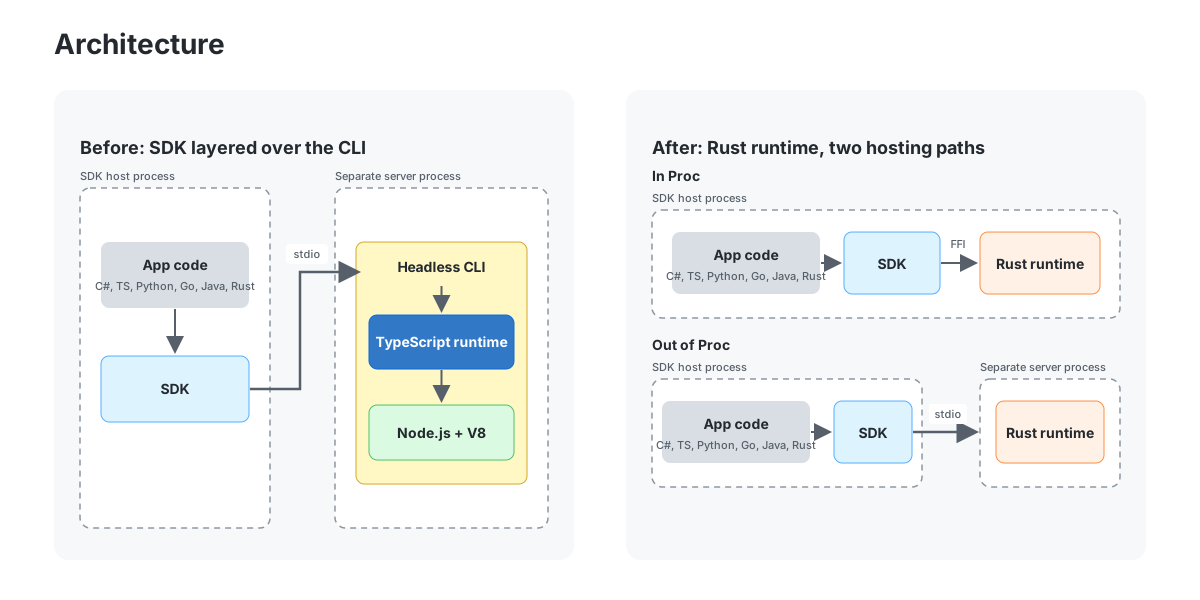
For years, the idea of rewriting a massive, production-grade system like the GitHub Copilot runtime in a new language was dismissed as a fool's errand. The sheer scale of the existing codebase, built over a decade in Python and JavaScript, seemed like an immovable mountain. Yet, the emergence of AI agents has fundamentally shifted the economic equation of software engineering, turning what was once an unaffordable undertaking into a manageable, even necessary, project. Before agents, the cost of migrating hundreds of thousands of lines of code outweighed the benefits; today, the cost of inaction—the technical debt, the security risks, and the performance bottlenecks—outweighs the cost of the move itself.
The decision to port the Copilot runtime to Rust was not merely a quest for performance or memory efficiency, though those are undeniable benefits. The primary driver was a deep-seated need for reliability in an environment where hallucinations in the underlying model must be contained within a robust, type-safe boundary. Python's dynamic nature, while flexible for prototyping, introduced friction when interacting with low-level systems and high-frequency inference loops. By rewriting the agent logic in Rust, the team gained a fortress of type safety that ensures the runtime behaves predictably, even when the AI suggestions it consumes are inherently unpredictable.
This migration was not a linear sprint but a chaotic dance between old and new, a process where the very tool being built—the Copilot agent—was used to construct itself. It is a meta-narrative that perfectly captures the current state of AI-driven development: using the power of artificial intelligence to automate the act of rewriting software with artificial intelligence. The team leveraged Copilot to generate the initial scaffolding, translate complex Python idioms into idiomatic Rust, and handle boilerplate that would have otherwise consumed weeks of human effort. It was a symbiotic relationship where the agent acted as both the architect and the laborer, iterating rapidly on its own output.
The result is a codebase of roughly 800,000 lines of production Rust, a testament to what is possible when humans and machines align on a shared goal. This isn't just a refactor; it is a reinvention of how large-scale agent systems are conceived and maintained. The Rust implementation has not only reduced the memory footprint and latency of the runtime but has also unlocked new architectural possibilities that were previously impossible in the interpreted environments of the past. The speed at which the team could iterate on the new code, thanks to the AI assistance, allowed them to focus on the hard problems of system design rather than the mundane drudgery of syntax conversion.
Ultimately, this story serves as a case study for an industry on the brink of transformation. It suggests that the era of manual, line-by-line porting is fading, replaced by an era where AI agents can manage the complexity of massive refactors. The journey from a legacy Python monolith to a high-performance Rust runtime demonstrates that the future of software engineering lies in collaboration, not replacement. As we move forward, the tools we build will likely be the architects of their own evolution, creating a cycle of continuous improvement that was once thought to be reserved only for the theoretical limits of computer science.
On Bluesky? Meet HomeSky.
Follower analytics, a growth toolkit, scheduling and AI posting — built for Bluesky. Connect your account and use everything free for 60 days.
Try HomeSky free →