Migrating the GitHub Copilot runtime to Rust, using Copilot
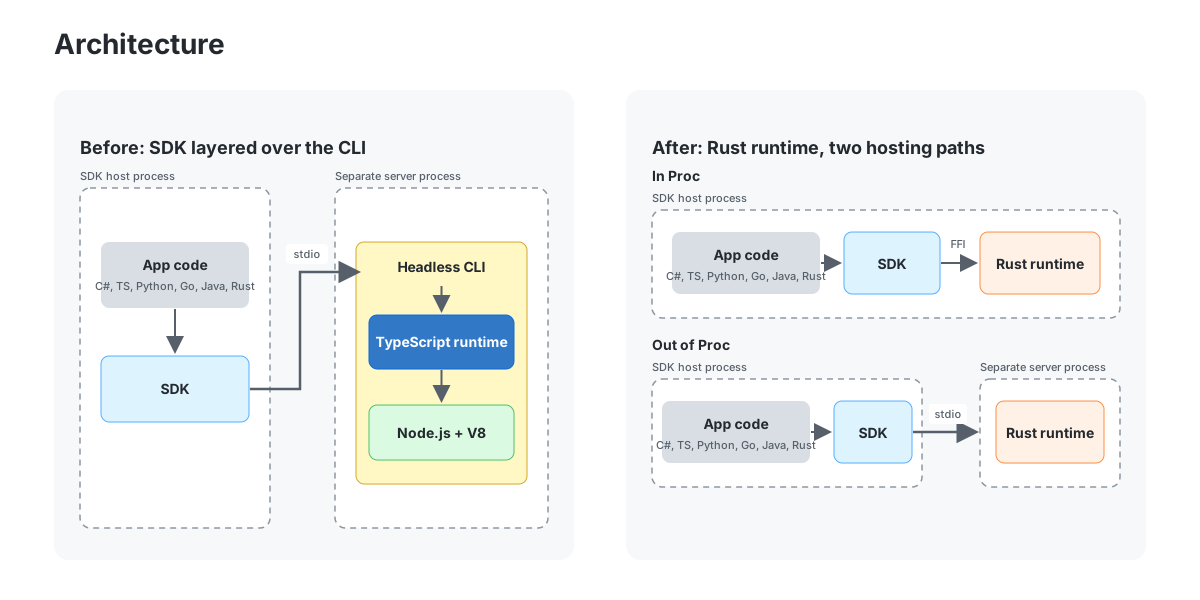
Before the advent of AI agents, rewriting a system of this magnitude was a luxury few teams could afford. The GitHub Copilot runtime, a critical piece of infrastructure serving millions of developers, was built on a legacy stack that was stable but heavy. The decision to migrate this sprawling system to Rust was not just a technical upgrade; it was a necessary evolution for performance and security. The sheer scale of the undertaking, involving approximately 800,000 lines of production code, initially seemed like an insurmountable mountain for a single team to climb.
What made this project truly unique was the method of ascent. Instead of relying solely on human intuition and manual refactoring, the team leveraged the very system they were rewriting to guide the rewrite. By using Copilot, the AI agent, to generate the Rust code, they turned the migration into a dialogue between the old architecture and the new future. It was a recursive process where the AI understood the context of the existing logic well enough to translate it into idiomatic, high-performance Rust, effectively acting as a force multiplier for the engineering team.
The result was a transformation that defied traditional timelines. What could have taken years of painstaking, error-prone refactoring was condensed into a manageable sprint. The AI didn't just write syntax; it grasped the intent behind the original logic, allowing developers to focus on architectural decisions and edge cases rather than the drudgery of boilerplate conversion. This approach demonstrated a new paradigm in software engineering, where humans and agents collaborate not as master and tool, but as co-pilots navigating a complex system.
Beyond the speed of the rewrite, the benefits are tangible and measurable. Rust's memory safety guarantees eliminated an entire class of vulnerabilities that had plagued the legacy stack, while the performance gains provided a noticeable improvement in latency for end-users. For a service as ubiquitous as Copilot, these improvements translate directly to a better experience for developers worldwide, ensuring that the assistance they receive is both fast and secure. The migration proved that modern AI tools can handle the heavy lifting of large-scale system modernization.
Looking back, the project stands as a testament to the changing landscape of software development. It challenges the old notion that massive codebases must be rewritten by human hands alone, inch by inch. Instead, it shows a path where intelligent agents can understand, translate, and optimize complex systems with a level of efficiency previously thought impossible. This is not just about moving code from one language to another; it is about fundamentally changing how we approach the maintenance and evolution of the digital infrastructure we rely on every day.
On Bluesky? Meet HomeSky.
Follower analytics, a growth toolkit, scheduling and AI posting — built for Bluesky. Connect your account and use everything free for 60 days.
Try HomeSky free →