Migrating the GitHub Copilot runtime to Rust, using Copilot
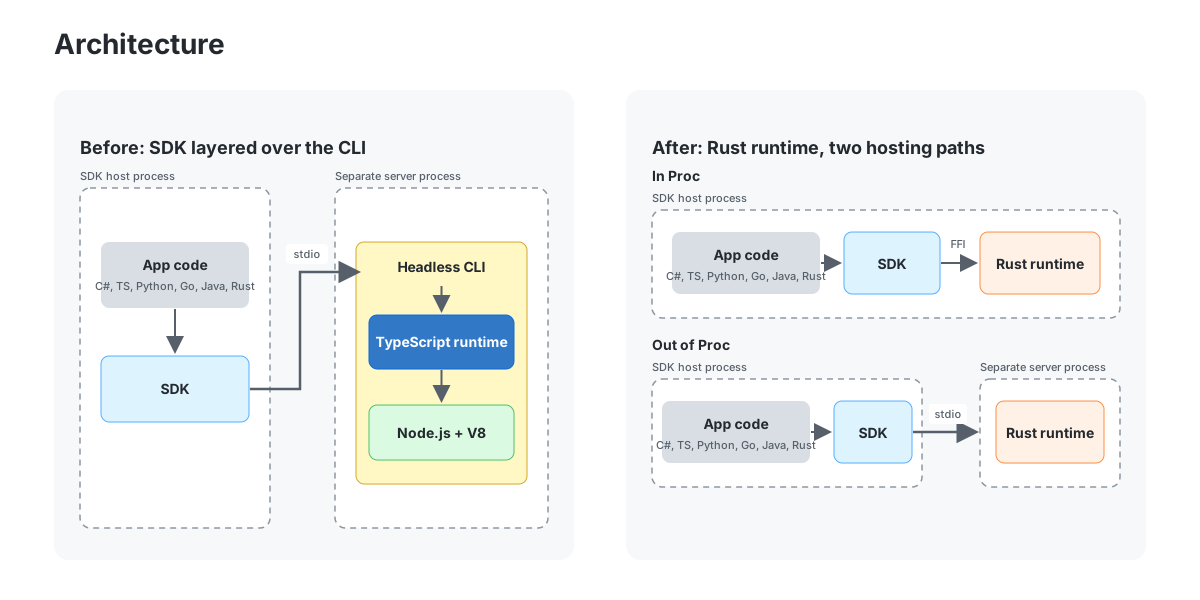
For years, the promise of rewriting the GitHub Copilot agent runtime in Rust felt like a theoretical exercise reserved for white papers, not a practical engineering challenge. The sheer volume of code—nearly 800,000 lines of production-grade Rust—represented a mountain that seemed impossible to climb without breaking the mountain itself. We assumed that the complexity of the agent logic and the critical nature of the infrastructure would require a team of engineers to toil for months, manually translating logic line by line, testing edge cases, and hoping for the best.
The reality, however, was a revelation that fundamentally changed how we approached large-scale system migrations. By leveraging the very capabilities we were building, we utilized Copilot to perform the heavy lifting of the initial port. It wasn't magic, nor was it a black box; it was a precise orchestration of context-aware generation that understood the architectural patterns deep within the existing codebase. The tool didn't just spit out syntax; it understood the intent, the data structures, and the behavioral contracts that made the original C++ implementation tick.
This approach shattered the traditional notion that legacy code migration is a slow, arduous grind of manual refactoring. In previous iterations of similar projects, teams often spent the majority of their budget and timeline simply copying and pasting code, only to spend the rest debugging the inevitable drift between the new implementation and the old specification. By using an AI agent to generate the bulk of the Rust implementation, we compressed a timeline that would have taken years into a manageable sprint. The resulting code was not just a syntactic translation; it was a semantic reconstruction that often improved upon the original patterns while adhering strictly to the required functionality.
The technical stakes were incredibly high. We weren't building a toy project; we were modernizing the core runtime that powers code completion for millions of developers globally. Every line of generated Rust had to be scrutinized, tested, and integrated into a live environment where latency and reliability are non-negotiable. The transition required a rigorous validation framework that could prove the new Rust implementation behaved identically to the legacy system under all conceivable workloads. Yet, because the AI-generated code was so close to the source truth, the delta between the expected and actual behavior was minimal, allowing the engineering team to focus on optimization rather than basic correctness.
Ultimately, this migration demonstrated a paradigm shift in software engineering where the boundary between developer and tool becomes increasingly porous. It proved that agents can handle the drudgery of massive refactoring while preserving the human element of architectural decision-making. The journey to 800,000 lines of Rust wasn't about replacing human engineers; it was about empowering them to do what they do best: design, reason, and innovate, while the machine handles the scale of the transformation.
Looking back at the process, the success lies in the synergy between the precision of Rust and the contextual awareness of the AI agent. We didn't just move code; we evolved our infrastructure, gaining the performance benefits of Rust and the velocity of AI-driven development simultaneously. This is the new standard for system modernization, a future where rewriting the future of code is no longer an insurmountable burden but a streamlined, repeatable capability.
On Bluesky? Meet HomeSky.
Follower analytics, a growth toolkit, scheduling and AI posting — built for Bluesky. Connect your account and use everything free for 60 days.
Try HomeSky free →