Migrating the GitHub Copilot runtime to Rust, using Copilot
There was a time when migrating a massive codebase was a solitary act of endurance, a marathon where the runner hoped the finish line didn't move. Before the arrival of AI agents, rewriting 800,000 lines of C++ to Rust was a project that demanded armies of engineers and years of sleepless nights. It was a cost-prohibitive endeavor, reserved for the most critical of infrastructure because the sheer volume of manual context switching and error correction made it economically impossible for anything but the most essential services. We were stuck in a paradigm where speed and correctness were a zero-sum game, and the only way to win was to sacrifice one for the other.
That balance shifted dramatically the moment agents entered the room. Suddenly, the monolithic task of porting the GitHub Copilot runtime fractured into thousands of micro-problems that could be solved in parallel, not by a thousand humans, but by a swarm of specialized bots. The challenge wasn't just translating syntax from C++ to Rust; it was managing a chaotic ecosystem of dependencies, legacy business logic, and intricate error handling paths that had evolved over decades. Without agents, this would have been a project of attrition, but with them, it became an exercise in orchestration, where the goal was to keep the bots fed with accurate context while they chipped away at the fortress of legacy code.
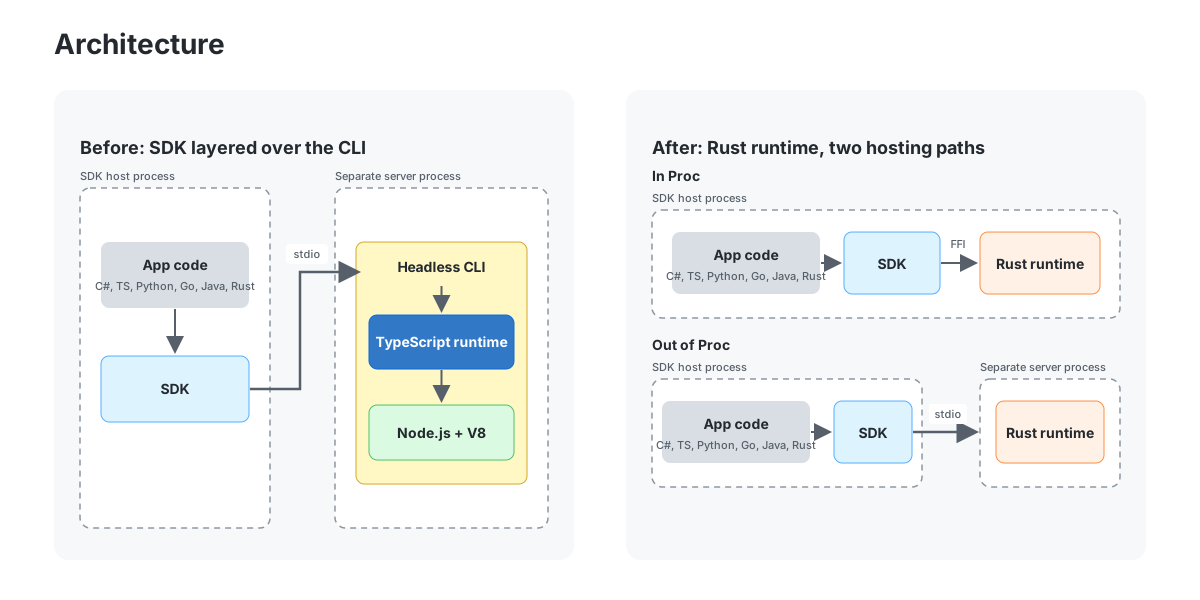
The sheer scale of the operation was staggering. We weren't just rewriting a simple utility; we were re-architecting the very engine that powers billions of code completions daily. The Rust codebase grew to nearly a million lines, a massive undertaking that required a new way of thinking about concurrency, memory safety, and system stability. Every function had to be scrutinized not just for correctness, but for how it interacted with the rest of the runtime. The agents allowed us to break down this monolith into manageable chunks, assigning specific modules to specific agents, which then generated diffs, ran tests, and iterated on the code until the green lights appeared across the board.
However, the technology alone couldn't do the heavy lifting; the strategy was what made the difference. We had to design a workflow where the agents could understand the global architecture while working on local details, a feat that requires sophisticated context management. It was a delicate dance of pushing and pulling information, ensuring that a change in the authentication module didn't break the file parsing logic three modules down. This level of coordination was previously impossible for a team of humans to maintain manually, as the cognitive load of keeping track of 800,000 lines of interdependencies would have led to inevitable breakage. The agents provided the persistence and parallel processing power needed to navigate this complexity without losing the forest for the trees.
Looking back at the result, the migration to Rust has fundamentally altered the performance profile of the Copilot service. The new runtime is significantly faster and more memory-efficient, allowing us to handle more concurrent users with the same hardware footprint. But beyond the metrics, the process itself proved that the future of large-scale software development lies in collaboration between human architects and AI agents. We moved from a model of manual, sequential rewriting to one of automated, parallel evolution, setting a precedent for how complex systems can be modernized in an era where code can be generated and refined at unprecedented speeds.
This rewrite wasn't just about swapping languages; it was about reimagining the entire lifecycle of software production. It demonstrated that the barriers to modernizing legacy infrastructure were not insurmountable walls, but rather puzzles that could be solved with the right tools and a shift in perspective. As we look toward the next decade of engineering, the lessons from this migration are clear: the tools we build today will define the scale of what we can achieve tomorrow, and the integration of intelligent agents into our development workflow is no longer optional, it is the only path forward.
On Bluesky? Meet HomeSky.
Follower analytics, a growth toolkit, scheduling and AI posting — built for Bluesky. Connect your account and use everything free for 60 days.
Try HomeSky free →