Migrating the GitHub Copilot runtime to Rust, using Copilot
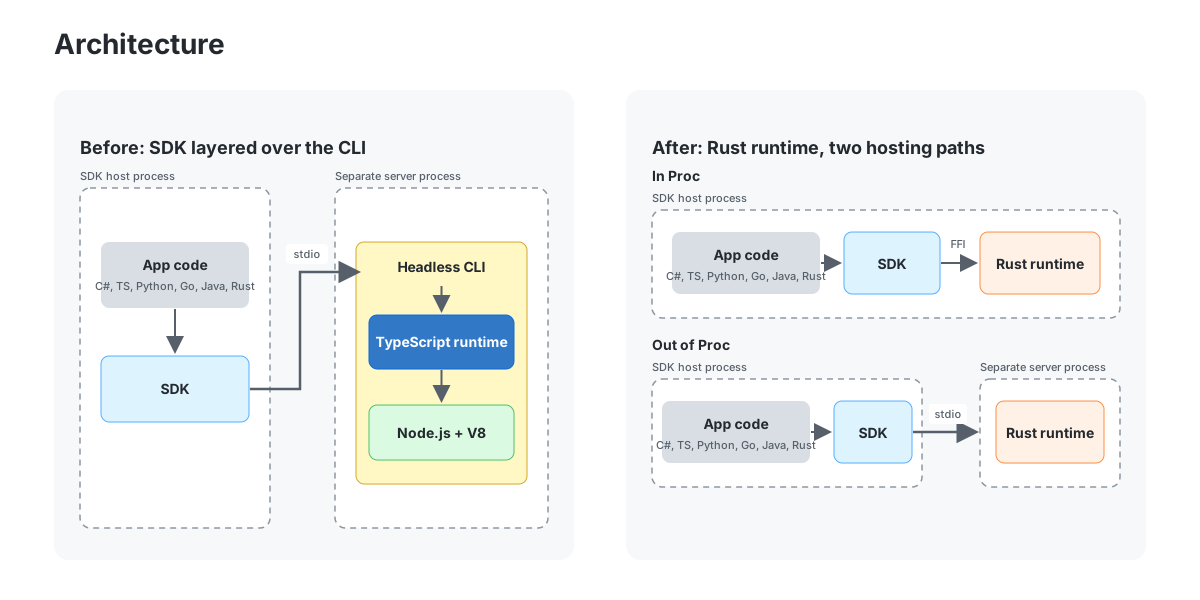
Before the era of autonomous agents, rewriting a system of this magnitude was a prohibitively expensive endeavor, a financial and temporal undertaking that simply did not exist in the budgetary reality of most engineering teams. The decision to migrate the GitHub Copilot runtime, a massive codebase spanning 800,000 lines of production Rust, was not just a technical pivot but a strategic gamble on the capabilities of the very tools we were building. It required a level of orchestration where the agent could understand its own context, navigate the labyrinth of existing dependencies, and refactor without introducing the subtle, silent bugs that usually plague such transitions.
The sheer scale of the operation was daunting, not because of the lines of code themselves, but because of the invisible architecture holding them together. Porting a runtime of this complexity is akin to moving a city while it is still functioning; every streetlight must remain lit, every traffic signal must sync, and every citizen must continue their day-to-day life without noticing the chaos beneath their feet. The team had to build a migration strategy that allowed the new Rust implementation to coexist with the legacy stack, ensuring that the critical path for generating code suggestions remained uninterrupted while the underlying engine was completely overhauled.
What makes this specific rewrite unique is the meta-narrative of using Copilot to write the port of itself. It was a recursive act of engineering, where the agent acted as both the architect and the bricklayer, constantly evaluating its own output against the strict performance and safety standards required for a production environment. This approach fundamentally changed the workflow, shifting the burden of repetitive, low-level translation tasks from human engineers to the AI, allowing the team to focus on high-level architectural decisions and edge-case handling rather than getting bogged down in the mechanical drudgery of syntax conversion.
However, relying on an AI to handle such critical infrastructure was not without its perils. The initial attempts revealed that the agent could easily hallucinate valid-looking code that failed under load or introduced security vulnerabilities when integrated with external services. The solution was a rigorous human-in-the-loop validation process, where engineers acted as editors and safety inspectors, guiding the agent through the most complex sections of the codebase and providing the context it often missed. This hybrid model proved that the future of large-scale software development lies not in replacing engineers, but in augmenting them with tools that can handle the volume while humans retain the judgment.
The result was a modernized, high-performance runtime that not only met all original requirements but also laid the groundwork for future scalability. By tackling this 800,000-line migration using the very product it powers, the team demonstrated a proof of concept for how AI-driven development can be applied to the most sensitive parts of a company's technology stack. It was a testament to the fact that when the tools are sharp enough and the strategy is sound, the impossible becomes merely a matter of patience and persistence.
Ultimately, this migration story is less about the language switch to Rust and more about the paradigm shift in how we approach massive code rewrites. It shows that the age of manual, line-by-line porting is ending, replaced by an era where intelligent agents can assist in navigating the complexities of legacy systems. As we continue to push the boundaries of what software can do, the ability to leverage these agents for foundational infrastructure will likely become the standard, not the exception, defining the next chapter of engineering excellence.
On Bluesky? Meet HomeSky.
Follower analytics, a growth toolkit, scheduling and AI posting — built for Bluesky. Connect your account and use everything free for 60 days.
Try HomeSky free →