Migrating the GitHub Copilot runtime to Rust, using Copilot
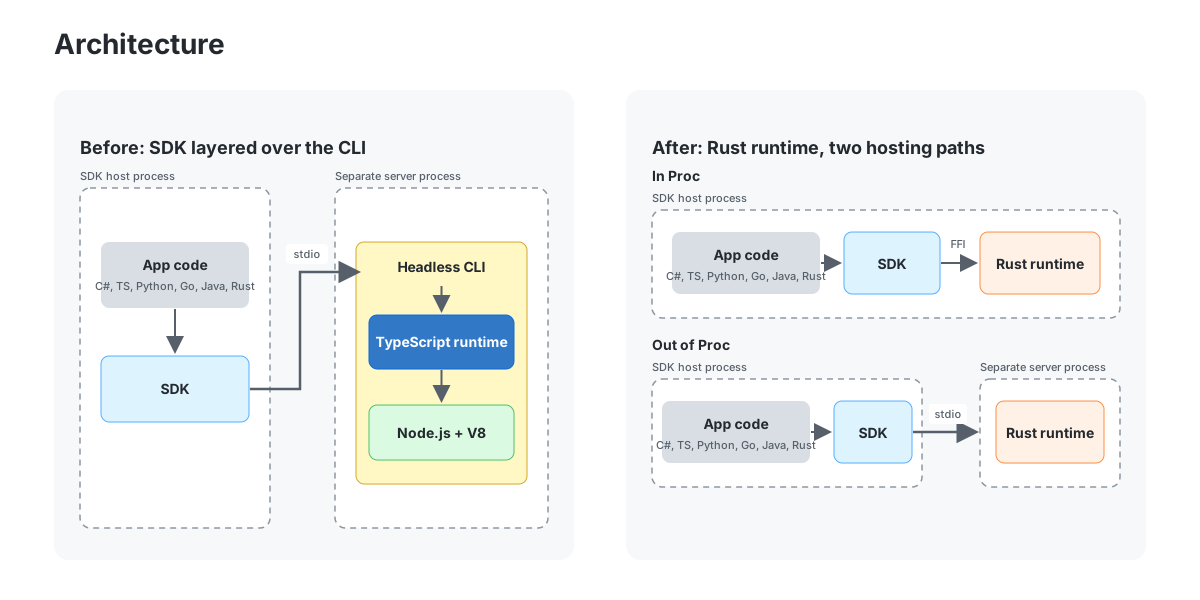
There was a time when refactoring a system of that magnitude was a logistical nightmare reserved for teams with unlimited budgets and months of downtime. The idea of porting the Copilot agent runtime, a sprawling beast of 800,000 lines of production code, felt like asking a small business to rebuild its entire supply chain overnight. Before the era of autonomous agents, this was simply not affordable; the cost in developer hours, the risk of regression, and the sheer cognitive load required to map the old architecture to a new one would have caused most projects to stall before they even began.
But then we decided to ask the very thing we were trying to build to do the work of rebuilding itself. It sounds like a paradox, a chicken-and-egg scenario where the tool is both the hammer and the nail, yet it turned out to be the most pragmatic solution available. We didn't just hand Copilot a vague prompt to "translate this to Rust"; we gave it the context of the entire ecosystem, the specific constraints of our internal infrastructure, and the freedom to iterate on its own code. The result was a demonstration that agents can handle complexity far beyond what we previously imagined possible for automated refactoring tasks.
The journey wasn't without its friction. There were moments where the generated code required significant human intervention to align with our specific security protocols or to handle edge cases that the model initially glossed over. This wasn't a case of magic; it was a case of collaboration. The human developers acted as the architects, defining the blueprint and the guardrails, while Copilot served as the tireless construction crew, laying down the foundation and filling in the walls at a speed that would have been impossible with a traditional manual migration.
What emerged from this process was a runtime that felt familiar yet distinctly different, optimized for the performance characteristics of Rust while retaining the semantic integrity of the original logic. The shift wasn't just about swapping languages; it was about unlocking the potential of a codebase that could now leverage Rust's memory safety and concurrency models without the decades-old baggage of legacy patterns. We reduced the technical debt that had been accumulating for years, turning a ticking time bomb into a robust, modern platform ready for the next generation of AI features.
Ultimately, this migration serves as a case study for the future of software engineering. It proves that while human judgment remains essential for strategy and oversight, the execution of massive, repetitive, and complex tasks is increasingly within the realm of machine intelligence. We are standing on the precipice of a new era where the boundaries between developer and tool blur, allowing us to focus on solving the hard problems of business and innovation rather than wrestling with the mechanics of implementation.
On Bluesky? Meet HomeSky.
Follower analytics, a growth toolkit, scheduling and AI posting — built for Bluesky. Connect your account and use everything free for 60 days.
Try HomeSky free →