Migrating the GitHub Copilot runtime to Rust, using Copilot
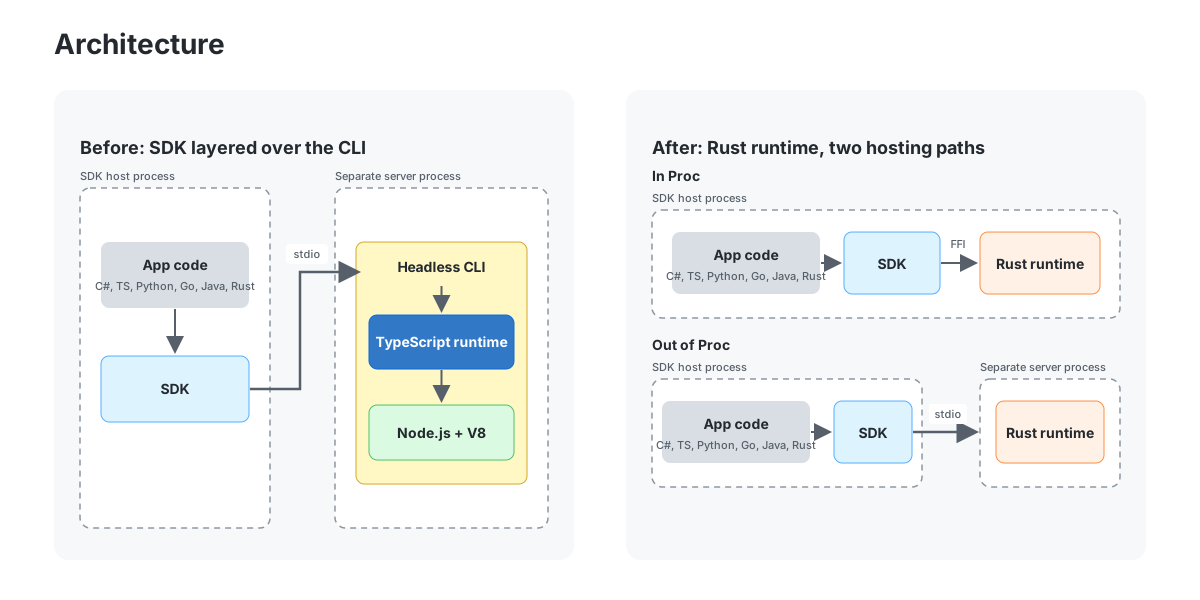
For years, the thought of rewriting the GitHub Copilot runtime felt like a logistical impossibility, a Herculean task best left to a team of specialists rather than a single developer. The sheer volume of code involved—some 800,000 lines of production-quality Rust—represented a barrier that simply wasn't worth climbing without a massive army of engineers. We needed to understand exactly why this rewrite was even on the table in the first place, why the decision was made to tackle such a monumental refactoring, and what the actual cost of that effort looked like when stripped of the usual fanfare.
The catalyst for this massive undertaking was the realization that traditional development workflows were hitting a ceiling of inefficiency. Before the arrival of modern coding agents, the idea of an AI autonomously navigating, understanding, and rewriting a codebase of this magnitude was a fantasy reserved for science fiction. It was a domain of pure speculation where the complexity of the system would inevitably cause the rewrite to stall, leading to a fragmented mess rather than a cohesive improvement. The transition from a hypothetical future to an executable reality required a fundamental shift in how we approached large-scale software migration.
Porting the runtime to Rust was not just a switch in syntax; it was a complete overhaul of the system's architectural DNA. Rust's safety guarantees offered a level of robustness that was essential for an agent operating in a live environment, where a single memory safety violation could cascade into a system-wide failure. However, the challenge lay in the sheer density of the logic. Every loop, every conditional branch, and every interaction with the underlying model required careful translation, ensuring that the semantic meaning of the old code was preserved perfectly in the new, while simultaneously leveraging the performance benefits of the new language.
The process was far from linear, filled with unexpected hurdles that demanded creative problem-solving and a deep understanding of both the source and target systems. There were moments of profound frustration where the AI would generate code that was syntactically correct but logically flawed, requiring human intervention to guide the agent back on track. Yet, each iteration brought us closer to a system that was not only faster and safer but also easier to maintain, proving that the synergy between human oversight and autonomous agents could scale to tasks that were previously thought impossible.
The final result is a testament to what is possible when we stop viewing automation as a replacement for human expertise and start seeing it as a force multiplier for our collective capabilities. By successfully migrating the Copilot runtime to Rust, we have demonstrated that agents can handle the gritty, unglamorous work of large-scale refactoring, freeing up human developers to focus on high-level architecture and innovation. This is not just a technical victory; it is a philosophical one, marking a turning point in how we build and maintain the complex systems that power our digital lives.
On Bluesky? Meet HomeSky.
Follower analytics, a growth toolkit, scheduling and AI posting — built for Bluesky. Connect your account and use everything free for 60 days.
Try HomeSky free →