Migrating the GitHub Copilot runtime to Rust, using Copilot
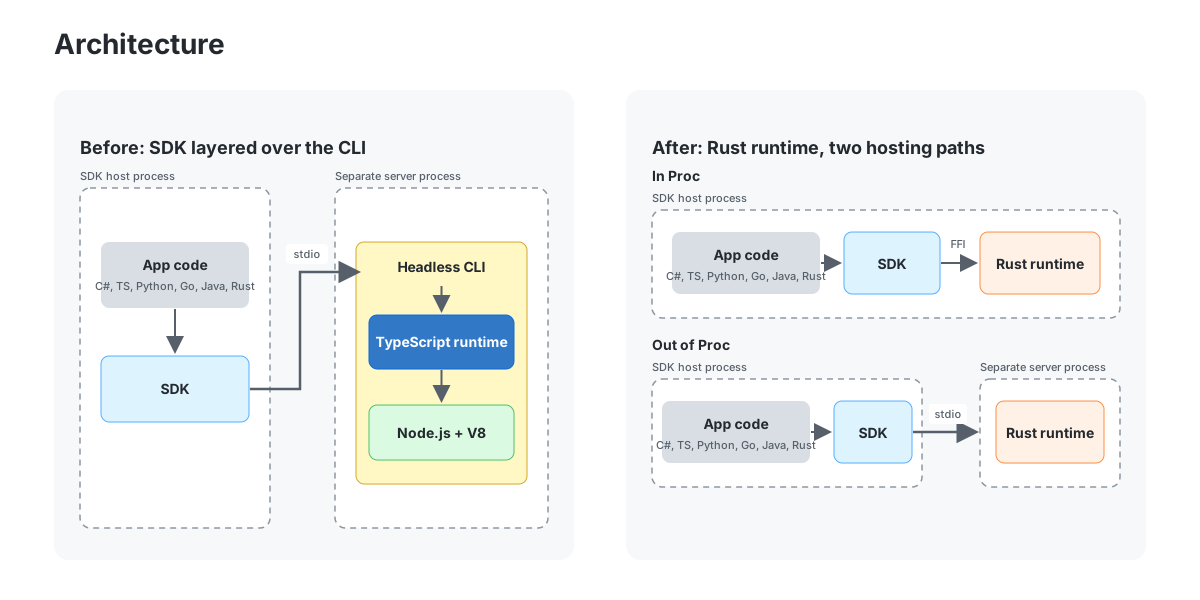
Porting the GitHub Copilot runtime to Rust felt like an impossible mountain climb until the advent of AI agents. For years, the sheer volume of code required for such a migration was prohibitive; the complexity alone suggested a multi-year undertaking for a small team. Yet, by leveraging Copilot itself to write the migration scripts, we realized that the tool could be used to build the very infrastructure that supports it. The irony of using an AI agent to orchestrate the porting of an AI agent's runtime to a new language was almost poetic, turning a theoretical nightmare into a manageable engineering sprint.
The scope of this undertaking was staggering, involving approximately 800,000 lines of production-grade Rust code. Before the era of intelligent coding assistants, a rewrite of this magnitude would have required a dedicated team of senior engineers working for years, fraught with the risk of subtle bugs and performance regressions. The challenge wasn't just writing the code; it was ensuring that the new Rust implementation mirrored the reliability and security standards of the original while drastically reducing the overhead of the underlying runtime. Every function, every memory allocation, and every concurrency model had to be re-evaluated through the lens of Rust's strict ownership system.
What initially seemed like a chaotic process of replacing thousands of lines of Python and JavaScript logic quickly revealed a structured path. Copilot didn't just generate syntax; it understood the architectural intent behind the legacy code. It could infer the data flow and state management requirements, proposing Rust equivalents that were not only syntactically correct but semantically aligned with the original business logic. This capability allowed the team to maintain velocity without sacrificing quality, effectively automating the translation layer while human engineers focused on high-level architecture and edge-case validation.
The shift to Rust was not merely a change of syntax; it was a fundamental transformation in how the runtime interacted with the host environment. Rust's memory safety guarantees eliminated entire classes of vulnerabilities that plagued the previous runtime, providing a much stronger foundation for the sensitive data processing that Copilot performs. The performance gains were immediate and tangible, allowing the runtime to handle higher loads with less resource contention. This efficiency is critical for an AI service that must respond to thousands of developer queries in real-time, ensuring that the latency between a user's request and the AI's response remains negligible.
However, the journey was not without its hurdles. There were moments where the generated code required significant human intervention to align with the project's specific linting rules and idiomatic practices. The team had to establish a rigorous review process where Copilot's suggestions were treated as first drafts rather than final solutions. This hybrid approach—leveraging the speed of AI with the judgment of experienced engineers—proved to be the winning strategy. It balanced the need for rapid iteration with the necessity of maintaining the high standards expected from a core GitHub product.
Ultimately, this migration demonstrates a pivotal moment in software development history. It marks the transition from AI as a simple autocomplete tool to AI as a collaborative architect capable of handling enterprise-scale refactoring. By successfully rewriting 800,000 lines of code using the very technology being upgraded, we have set a new precedent for what is possible in modern engineering. The result is a faster, safer, and more efficient runtime that stands ready to support the next generation of intelligent coding assistants, proving that the future of software is built on the foundation of intelligent collaboration between humans and machines.
On Bluesky? Meet HomeSky.
Follower analytics, a growth toolkit, scheduling and AI posting — built for Bluesky. Connect your account and use everything free for 60 days.
Try HomeSky free →