Migrating the GitHub Copilot runtime to Rust, using Copilot
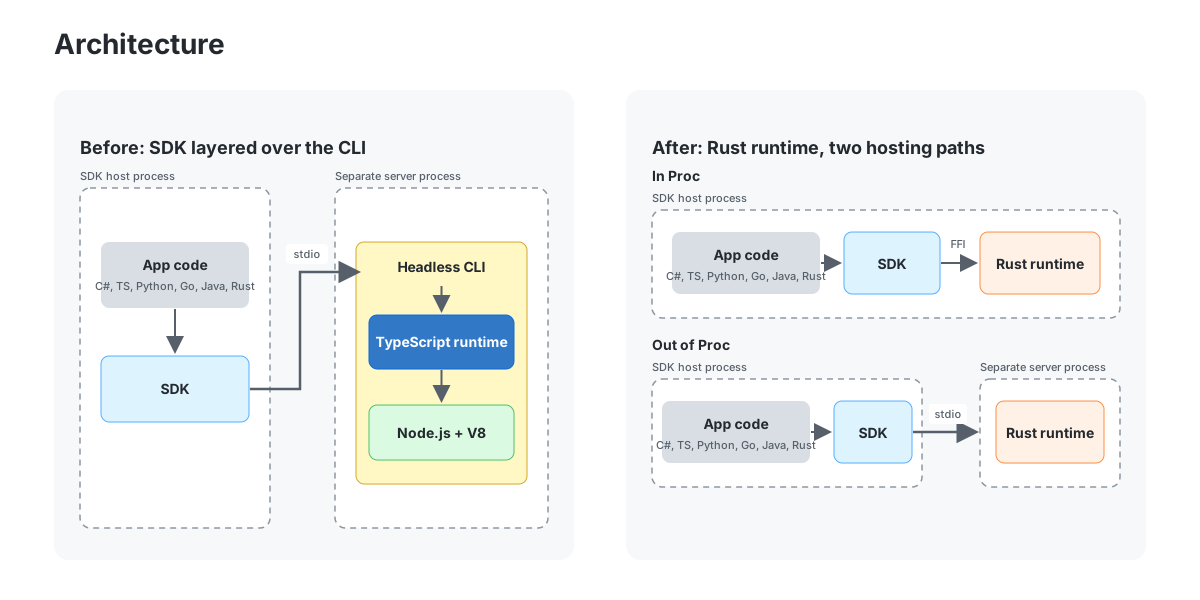
For years, the idea of rewriting a complex, production-grade system in a new language felt like a fool's errand, a luxury reserved for greenfield projects where nothing was at stake. The GitHub Copilot runtime, a critical piece of infrastructure serving millions of developers, was no exception. It was a sprawling beast of 800,000 lines of code written in a different dialect, holding the system together through a fragile patchwork of dependencies. We assumed that the cost of such a migration would be prohibitive, requiring an army of engineers and years of downtime. That assumption was shattered not by a massive budget or a dedicated team, but by the arrival of AI agents. Before Copilot, this rewrite was simply too expensive; after Copilot, it became a manageable, albeit intense, sprint that redefined what is possible in modern software engineering.
The challenge was not merely a matter of translation; it was about capturing the essence of the runtime's logic and translating it into Rust's strict type system and memory safety guarantees. The original codebase was a dense forest of edge cases, legacy quirks, and business rules that had evolved over many years of iteration. Porting this to Rust demanded a level of precision that felt almost alien to the original architecture. However, the real breakthrough came when we stopped trying to manually map every function and started letting the AI understand the context. Copilot didn't just suggest lines of code; it understood the architectural intent, allowing us to refactor massive sections of logic while simultaneously generating the safety-critical Rust wrappers that the new codebase required.
What makes this migration particularly fascinating is the self-referential nature of the work. We used Copilot, an AI trained to assist with coding, to write the code that powers Copilot itself. It is a meta-narrative of recursive improvement, where the tool used for the rewrite was the very product being rewritten. This created a unique feedback loop where the AI could learn from the new Rust implementation in real-time, suggesting optimizations that a human might have missed due to fatigue or cognitive tunneling. The result was a runtime that is not only faster and more secure but also cleaner, with the 800,000 lines of code becoming significantly more maintainable than the original.
The impact on the development team was immediate and profound. By automating the heavy lifting of boilerplate and syntax translation, engineers were freed to focus on the high-level architecture and the tricky, nuanced logic that defined the product. This shift in focus allowed us to move at a velocity that would have been impossible a few years ago. The fear of breaking the production system, which often paralyzed large-scale rewrites, was mitigated by the ability to generate test suites and validation logic alongside the code itself. The migration became less of a risky gamble and more of a systematic, iterative process where confidence grew with every commit.
Ultimately, this project serves as a powerful testament to the evolving role of AI in the software lifecycle. It proves that the barrier to entry for massive infrastructure refactoring has been dramatically lowered. What once required a multi-year, multi-million dollar endeavor can now be approached with a well-tuned agent and a clear vision. The rewrite of the Copilot runtime to Rust is not just a technical victory; it is a signal that the future of software development is collaborative, where human intent guides the machine, and the machine amplifies human capability to scales we previously thought unreachable.
On Bluesky? Meet HomeSky.
Follower analytics, a growth toolkit, scheduling and AI posting — built for Bluesky. Connect your account and use everything free for 60 days.
Try HomeSky free →