Migrating the GitHub Copilot runtime to Rust, using Copilot
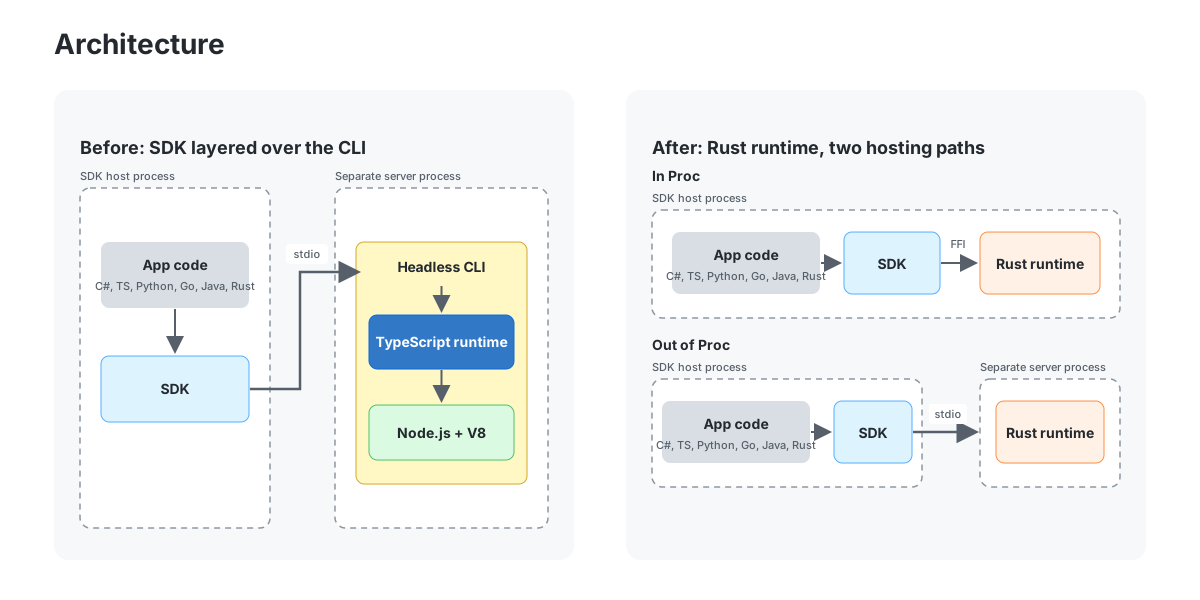
For years, the promise of rewriting massive codebases with artificial intelligence felt like science fiction, a distant dream reserved for theoretical explorers rather than pragmatic engineers. The idea that we could take a critical, production-grade system running on millions of lines of legacy code and translate it into a new language with the same level of confidence and speed was deemed impossible. But the landscape has shifted dramatically, proving that what was once an unaffordable luxury is now a tangible reality. This shift wasn't just a matter of better prompts; it was the arrival of agents capable of understanding context, making architectural decisions, and executing complex refactorings autonomously.
The specific challenge here was the migration of the GitHub Copilot agent runtime to Rust, a project encompassing roughly eight hundred thousand lines of code. Before the emergence of these advanced agents, attempting such a port would have required years of manual labor, a massive budget for senior engineers, and a risk profile that could have derailed the entire product. The sheer volume of code meant that human reviewers could not possibly verify every transaction, every edge case, or every performance optimization without introducing bugs. The old model of "write code, review code, fix bugs" simply couldn't scale to this magnitude, creating a bottleneck that threatened to stall innovation entirely.
Porting this infrastructure to Rust offered more than just a change in syntax; it was a strategic move toward memory safety and performance that was previously blocked by the cost of execution. Rust's ownership model is notoriously difficult to master, requiring a deep understanding of system programming that most application developers avoid. However, with the help of Copilot, the barrier to entry lowered significantly. The agent didn't just translate lines of text; it understood the semantic meaning of the application logic, allowing it to generate idiomatic Rust that adhered to strict safety guarantees while maintaining the complex business logic required by the runtime.
The process revealed that the true power of AI agents lies in their ability to handle the "gray area" of software engineering—the messy middle ground between perfect documentation and messy reality. Where a human might hesitate, afraid of breaking a subtle dependency or misunderstanding a niche library function, the agent could iterate rapidly, testing hypotheses and adjusting its approach in real-time. It wasn't magic, of course; there were still instances where the generated code required human intervention to align with specific organizational standards or to debug obscure issues that fell outside the training data. Yet, the overall velocity of development increased by orders of magnitude compared to traditional methods.
This migration serves as a profound case study in the evolution of software craftsmanship. It suggests that the future of large-scale system maintenance may not involve hiring more people to do the same work faster, but rather augmenting human intent with autonomous tools that can handle the bulk of the translation. The result was a robust, safe, and high-performance Rust runtime built by a system that effectively acted as a super-compiler, guided by human oversight but executing at a scale no single team could have achieved alone.
Ultimately, the story of rewriting the Copilot runtime is less about Rust itself and more about the democratization of high-stakes engineering. It proves that the tools we build today will determine the scale at which we can build tomorrow. By leveraging agents to navigate the complexities of a half-million-line migration, we have not only secured the future of a critical infrastructure component but also paved the way for an era where the most difficult programming tasks become routine, accessible exercises rather than insurmountable mountains.
On Bluesky? Meet HomeSky.
Follower analytics, a growth toolkit, scheduling and AI posting — built for Bluesky. Connect your account and use everything free for 60 days.
Try HomeSky free →