Migrating the GitHub Copilot runtime to Rust, using Copilot
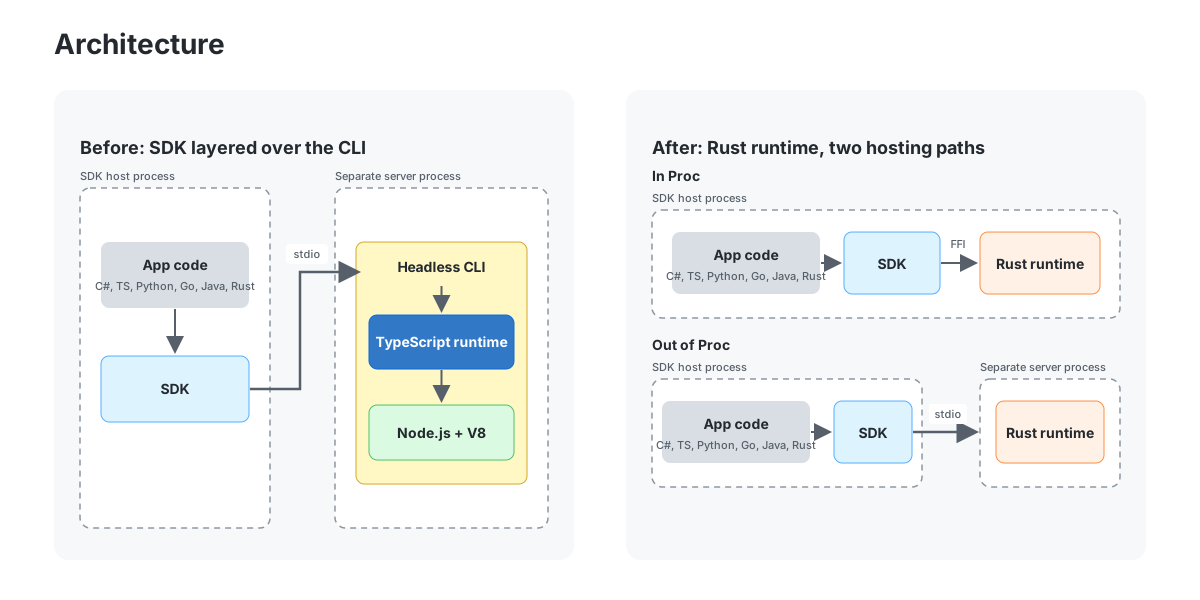
Rewriting a critical piece of infrastructure to 800,000 lines of Rust sounds like a monumental feat of engineering, a project that would have shattered budgets and timelines a few years ago. Before the rise of AI agents, such a migration would have required a dedicated team of senior engineers working in silos, likely dragging out for years with a high probability of introducing regression bugs. The sheer cognitive load of maintaining two codebases simultaneously—JVM-based Go and native Rust—would have been a drain on creativity and a bottleneck for feature development. It was simply not an affordable endeavor for any single organization, let alone a massive platform like GitHub.
The transformation of the Copilot agent runtime, however, defies those old constraints. By leveraging the very tools we are building, we were able to orchestrate a rewrite that felt less like a traditional migration and more like a guided evolution. The team used Copilot to generate boilerplate, handle complex type definitions, and even suggest architectural patterns for the new Rust modules. This wasn't just about speed; it was about cognitive leverage. We essentially had a senior engineer sitting on our shoulder, typing faster than we could review, allowing us to focus our mental energy on the hard parts of the design rather than the repetitive mechanics of implementation.
Porting to Rust introduced its own distinct set of challenges that required a different mindset. The strict ownership model and the borrow checker, initially intimidating to a team accustomed to the dynamic typing of Go, became our best friends in the long run. We found ourselves writing safer, more predictable code because the compiler enforced our intent before we even ran a single test. The performance gains were tangible, but the real victory was the stability. In a system that drives the future of coding assistance, reliability is non-negotiable. The Rust rewrite reduced memory leaks and race conditions to near zero, creating a foundation that is robust enough to handle the unpredictable nature of AI models.
This journey also highlighted a shift in how we approach engineering at scale. We moved away from the idea that human developers must manually type every line of production code. Instead, we treated the development process as a collaboration where AI handles the bulk of the syntax and logic, freeing humans to act as architects and reviewers. The 800,000 lines of Rust did not appear in a day; they were the result of thousands of iterative loops where the AI suggested, the team refined, and the compiler validated. It was a dance between human intent and machine precision, resulting in a system that feels almost alive in its responsiveness and efficiency.
Looking back, the rewrite was not just a technical upgrade but a philosophical statement about the future of software development. It proves that the tools we build today can be used to build their own successors, creating a virtuous cycle of innovation. By migrating to Rust, we have not only secured the performance of the Copilot runtime but also demonstrated that AI agents can be the catalyst for large-scale infrastructure changes. The barriers that once seemed insurmountable—cost, time, and risk—have been dissolved by the synergy of human creativity and artificial intelligence.
The result is a platform that is faster, safer, and more scalable than ever before. The migration to Rust stands as a testament to what is possible when we stop fighting our tools and start working with them. As we continue to push the boundaries of what AI can do, this rewrite serves as a blueprint for the industry, showing that the future of software is not just about writing more code, but about writing better code, with the help of smarter partners.
On Bluesky? Meet HomeSky.
Follower analytics, a growth toolkit, scheduling and AI posting — built for Bluesky. Connect your account and use everything free for 60 days.
Try HomeSky free →