Migrating the GitHub Copilot runtime to Rust, using Copilot
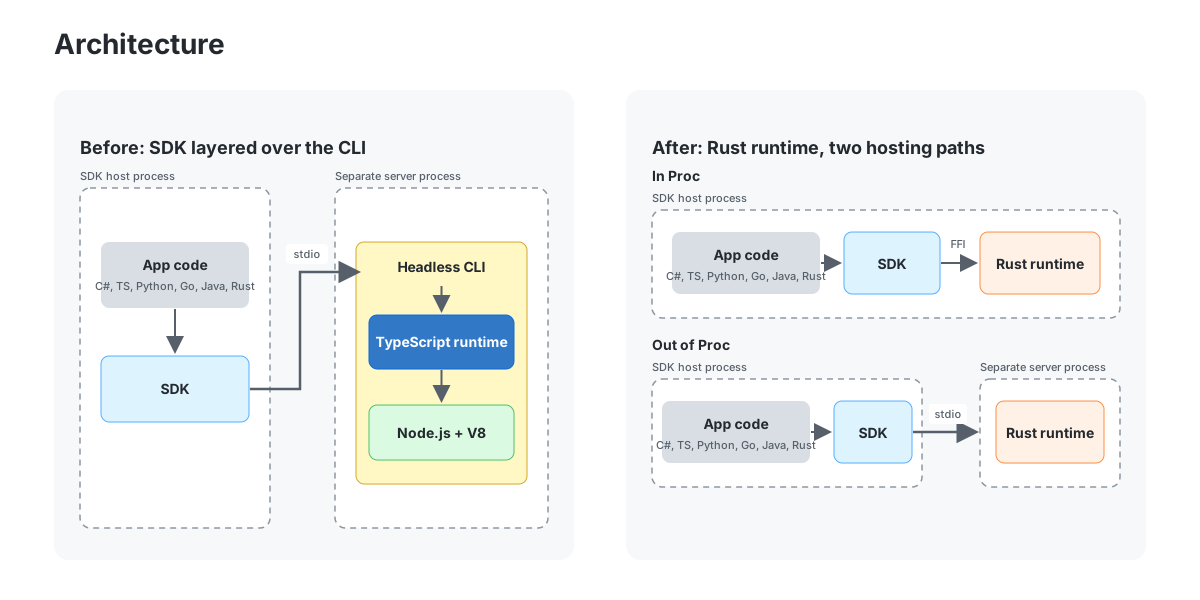
There was a time when rewriting a major software component was a logistical nightmare, a project that required months of manual refactoring and a team of senior engineers working in shifts. The sheer volume of legacy code often acted as an immovable object, creating a wall that blocked progress for years. That was the reality before the advent of sophisticated AI agents, a paradigm shift that has fundamentally altered how we approach enterprise-grade refactoring. At GitHub, we recently undertook the monumental task of migrating the entire Copilot runtime to Rust, a rewrite encompassing approximately 800,000 lines of production code. Before automation, this endeavor was simply not affordable; the cost in man-hours and opportunity cost would have stalled the project indefinitely.
The decision to move to Rust was driven by a critical need for performance and reliability that Go and Python simply could not guarantee for the underlying agent infrastructure. However, the transition presented a unique paradox: the very tool we were building could not be the tool we used to build it. We needed to port a complex, intelligent agent to a new language while maintaining the agent's own functionality to guide the process. This created a self-referential engineering challenge where the Copilot agent had to learn to write Rust code to migrate itself, effectively teaching an AI to rewrite its own brain in a new language without losing its mind.
What emerged from this process was a testament to the power of autonomous development workflows. By leveraging the Copilot agent to handle the bulk of the translation and refactoring logic, we reduced a project that would have taken a large team years into a matter of weeks. The agent didn't just blindly translate syntax; it understood the semantic intent of the code, adapted complex business logic to Rust's strict type system, and even managed the migration of dependencies and testing suites. It was a collaboration between human architects and autonomous agents, where the humans defined the boundaries and the agent filled the gaps at an unprecedented scale.
The results speak for themselves, but the journey revealed deeper insights into the future of software maintenance. We discovered that large-scale migrations are no longer limited by human throughput; they are limited only by the clarity of the specifications we can provide to our agents. The friction that once slowed us down—the endless meetings, the context switching, the fear of breaking production logic—was largely replaced by a rapid, iterative cycle of generation and validation. This isn't just about writing faster code; it's about democratizing the ability to tackle technical debt that has paralyzed organizations for decades.
Porting the Copilot runtime to Rust has solidified our position at the forefront of intelligent coding infrastructure, but it also serves as a blueprint for the industry. As we continue to refine this capability, the implications extend far beyond one project. We are moving toward an era where the most complex software rewrites become trivial exercises in orchestration rather than feats of endurance. The 800,000 lines of Rust code now powering the Copilot runtime stand as proof that the future of software development is not just about better compilers or faster processors, but about empowering agents to solve problems that were once considered unsolvable.
On Bluesky? Meet HomeSky.
Follower analytics, a growth toolkit, scheduling and AI posting — built for Bluesky. Connect your account and use everything free for 60 days.
Try HomeSky free →