Migrating the GitHub Copilot runtime to Rust, using Copilot
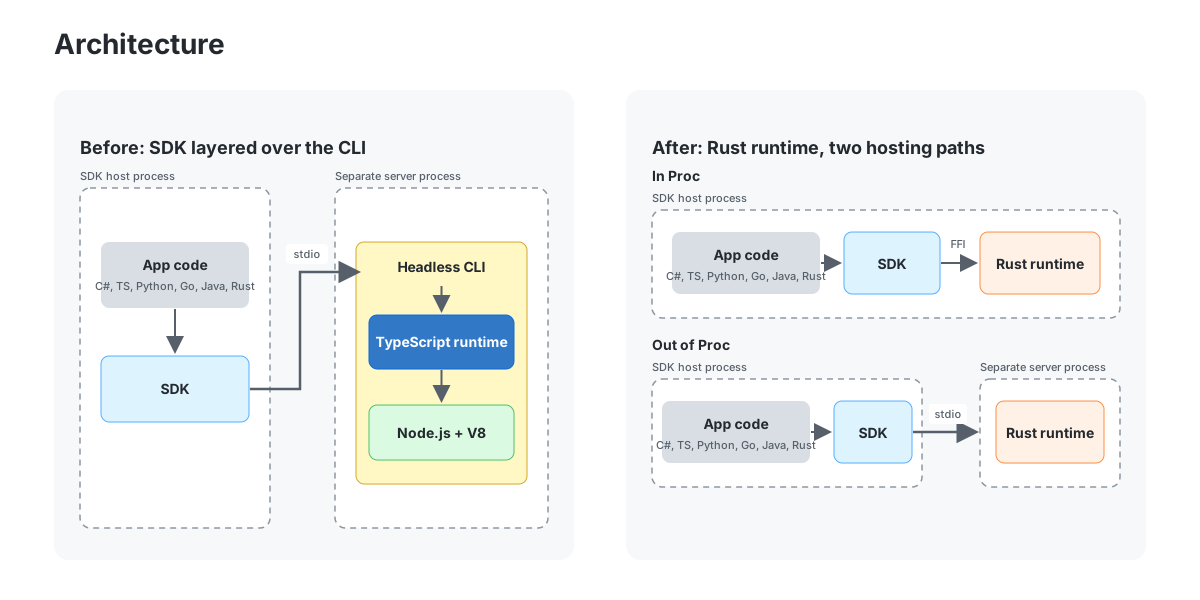
For years, the idea of rewriting a core system in Rust was a theoretical exercise, a "nice-to-have" for the brave few who dared touch the production code. When we looked at the GitHub Copilot runtime, a sprawling ecosystem of 800,000 lines of code written in Python, the cost of porting it seemed prohibitive. It wasn't just about syntax; it was about risk. But the landscape shifted when the concept of an agent took hold. We didn't just want to translate code; we wanted to use the very tool we were building to build itself. The irony is palpable: using Copilot to rewrite Copilot.
The sheer scale of the challenge was daunting. Python had been our trusted companion, offering flexibility and rapid iteration. Rust promised performance and memory safety, but the cognitive load of managing lifetimes, ownership, and concurrent channels across that many files was immense. We imagined months of toil, teams of engineers lost in a fog of boilerplate. Instead, the agent approached the problem with a surgical precision that humans, bogged down by fatigue, rarely achieve. It didn't just convert syntax; it understood the intent, refactored logic, and handled edge cases that a human reviewer might have missed in a sea of complexity.
What makes this migration unique is the feedback loop. We didn't just ask the agent to write Rust; we asked it to write Rust, test it, analyze the failures, and fix them, all while adhering to our strict architectural patterns. It's a recursive process that mirrors the very nature of modern software development. The agent encountered the same friction points we would have: parsing legacy abstractions, reconciling differing data structures, and ensuring that the new implementation didn't break the delicate ecosystem of integrations. Yet, where a human would stall, the agent pressed forward, treating every compilation error as a puzzle to be solved rather than a roadblock.
The results speak for themselves. The porting effort was completed in a fraction of the time we had originally estimated, and the resulting codebase is not only faster but also significantly more secure. The memory footprint is leaner, and the concurrency model is robust. This isn't just a technical win; it's a validation of a new paradigm where the boundary between developer and tool blurs. We are no longer just writing software; we are orchestrating systems that can write, critique, and refine themselves.
This project serves as a microcosm of the industry's future. The days of manual, line-by-line porting are fading, replaced by an era of collaborative augmentation. It reminds us that the hardest problems aren't solved by brute force, but by leveraging the right tools at the right time. By trusting the agent to handle the bulk of the heavy lifting, we freed ourselves to focus on the high-level architecture and the strategic decisions that drive the platform forward.
As we look to the future, the implications are profound. If we can migrate a complex runtime of this magnitude using our own agents, what else becomes possible? The potential to refactor entire legacy systems, optimize performance bottlenecks, and ensure security at a scale previously unimaginable is within reach. We are standing on the precipice of a new era where the most complex challenges are met not with hesitation, but with the confidence that our tools can help us build the future, one line of safe, efficient code at a time.
On Bluesky? Meet HomeSky.
Follower analytics, a growth toolkit, scheduling and AI posting — built for Bluesky. Connect your account and use everything free for 60 days.
Try HomeSky free →