Migrating the GitHub Copilot runtime to Rust, using Copilot
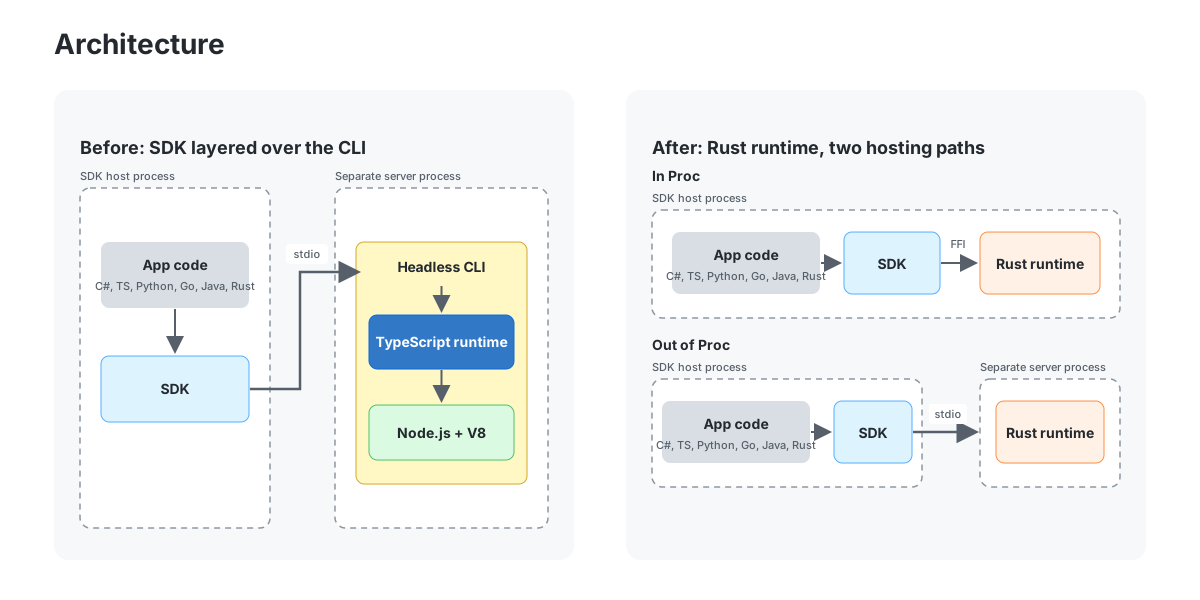
For years, the idea of porting a massive, complex AI runtime to a new language felt like an impossible logistical nightmare, a task reserved for armies of engineers and bottomless budgets. We assumed that rewriting the Copilot agent, a system deeply woven into the fabric of our platform, would require months of painstaking manual labor where every line of Go code had to be meticulously translated, tested, and debugged by human hands. It was a project we believed was simply not affordable in terms of time and resources until the emergence of AI agents fundamentally shifted the cost-benefit equation.
The reality of that migration turned out to be less a Herculean feat of brute force and more a demonstration of how intelligent tooling can leverage its own capabilities to solve its own problems. By deploying Copilot agents to assist in the rewriting process, we weren't just asking the software to write code; we were asking it to understand the architectural nuances of a 800,000-line production system and orchestrate the transition from Go to Rust. This approach transformed the rewrite from a linear, grueling slog into a dynamic, iterative partnership where the machine guided the machine through the most dangerous parts of the landscape.
Porting to Rust introduced a unique set of challenges that Go does not face, particularly regarding memory safety and ownership models that demand a different mindset for the entire codebase. The Rust compiler's borrow checker, while a safety feature, often felt like an impenetrable fortress to developers accustomed to Go's more relaxed garbage collection. However, using Copilot to generate idiomatic Rust code allowed us to bypass the initial learning curve, effectively translating high-level logic into safe, low-level operations without the usual friction. The agents didn't just fill in blanks; they proposed structural changes, managed lifetimes, and handled concurrency patterns that would have taken a human team weeks to debug individually.
The sheer scale of the operation—800,000 lines of production code—is a number that usually induces paralysis, but in this context, it became a testament to the power of automation. Instead of treating the rewrite as a monolith, we broke the system down into logical domains where agents could operate with focused intent, verifying their own work against the original functionality. This self-correcting loop meant that we could push the migration forward with a confidence that was previously unimaginable, knowing that the code we were generating was not only syntactically correct but semantically aligned with the rigorous standards of the GitHub infrastructure.
Ultimately, this migration proves that the future of large-scale software engineering lies not in hiring more people to do the same work faster, but in empowering teams with tools that can think, reason, and execute at scale. The journey to a Rust-native Copilot runtime wasn't just about performance gains or safer memory management; it was about redefining what is possible when an engineering team stops fighting the machine and starts collaborating with it. The result is a faster, safer, and more maintainable system that stands ready to serve millions of developers around the world, built with the very intelligence it now helps to deliver.
On Bluesky? Meet HomeSky.
Follower analytics, a growth toolkit, scheduling and AI posting — built for Bluesky. Connect your account and use everything free for 60 days.
Try HomeSky free →