Migrating the GitHub Copilot runtime to Rust, using Copilot
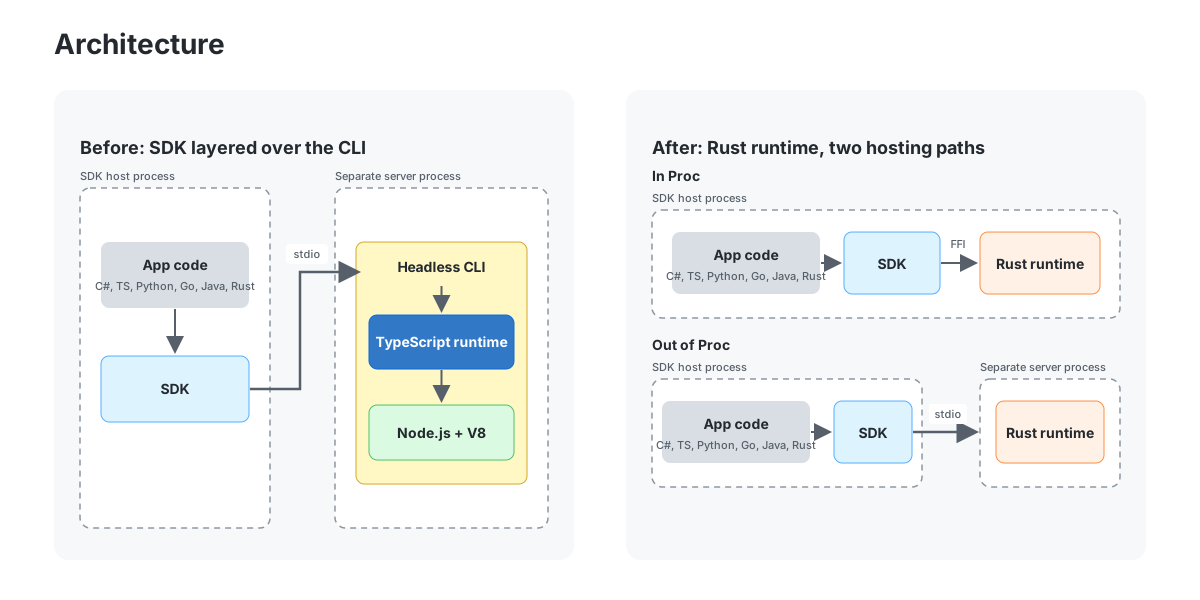
Rewriting a system of 800,000 lines of code isn't just a matter of swapping function signatures; it's a logistical operation that usually requires armies of engineers, months of planning, and a budget that bleeds into the millions. Before the advent of AI agents, this kind of migration was an unaffordable luxury for most organizations, a high-risk gamble where a single misunderstood context could result in months of downtime. The GitHub Copilot runtime is no different, yet by leveraging its own capabilities to write the migration, we turned a theoretical impossibility into a concrete reality, effectively asking the machine to build the bridge that would carry it to a new language.
The decision to port the Copilot agent runtime to Rust wasn't driven by marketing or a desire to chase shiny objects; it was a fundamental architectural necessity. The previous implementation, built in Python, had become a bottleneck for the sheer volume of requests it needed to handle, lacking the memory safety guarantees and execution speed that a high-performance C-family language provides. Rust offered the perfect antidote to these constraints, but translating an existing, complex agent system into it was a non-trivial task. It required not just syntax translation, but a deep understanding of concurrency models, memory management, and the subtle interactions between the agent's reasoning loops and the underlying infrastructure.
What makes this endeavor truly fascinating is the recursive nature of the solution. We didn't bring in a team of external consultants or rely on static documentation to guide the port; we used the very system we were trying to improve to generate the code for itself. This created a fascinating feedback loop where the Copilot agent, acting as both the architect and the builder, analyzed the Python codebase, identified patterns, and generated Rust equivalents while simultaneously refining its own understanding of the system's internal logic. It was a meta-problem-solving exercise, essentially teaching the agent how to translate its own DNA into a more robust form.
The results speak for themselves, but the process reveals the true value of modern AI-assisted development. The agent didn't just write syntax; it understood the intent. It handled edge cases that human reviewers might have missed during a manual pass because it could simulate the execution flow across millions of lines of context. This allowed us to maintain the integrity of the original logic while aggressively optimizing for performance, achieving a level of stability and speed that was previously out of reach. The transition wasn't just about switching compilers; it was about unlocking a new tier of reliability for the service millions of developers rely on every day.
Ultimately, this migration demonstrates a paradigm shift in how we approach large-scale software engineering. We are moving away from the era of manual, line-by-line refactoring toward an era where AI acts as a force multiplier, handling the drudgery of translation so humans can focus on architecture and innovation. The 800,000 lines of Rust code sitting in production today are not just a technical achievement; they are proof that the tools we build today can evolve themselves, becoming faster, safer, and more efficient without waiting for the next version cycle. This is the future of development, and it is arriving much sooner than we anticipated.
On Bluesky? Meet HomeSky.
Follower analytics, a growth toolkit, scheduling and AI posting — built for Bluesky. Connect your account and use everything free for 60 days.
Try HomeSky free →